


EMF-Inducible Ei Switch Enables Remote Gene Control in Mice
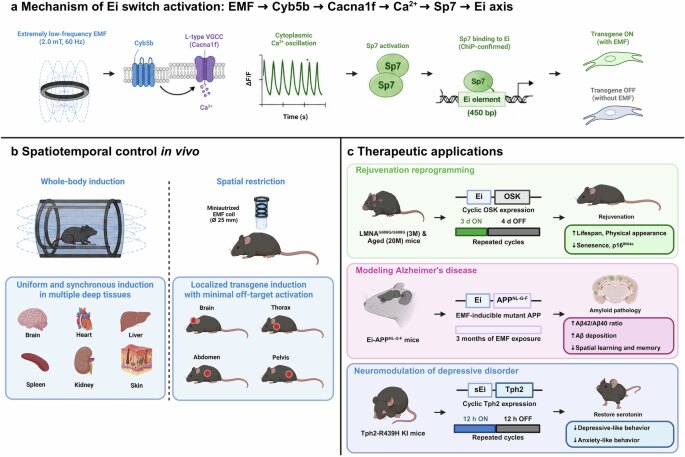
Researchers have described an electromagnetic field (EMF)-inducible gene switch, called Ei, that remotely activates transgene expression in mice without pharmacological inducers or invasive procedures. Reported in Cell and highlighted in Signal Transduction and Targeted Therapy, the platform uses a 450-base-pair DNA regulatory element derived from the Lgr4 promoter and responds to extremely low-frequency EMF under the tested conditions.
In transgenic Ei-GFP mice, whole-body exposure produced transgene expression in the brain, heart, liver, spleen, kidney and skin. Fluorescence diminished within about three days after EMF exposure stopped. A 25 mm single-loop coil restricted induction largely to selected regions, including the brain, thorax, abdomen or pelvis, while Cre-dependent Ei-DIO reporters demonstrated cell-type-restricted expression in Dat-Cre and Gfap-Cre mice.
From field exposure to transcription
The team began with single-cell RNA sequencing of EMF-exposed mouse brains and then used independent validation assays to identify Lgr4 as a reproducibly induced gene across multiple cell types. Its transcripts rose within 24 hours of exposure and returned to basal levels within 24 hours of withdrawal. Deletion mapping and luciferase assays narrowed the response to the 450-bp Ei element, which showed low background activity without stimulation.
A second-generation construct, sEi, adds a CMV enhancer upstream of Ei and achieved robust transgene induction within two hours of EMF exposure. A pooled CRISPR-Cas9 knockout screen spanning 20,611 genes identified cytochrome b5 type B, or Cyb5b, as essential: knockout abolished EMF-dependent reporter activity, while reintroduction restored it.
The proposed pathway is Cyb5b to the L-type voltage-gated calcium channel Cacna1f, then rhythmic cytoplasmic calcium oscillations, Sp7 activation and Sp7 binding to Ei. Chromatin immunoprecipitation confirmed reversible EMF-dependent Sp7 binding. The reported oscillations differed from calcium signals induced by ionophores and other pharmacological stimuli, providing the mechanism proposed for the switch’s transcriptional specificity under the tested conditions.
Applications tested and limits to translation
The researchers used cyclic EMF-driven Oct4-Sox2-Klf4 expression in progeroid and naturally aged mice, using a three-days-on, four-days-off schedule. They reported longer median and maximum lifespans, changes in senescence-associated signatures and epigenetic marks, without detectable Nanog induction or overt hyperplasia under the tested conditions.
Other experiments conditionally induced mutant APPNL-G-F in aged mice to model amyloid pathology, and delivered sEi-Tph2 to the dorsal raphe nucleus in a depression model. In the latter study, 12-hour circadian-aligned EMF cycles restored measured Tph2, serotonin and 5-HIAA levels and improved behavioural phenotypes; continuous 24-hour exposure did not achieve comparable improvement.
The findings remain preclinical. The physical mechanism connecting EMF exposure to Cyb5b redox changes and Cacna1f gating is not fully resolved, and all therapeutic validation was performed in small rodents. Large-animal studies, cell-type benchmarking, delivery-platform validation, long-term safety work, coil miniaturization and dosimetric standards are still needed. For businesses developing gene-therapy or disease-modeling platforms, Ei is a research-stage option whose programmable timing and targeting warrant evaluation alongside rigorous translational validation.