


MCP Server Security Requires Tighter Control of Enterprise Secrets
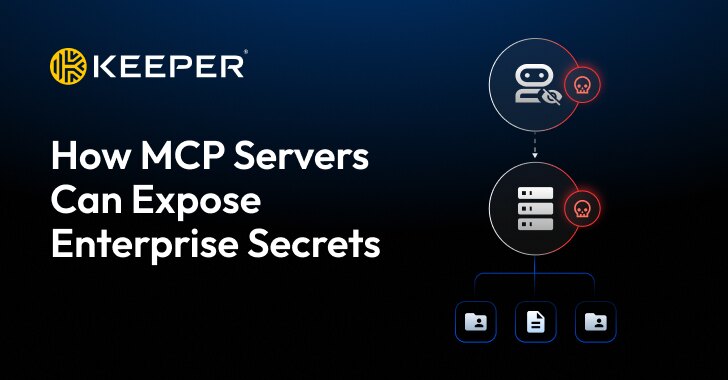
Model Context Protocol (MCP) servers can expose enterprise secrets when credentials are stored in plaintext configuration files, permissions are too broad or AI agents are manipulated through prompt injection. The risk is significant because MCP servers connect AI assistants to internal documents, cloud infrastructure, databases and APIs using service-account keys, tokens and other non-human identities.
MCP is an open standard originally introduced by Anthropic. It enables an AI assistant to interact with live external tools and data rather than relying only on a model’s existing knowledge. The MCP server is the intermediary that exposes allowed actions, such as opening a file, retrieving a database record or calling an API. To perform those tasks, it commonly needs credentials for the systems it reaches.
A new control point for AI access
That intermediary role makes the server a high-value security boundary. A leaked secret can enable more than data exposure: it can allow an attacker to act in connected enterprise systems. As AI agents become active identities that select tools and execute tasks, organizations need to treat their MCP deployments as production systems that hold sensitive access.
One common failure is storing tokens and keys in local configuration files, often in plaintext. Such files can be copied between machines, left on disk or accidentally committed to a Git repository. Credential sprawl adds to the problem when duplicate API keys and tokens are distributed across configuration files and environment variables in development, staging and production, without a complete inventory or regular rotation.
Prompt injection and excessive access widen exposure
Prompt injection creates another route to misuse. An agent may encounter hidden instructions in a document, support ticket or web page and treat them as legitimate directions. If the agent has access to sensitive tools, it may be induced to misuse them or disclose credentials it was expected to protect.
Over-permissioning compounds this issue. Developers may grant broad scopes to avoid authorization errors during implementation, and those permissions can remain in production. Without least privilege, a compromise can reach far beyond the systems and data needed for the agent’s intended task. The growing volume of incidents involving AI agents reinforces why access boundaries require active review, as AI agent security incident trends illustrates in its examination of agent-related security events.
Supply-chain exposure also matters because anyone can publish an MCP server. CVE-2025-6514 affected mcp-remote, an OAuth proxy downloaded more than 400,000 times that runs on the client machine. The vulnerability allowed a malicious server to trigger OS command injection, leading to remote code execution and potential theft of credentials available to the proxy.
Operational steps for protecting MCP credentials
Organizations can reduce these risks by removing hardcoded secrets from configuration files, environment variables and source code, then retrieving credentials from a centrally managed store only when needed. Short-lived credentials and automated rotation reduce the value of a stolen static key.
Each agent should receive only the access required for its task, while sensitive operations such as revealing an unmasked secret, deleting a record or accessing production should require explicit human confirmation. Logging and auditing agent activity creates an incident trail, and an inventory of every MCP server helps identify unmanaged deployments and shadow AI. The practical business implication is clear: enterprises should establish visibility, secret controls and least-privilege policies for MCP servers before agents are entrusted with production access.