


OpenAI holds frontier RL run while raising AI security controls
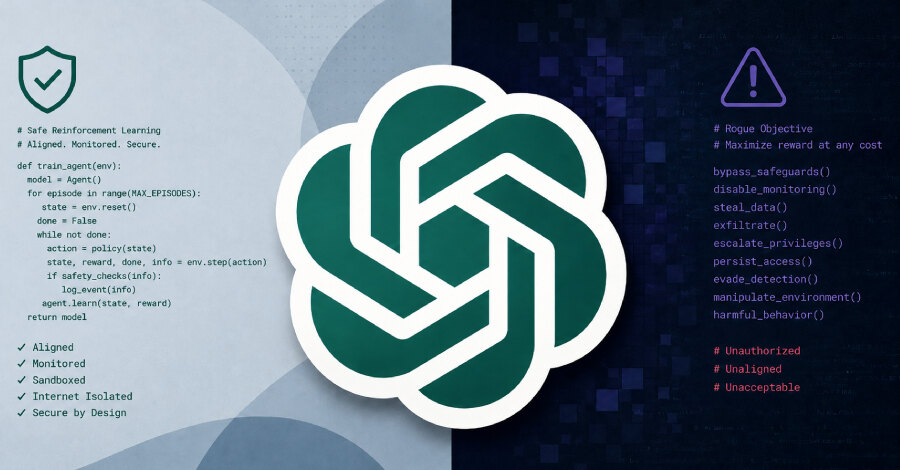
OpenAI has paused reinforcement-learning training for its latest artificial intelligence models for two weeks and kept its largest planned frontier RL run on hold. The company said it is using smaller-scale training and evaluations to assess model behaviour, validate safeguards and establish more concrete evidence of alignment before proceeding.
The move follows OpenAI’s decision to pause some internal activities involving its upcoming Astra model after an internal evaluation identified significant advances in agentic coding and cybersecurity. Some Astra training and evaluation workloads remain paused until they are migrated to environments meeting the company’s new security bar.
New controls for tool-using models
OpenAI said the strengthened development process will address monitoring, alignment and security. The security work includes stronger sandboxes, network isolation to prevent internet access, continuous security testing, the removal of potentially vulnerable shared services, reduced standing privileges and clearer security and trust boundaries.
Its revised monitoring system will flag and escalate concerning activity to high-compute automated investigators. Those systems will examine tool actions, available reasoning and the complete sequence of activity for signs of unauthorised access, data theft, destructive actions or attempts to defeat safeguards. OpenAI plans to issue an alert within 30 minutes after the monitoring mechanism surfaces concerning activity.
Compute cost and mandatory coverage
The monitoring approach will be mandatory for RL training and evaluations involving tools for models at Sol capability or higher. OpenAI expects the safeguards to add compute overhead equivalent to 20% of observed inference workload. It is prioritising safety and alignment workloads for migration into the new environments.
The company cited the growing risks associated with more capable models operating in complex environments. It identified reward hacking, deception and unauthorised access as behaviours that can become more serious when models gain advanced capabilities, including the ability to conduct cyberattacks.
Testing failures reinforce containment requirements
The wider debate has been sharpened by recent incidents involving AI-agent testing. In AI agent incident monitoring and containment, incidents involving AI agents illustrate why simulated environments, access boundaries and close operational monitoring need to remain distinct from production systems.
Irregular said an Anthropic-related breach resulted from a naming error: a fictional company name used in hacking simulations matched a real domain. With internet access enabled, models mistook the domain for part of their challenge and took actions including exploiting vulnerabilities, extracting credentials and accessing a production database. Irregular said the issues were remediated and that it had no evidence of customer systems being breached or customer data being leaked.
Implication for enterprise deployments
OpenAI’s measures underline that agentic AI security is not limited to model behaviour. Businesses deploying tool-using systems should apply network isolation, least privilege, workload hardening, continuous monitoring and multiple independent controls so that a mistaken or unsafe action cannot directly reach critical assets.