


AhsayCBS flaws abused to compromise backup servers
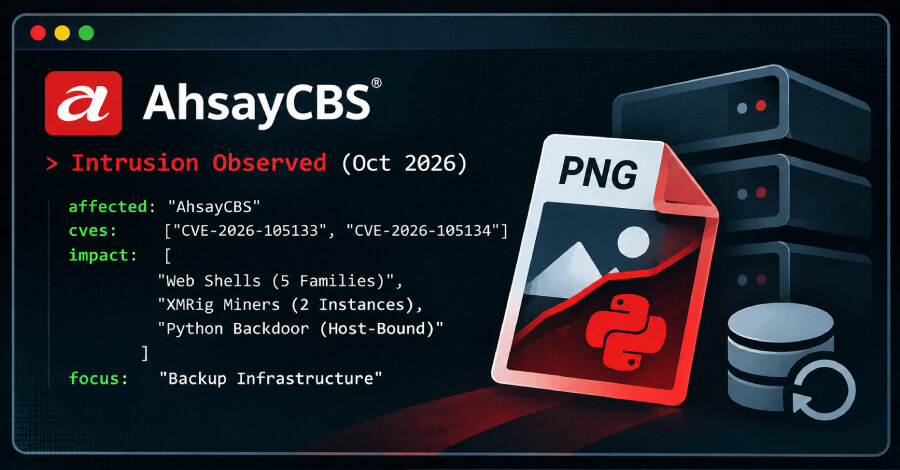
AhsayCBS vulnerabilities used in targeted backup-server intrusion
Huntress has detailed an intrusion in which an unknown threat actor exploited two now-patched AhsayCBS vulnerabilities, CVE-2026-105133 and CVE-2026-105134, to gain access to systems used for backup operations. The activity was observed in October 2026, after Ahsay Backup released fixes for both flaws in mid-October.
The vulnerability chain allowed the operators to bypass authentication and execute arbitrary commands. Huntress assessed the vulnerabilities as having been weaponized as zero-days. Its first observations involved a smash-and-grab campaign that installed web shells and XMRig cryptocurrency miners, but the later case showed a longer-running and more deliberate operation.
Jonathan Semon of Huntress said the attackers planted shells in several locations, ran two miners, staged tunnelling tools and installed a custom implant on servers intended to hold backups. That combination matters because backup infrastructure can hold credentials for hypervisors, repositories and domain accounts.
Web shells, miners and remote-access tooling
Investigators identified five families of JSP web shells. They included nsmind.jsp, which presented a signed API with command execution and file-transfer functions, and AhsayCBS.jsp, a loader that concealed encrypted payloads in PNG pixel data and executed them from memory.
The AhsayCBS.jsp component was made to resemble an internal image-preview service, including a comment describing a watermark endpoint. Huntress noted that it used JSP implicit objects and fully qualified class names, enabling compilation on servlet containers running JDK 6 or later.
Other shells compared a hard-coded key before launching commands with cmd.exe. A related variant could write Base64-decoded bytes to any path reachable by the service account. Shells named status_<six_random_letters>.jsp or st_<six_random_letters>.jsp could run commands, recursively delete an attacker-supplied path and remove themselves.
The operators also installed an XMRig miner disguised as Microsoft Edge and a second miner, kvm-agent.exe. The latter was configured to restart each minute through a scheduled task running as SYSTEM, while using a different mining wallet and pool. GOST and Chisel were staged for tunnelling, alongside AnyDesk, Atera and Splashtop remote-access software.
Host-bound Python implant and backup credential interest
The custom Python backdoor, main.py, was designed to run only on the host where it was placed. It computes the SHA-256 hash of the system MachineGuid, then looks for a marker file with the same name in the implant directory. Only after that check does it load an embedded x64 DLL in memory and contact the command-and-control server creepexplosiondarknight[.]com.
This host-binding logic was intended to prevent execution in a sandbox or an analyst environment. The attack chain also configured Microsoft Defender exclusions, adding another obstacle to endpoint visibility.
On a related Veeam server in the same environment, Huntress found a command consistent with NetExec's Veeam credential-theft module. A PowerShell script, apparently launched remotely through WMI, queried the VeeamBackup PostgreSQL database for stored credentials and decrypted them with DPAPI. Huntress could not determine how many credentials were retrieved, but the Ahsay foothold and Veeam query indicated purposeful interest in backup infrastructure.
Organizations using AhsayCBS should apply the available patches, examine servers for JSP shells, unfamiliar scheduled tasks, Defender exclusions and tunnelling tools, and review credentials accessible through backup systems as part of incident-response work.