


MIT mathematicians examine AI’s effect on proof, publishing and careers
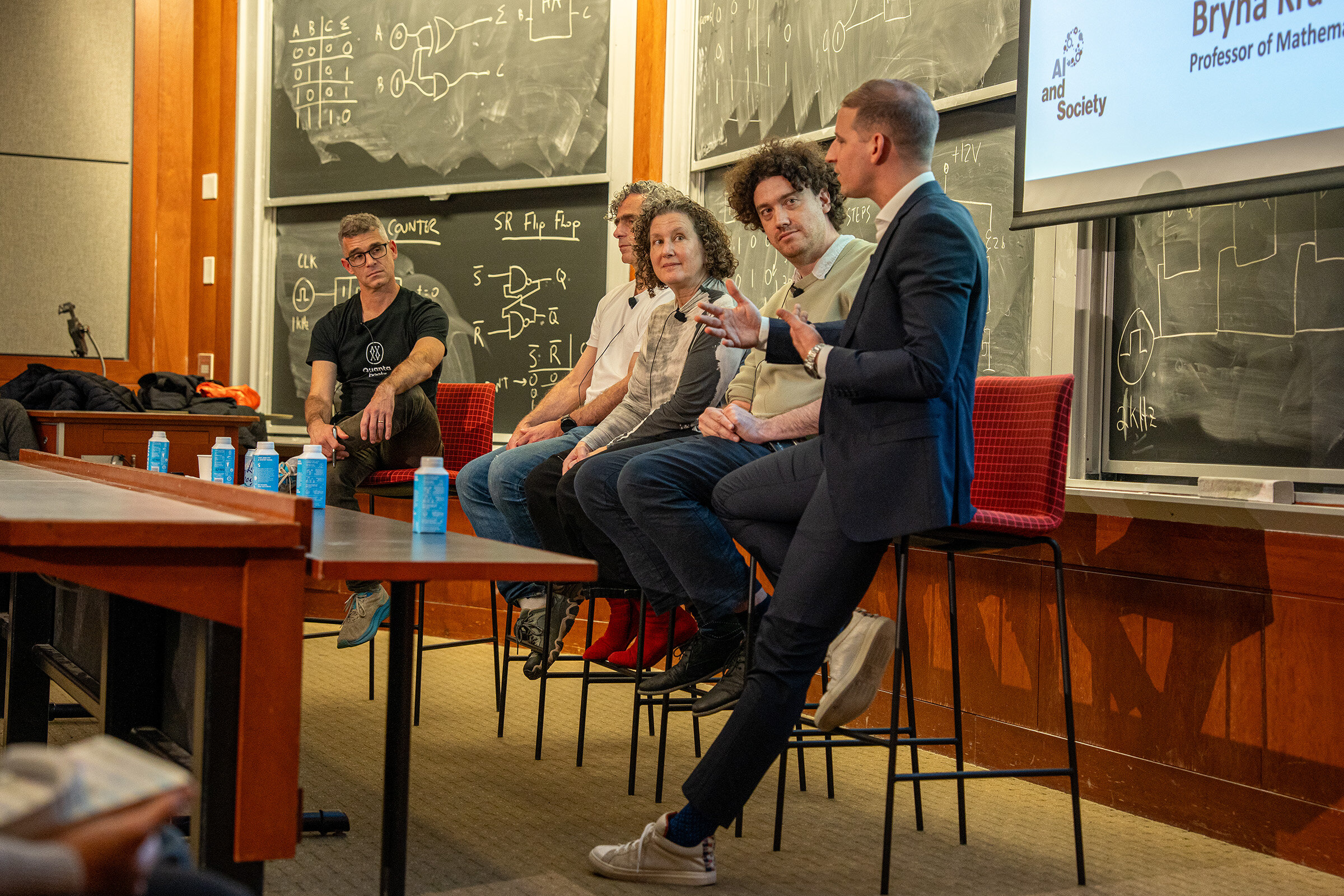
Mathematicians from MIT, Harvard University, Northwestern University and New York University used an MIT panel to examine how rapidly advancing AI is changing mathematical research, publishing and careers. The event, titled AI and Society: The Future of Math, followed OpenAI’s September effort in which thousands of AI agents worked for 88 hours on a proof related to the Navier-Stokes equation.
A month later, OpenAI released 722 manuscripts across mathematical subjects, claiming that AI had solved major unsolved problems. The collection has been widely dubbed the “mathocalypse.” At the discussion in MIT’s Building 3, Bryna Kra said mathematics had changed more in the previous two months than in the past 100 years.
Solving a problem is not the same as explaining it
The panel included Jacopo Borga of MIT, Michael Hopkins of Harvard, Kra of Northwestern and Tristan Buckmaster of New York University’s Courant Institute. It was moderated by science writer Kevin Hartnett. Their discussion focused not only on whether AI systems can reach correct conclusions, but on whether mathematicians can understand and communicate the route to those conclusions.
Hopkins said AI-generated proofs can contain “strange ideas” and argued that there remains a distinction between AI mathematics and human mathematics. Buckmaster framed the issue more directly: mathematics must have human understanding to be important. The debate followed questions over credit, possible leakage of mathematicians’ work, and the interpretability of the proof produced by OpenAI’s agents.
Kra argued that the field may need to move away from treating speed and priority as dominant measures of success. She helped draft the Leiden Declaration on Artificial Intelligence and Mathematics, which calls for action on risks AI poses to mathematical research. In her view, explaining how a proof emerged is becoming as important as being first to produce it.
Journals and hiring face a new evaluation problem
AI is also putting pressure on institutions that validate mathematical work. Borga noted that journals have historically accounted for much of how mathematicians are judged, but said that model may no longer be sufficient. Kra, a managing editor of a specialist journal, reported a substantial increase in submissions describing AI-generated or AI-assisted results; the journal hired an additional managing editor to manage the volume.
Some publications are placing greater value on exposition: the reasoning that makes a conjecture or proof intelligible. Kra pointed to experimental outlets, including Mathematical Discourse, a peer-reviewed video journal designed around researchers presenting mathematical work. Hopkins also described curation and translation of knowledge as an expanding opportunity, including making older results comprehensible to modern researchers.
Learning and careers remain human questions
The panelists said the disruption is particularly acute for students learning fundamentals amid readily available AI shortcuts. Kra said interviews are gaining importance because candidates increasingly need to demonstrate that they understand and can explain the ideas associated with their work. Hopkins said his group includes both people who avoid AI and others who use it, and that both need support.
For organizations using AI in high-stakes analytical work, the practical implication is clear: output alone is an incomplete measure of value. Review practices should test whether results can be explained, checked and responsibly attributed by people who understand the underlying work.