


AxiomMath completes Lean verification of the Stacks Project
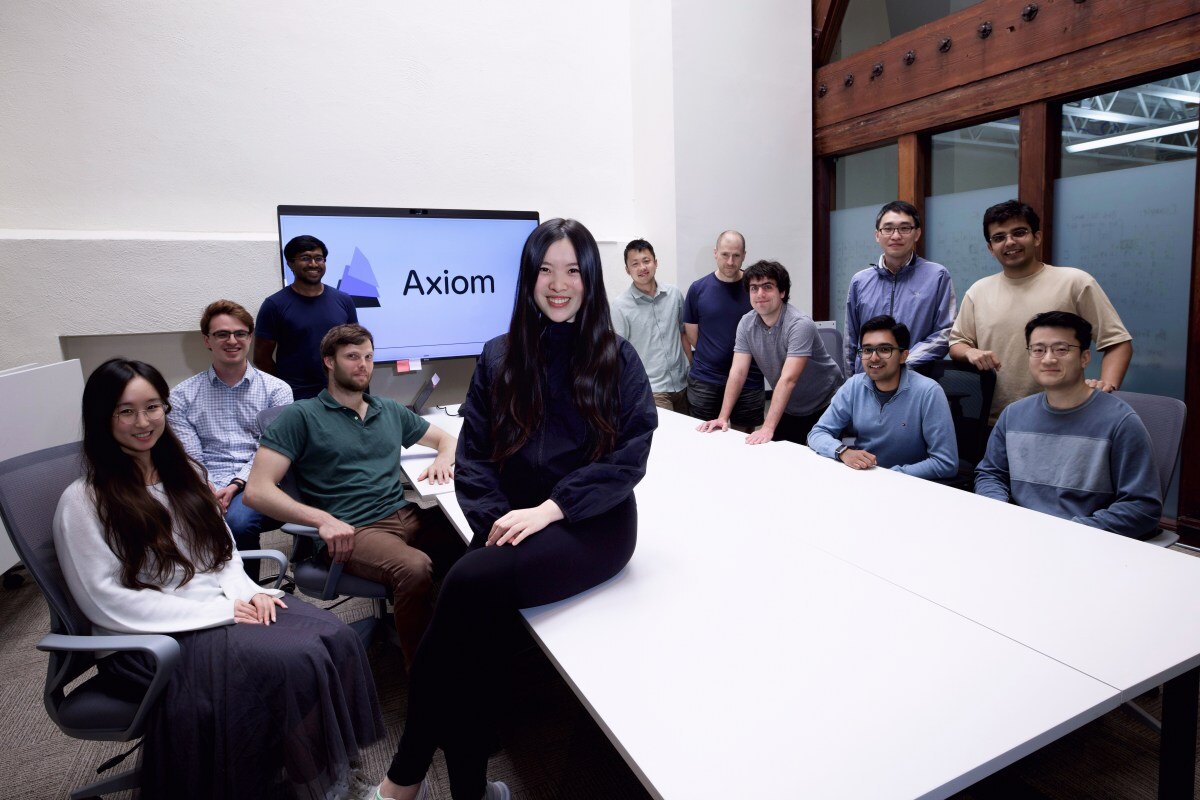
AxiomMath has announced the formal verification of the Stacks Project, an open-source mathematics reference begun in 2005 by Columbia mathematician Johan de Jong. The startup says its AI-agent system translated the library’s roughly 7,654 pages into about 16 million lines of Lean code, which a proof assistant can check line by line.
The Stacks Project spans material from college-level algebra to advanced work in algebra, geometry and number theory. Its publication in formally checked code gives researchers a large connected body of mathematical results that can be used within Lean rather than reconstructed theorem by theorem.
A large mathematical library checked as code
Formalization rewrites a mathematical proof in a programming language and submits that representation to a proof assistant. When the code passes, the proof is logically sound within the system’s rules. Formal verification is also used by engineers checking chip designs and by software researchers seeking errors in benefit-calculation systems.
For Stacks, the scale was not only a matter of converting individual statements. Definitions and theorems depend on earlier material throughout the collection. AxiomMath had to preserve those connections across approximately 16 million lines of Lean code, ensuring that definitions did not conflict and that the chain of results remained intact.
Carina Hong, AxiomMath’s chief executive, described the task as formalizing a collection of results that serves as a foundation for mathematics. The company, founded in March 2025, raised a $200 million Series A led by Menlo Ventures in March.
Agents worked in parallel under a loose structure
AxiomMath did not assign every action through a fully specified hierarchy. Ashvin Swaminathan, a member of the technical staff, said the company imposed a hierarchy while allowing agents to find tasks and identify work that could proceed in parallel. The company also trained its own models for mathematics and initially used an in-house Lean expert to guide the agents’ judgement.
The outcome is significant for algebraic geometry, which Swaminathan described as a major gap in formalized mathematics. Researchers seeking to check new work in that field with Lean previously had little formalized material on which to build; the Stacks formalization provides a deeper base of definitions and results.
From mathematical proofs to software foundations
AxiomMath’s broader argument is that verified results become reusable building blocks. Terence Tao has framed the compounding effect simply: more formalized proofs enable more formalized proofs. A shared, checked library can let later work rely on established components rather than begin from an unverified foundation.
The company is also targeting software development, where developers must manage bugs and security weaknesses as AI agents produce more code. Hong and Swaminathan argue that agents need reusable, well-engineered knowledge rather than unchecked output if they are to extend complex systems reliably. For businesses adopting AI-assisted development, the practical implication is to identify high-consequence code and knowledge assets where formal checks and reusable verified components can provide stronger assurance.