


Token’s Rehearsal agent highlights browser AI identity gaps
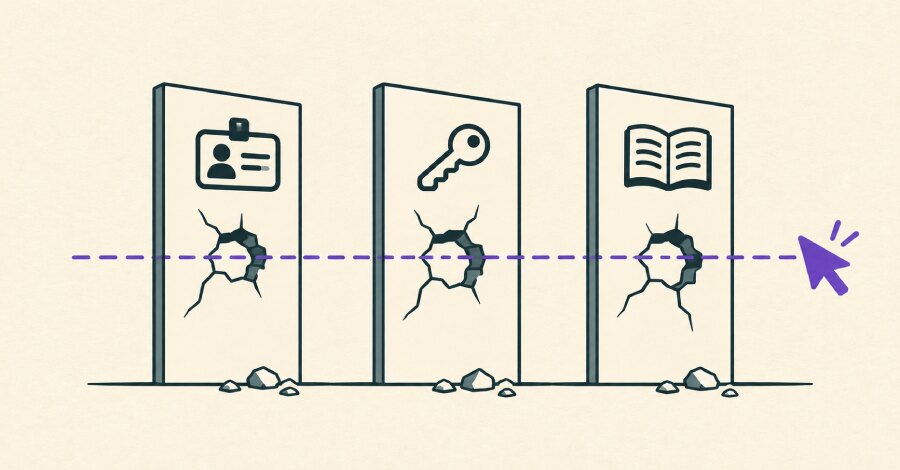
Token built a browser-based AI agent called Rehearsal to answer questions inside its platform by operating the interface: opening pages, setting filters and filling in forms. The experiment showed that a typical UI agent can breach three security principles by default: it lacks its own identity, inherits access broader than its task, and is not independently traceable from the human user.
Rehearsal runs in the authenticated browser session of the person using it. To the application server, its actions look like the user’s actions because a session cookie does not identify the driver of the session. The application therefore cannot see the agent, the delegation behind its task, or the boundaries intended for that task.
Why browser agents create an authorization problem
The model is useful precisely because it can act in an existing web interface. But that convenience joins the agent to the user’s existing privileges. An external browser agent controlling a CRM or cloud console may not know which field contains a secret or which control deletes a record, while the application cannot reliably tell that an agent is operating the page.
Token could address parts of this problem because it controls both Rehearsal and the application. The company says it signals when the agent has control by dimming and locking the application, logs every session action including blocked attempts, and limits Rehearsal to read-only dashboards. The agent cannot save changes without user approval, does not fill secret fields and does not send calls that the platform has rejected. It also uses page accessibility labels to understand dashboard controls.
Those controls cannot simply be assumed for agents built by other vendors. Token argues that useful authorization requires three linked signals: an agent identity, a verifiable connection to the person on whose behalf it acts, and a scope narrower than that person’s own access. Without those signals together, a new automation route can accelerate misuse of existing privilege.
Standards address pieces of the context
Browser and web standards are beginning to expose some of the missing information. Chrome auto-browse requires human approval for high-stakes actions such as payments or mass emails, limits an agent to sites needed for a task, and tags visited pages in browser history. Microsoft allows administrators to enable agentic browsing by site and pause activity before passwords or card numbers are entered.
WebMCP, a draft being developed by Google and Microsoft in a W3C community group, enables sites to publish actions as tools and label them read-only or consequential. Web Bot Auth, an IETF working group draft, is designed to let sites verify which agent sent a request. Token notes that these mechanisms do not form a complete authorization layer: browsers do not define how agent-driving status reaches the application, WebMCP tools still run with the user’s session rights, and Web Bot Auth does not cover delegation.
Actions security teams can take now
Token advises organizations not to wait for standards to mature. Security teams can inventory browser agents, agentic extensions and endpoint agents operating through authenticated sessions, then map them to users and accountable owners. They can also trace each agent’s consumers, review the identities each agent can access, and identify paths where an agent could bypass existing access controls.
For sensitive or irreversible application actions, explicit approval or step-up authentication such as a passkey prompt can preserve a human decision point even when the originating click cannot be identified as human or automated. Businesses should also ask critical SaaS providers whether audit records distinguish agent activity from human activity and whether task-scoped delegation is supported. Until applications can receive agent identity, human delegation and task scope together, every agent borrowing a human session should be discovered, constrained and audited as delegated access.