


Check Point gateway attacks deploy TSGA backdoor and ESXi wiper
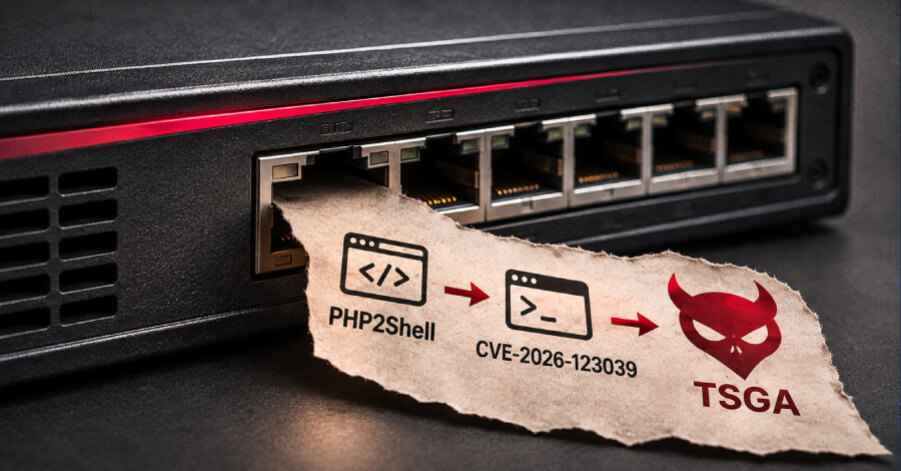
Check Point has reported active attacks against unpatched Security Gateways that combine PHP2Shell exploitation with CVE-2026-123039, a Gaia OS local privilege-escalation vulnerability rated 7.8. The attackers deployed PHP web shells, the TSGA backdoor and its TSProxy networking component; in some cases, they later reached VMware ESXi systems and executed the destroy_v6 wiper.
The activity began on 30 October 2026 against Israeli organisations and expanded on 2 November to targets in multiple countries and sectors. Check Point said the later wave also revisited some organisations targeted during the initial campaign. The observed pattern did not show a particular geographic or industry preference in the broader wave.
Initial access followed by root-level control
Check Point said activity from 130.94.19[.]204 targeted vulnerable Mobile Access portals roughly one week after a security fix became available. The initial-access activity was consistent with PHP2Shell, associated with CVE-2026-109618 and CVE-2026-109619.
Once on the appliance, the attackers allegedly used CVE-2026-123039 through the DynamicCLI interface to escalate from the portal service account to root. The flaw is a missing-authorization issue: an authenticated local user with existing code execution can run arbitrary commands by sending a single request to the socket. Check Point observed active exploitation against a couple of dozen customers.
The affected releases are R82.20, R82.10, R82, R81.20, R81.10 and R81 across Check Point Force Firewalls, Management and Log Servers, Multi-Domain Security Management and Multi-Domain Log Server, and Maestro Orchestrator. The incident underlines that a local escalation flaw can become operationally critical when an internet-facing weakness has already provided a foothold.
Backdoor capability and destructive follow-on activity
The PHP web shells observed in the campaign support command execution and file uploads. They provide a path to TSGA, which was deployed as slot_CPconfigdaemon. Check Point describes TSGA as a standalone passive Linux gateway implant tailored to its products, with encrypted remote access, configuration theft, backup and snapshot persistence, process injection and binary firewall-log tampering capabilities.
TSProxy is the implant's second component. Its injection code loads a library into selected appliance processes, intercepting networking functions to process specially marked attacker connections while ordinary traffic continues. Check Point said this combination provides a persistent backdoor as well as concealed access through existing appliance services.
Investigators also observed the gogo scanner being used to identify internal assets and services. The attackers then authenticated over SSH to a VMware ESXi host with the vpxuser service account, staged destroy_v6 and ran it. The Linux ELF wiper recursively deletes files in the target directory regardless of extension, attempts to overwrite them with zeros, and writes a DREAM_ANNEXATION.txt note in each processed directory.
Attribution remains unresolved
TSGA and TSProxy are assessed to be Check Point-specific elements of PhiliKit, a toolkit ESET documented in June 2026 and associated with the China-nexus group Armory Castle, formerly UNC5221. Check Point also cited LightNode VPS infrastructure and scanning hours aligned with typical Chinese working hours as contextual indicators.
However, the company said the available evidence does not support confident attribution of this operation. The use of a wiper, the focus on Israel and references to the Israeli-Palestine conflict in the note leave open possibilities including an initial-access broker, a false-flag operation or destructive activity used as a smoke screen.
Business implication
Organisations running the affected Check Point releases should apply available fixes, investigate Mobile Access portal exposure and hunt for PHP web shells, TSGA or abnormal appliance-process behaviour. They should also review gateway-to-ESXi SSH access, especially use of the vpxuser account, because an appliance compromise can progress from persistent access to destructive virtualisation-host activity.