


Closed-Loop Gene and Cell Therapies Move Toward Setpoint Medicine
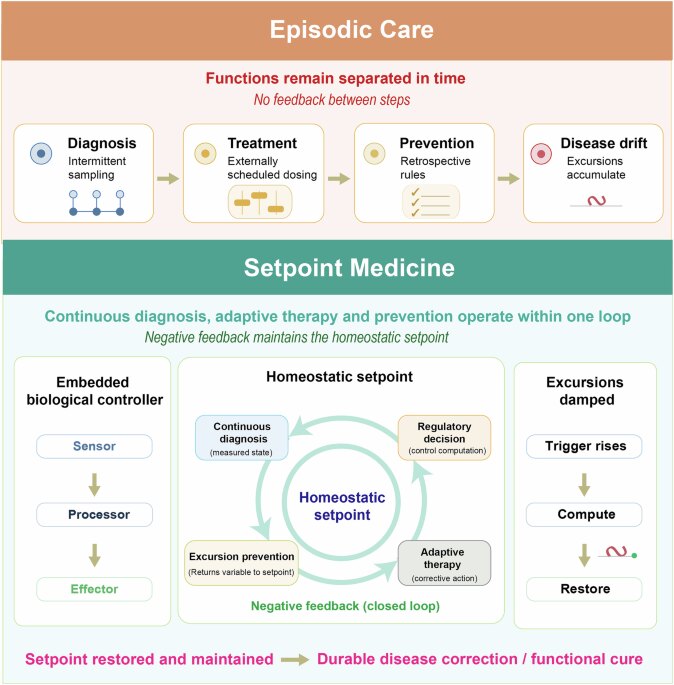
Haifeng Ye of East China Normal University and Martin Fussenegger of ETH Zurich and the University of Basel have reviewed the emerging field of closed-loop gene and cell therapies in Signal Transduction and Targeted Therapy. Published on 17 November 2026 as article 515 in volume 11, the review describes systems designed to sense disease-linked signals, process them through genetic circuits and adapt therapeutic output in response.
The clinical ambition is what the authors call setpoint medicine: maintaining a physiological variable within an interpretable, therapeutically desirable range rather than delivering a fixed dose at predetermined intervals. The article contrasts this approach with conventional open-loop treatment, in which pills, biologics, vectors or engineered cells are administered on an externally determined schedule.
From a dose to a biological control loop
Closed-loop therapies are organized around a sensor-processor-effector architecture. A sensor detects a molecular or physical input, such as glucose, inflammatory cytokines, hormones, hypoxia or a pathogen-associated signal. A processor turns that input into a regulatory decision, while an effector produces the therapeutic action. In a genuine feedback loop, the output changes the regulated variable and thereby reduces the input that triggered the response.
The distinction matters because not every responsive therapy is closed loop. The review classifies feedforward, inducible and logic-gated systems as context-responsive when they activate under predefined conditions but do not continuously adjust output around a physiological setpoint. This is especially relevant in cancer, where many engineered immune-cell systems use multi-input logic to improve tumour recognition and limit activity in healthy tissue.
Examples of feedback-oriented designs include glucose-responsive designer cells that release insulin or GLP-1, a cholesterol-sensitive circuit that controls an anti-PCSK9 effector, phenylalanine-responsive circuits that activate PAL and IL4I1, and a urate-sensing probiotic platform called PULSE. The authors also highlight an angiotensin-II/ACE2 hormone shunt in which AT1R signalling drives secretion-engineered soluble ACE2 to degrade angiotensin II in experimental hypertension.
Control performance becomes a clinical requirement
The review argues that living therapies should be assessed with concepts familiar from control engineering. Relevant measurements include restoration time after a perturbation, overshoot, oscillation, stability across repeated challenges and robustness across people with differing physiology or co-medications. A therapy that improves an average endpoint but has unstable thresholds, leakage or excessive output may not be suitable for autonomous use.
Safety therefore needs to be built into the architecture. The article identifies multi-signal logic, reversible attenuation, containment strategies, kill switches and external override as complementary safeguards. Inducible caspase-9 can eliminate engineered T cells after severe toxicity, while inhibitory CAR designs can suppress activity when healthy-tissue antigens are recognized. Neither approach alone resolves risks such as circuit instability, transgene loss, mutation, antigen escape or immune-mediated selection.
Translation depends on delivery, oversight and data
Many compelling autonomous demonstrations still use ex vivo engineered cells that are encapsulated and implanted. This provides retrievability and design flexibility, but also raises manufacturing, foreign-body-response and longevity issues. Vector, mRNA and plasmid delivery can broaden deployment options, yet a drifting closed-loop controller may alter threshold, leakiness or gain in clinically important ways.
AI may contribute at several stages, from designing protein switches and sensors to optimizing gene circuits and modelling in vivo performance. The authors emphasize that computational tools do not replace experimental validation. They also call for uncertainty quantification, interpretable metrics, explicit safety constraints and human oversight, particularly when supervisory systems use wearables, bioelectronics or patient-specific digital models.
For health-care developers and operators, the practical implication is clear: a closed-loop therapeutic should be evaluated as a controllable system, not merely as a biological payload. Clinical credibility will depend on defining the target range, proving durable and measurable control, preserving a path to monitoring and override, and selecting a delivery format that supports safe intervention when performance changes.