


Coldcard seed-generation flaw prompts emergency patch after $70.2M Bitcoin sweep
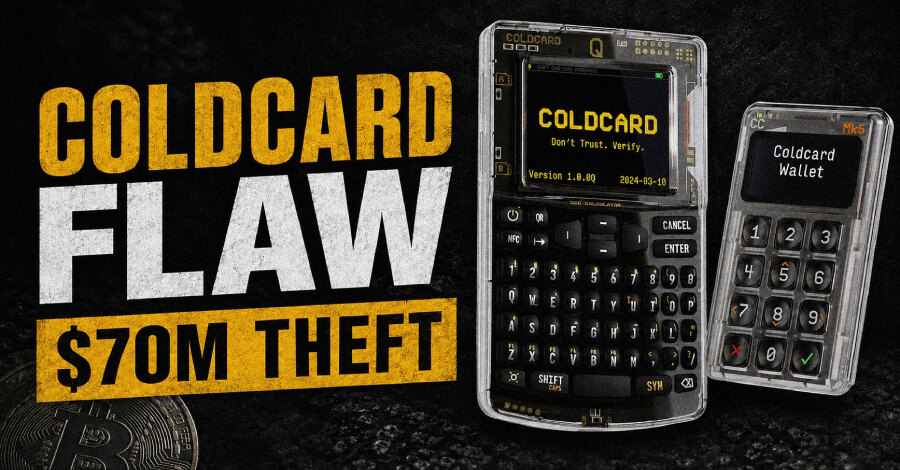
On July 30, 2026, an attacker swept 1,196 Bitcoin addresses in 41 minutes, moving 1,082.65 BTC worth about $70.2 million. Galaxy Research mapped the transactions and linked them to a seed-generation flaw in Coldcard, Coinkite’s Bitcoin-only hardware wallet. Coinkite released emergency firmware for every affected model on July 31.
Why installing the patch is not enough
Updated firmware prevents creation of more weak seeds, but it cannot repair an existing one. Owners must generate a new seed on patched firmware and transfer their bitcoin. Restoring the old seed on an updated Coldcard or another wallet preserves the weakness.
No public analysis has yet reconstructed a victim’s seed and matched it to a drained address, and the attacker remains unidentified. Galaxy also cautioned that the sweep pattern identifies an operator rather than proving theft:
It “looks the same as if a coin owner chose to move coins.”
How Coldcard seed generation failed
A March 2021 integration error routed seed creation to a deterministic software PRNG instead of the STM32 hardware RNG. Coldcard’s production configuration set MICROPY_HW_ENABLE_RNG to zero, but libngu checked whether the macro existed rather than whether it was enabled. The build therefore used MicroPython’s Yasmarang fallback.
That fallback was initialized from the chip UID and timer registers, with no fresh entropy added later. Block estimates that an attacker who sufficiently constrains the UID, timing and previous RNG calls could reproduce candidate streams offline, derive addresses and compare them with public blockchain records. Coinkite estimates roughly 40 bits of effective entropy for Mk3 and 72 bits for Mk4, Mk5 and Q, versus 128 bits for a 12-word BIP-39 seed.
Affected firmware
- Mk2 and Mk3: Block flags versions 4.0.0–4.1.9; Coinkite lists Mk3 4.0.1–4.1.9, fixed in 4.2.0.
- Mk4 and Mk5: versions before 5.6.0.
- Q: versions before 1.5.0Q.
- Edge builds: before 6.6.0X for Mk4 and Mk5, and 6.6.0QX for Q.
For businesses holding bitcoin, the operational priority is to inventory which firmware created each seed—not merely what is installed today. Patch devices, replace exposed seeds, transfer funds and verify that multisig quorums are not composed entirely of affected wallets. Treat uncertain seed provenance as exposure.