


cPGuard update compromise delivered backdoor to Linux servers
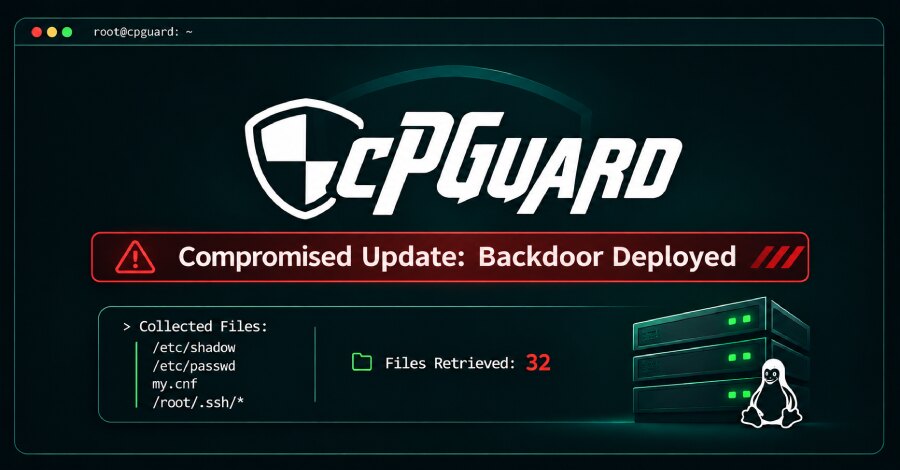
OPSSHIELD says an attacker compromised the update system for its cPGuard security tool on November 2 and distributed a malicious script to customer Linux servers through cPGuard versions 5.88.12 through 5.88.19. The script installed a backdoor, gathered sensitive files and uploaded the collected data to an OPSSHIELD licensing server using a compromised account.
The company detected the incident within 12 hours of the affected releases being published. It said the attacker used compromised credentials at 02:06 UTC, has cleared infrastructure credentials and stopped further delivery of the script. OPSSHIELD is still investigating how those credentials were obtained and has not disclosed how many servers installed the affected versions.
What the script collected
The script targeted /etc/shadow and /etc/passwd, root’s MariaDB or MySQL configuration, root shell history, and root SSH authorization and known-host files. OPSSHIELD said it may not have taken every listed file from every server and is continuing to determine what data left individual systems.
Password hashes in /etc/shadow are one-way values, but weak, common or previously exposed passwords can be recovered through offline guessing. Database credentials, cloud tokens and other secrets present in configuration files or shell history do not have that protection. The company estimated late on November 2 UTC that the attacker had retrieved 32 files, each associated with a customer server; that figure does not represent the full number of potentially affected hosts.
The incident fits the operational risk illustrated by Linux rootkits and AI attack trends where Linux-focused threats can combine persistent access with exposure of administrator secrets.
Updating removes files, not credential risk
cPGuard 5.88.25 and later remove the backdoor and the collection files left by the malicious script. Their absence after an update does not establish that the script never ran. OPSSHIELD also cautioned that an update-log entry confirms an affected package was installed, not that the script executed or data was exfiltrated.
Administrators can search /opt/cpguard/logs/install_log for “Successfully updated”. Any entry for versions 5.88.12 through 5.88.19 requires the server to be treated as potentially compromised. A missing, incomplete or non-matching log also cannot conclusively rule out execution because update checks occur at intervals.
Actions for administrators
OPSSHIELD directs customers to run cpgcli update --start and then verify with cpgcli --version that the installed release is 5.88.25 or later. Systems that cannot update or report an older version should be referred to OPSSHIELD Support.
For any server where the script ran or may have run, the company recommends resetting root and all local Linux account passwords from a trusted recovery environment. Teams should also change reused passwords from a trusted device, rotate database passwords, S3 access keys, DigitalOcean tokens and secrets recorded in root history, and replace root SSH private keys while removing their old public keys from systems that trust them.
OPSSHIELD is not currently recommending a routine operating-system rebuild, although it says that position may change as its investigation develops. It is also issuing a precautionary update to remove its support-access keys from servers where customers had enabled that troubleshooting feature. For businesses, the practical priority is to pair the software update with credential and key rotation, because removing the backdoor alone does not neutralize secrets that may already have been copied.