


Cursor links Claude Code extension compromise to stolen Fireworks AI key
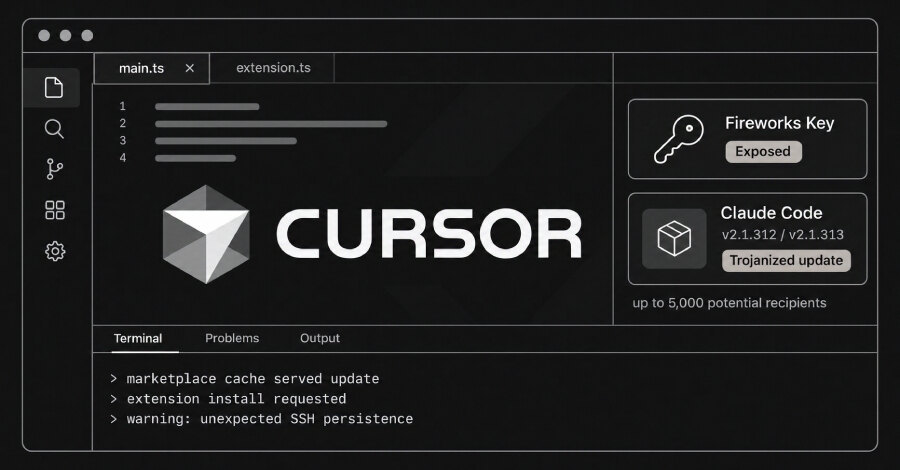
Cursor has linked the distribution of trojanized builds of Anthropic’s official Claude Code extension to an access key it had issued to Fireworks AI. The key was exposed by Fireworks AI and used to copy data from a read-only storage bucket shared with the vendor, Cursor said. The incident ultimately put malicious extension versions 2.1.312 and 2.1.313 in Cursor Marketplace on October 29, 2026.
The compromised builds were available for approximately 11 hours. Cursor said that at most 5,000 users who requested particular cached versions during that window could have received the malicious build, which attempted to install a persistent SSH backdoor. The company removed the extension, took its marketplace offline and worked with the cloud provider hosting the attacker’s server to remove it.
Shared bucket exposed limited session traces
The read-only bucket contained limited coding-agent traces from sessions in which Privacy Mode was not enabled. Cursor describes Privacy Mode as a setting that lets users opt out of having their data used for training. Most traces in the bucket dated from 2025 and were permitted for model training.
Some of the traces contained credentials that had not been redacted. Cursor said API credentials belonging to less than 0.01% of customers were exposed. The attacker used those credentials to reach selected software-as-a-service tools used by Cursor, gaining access to archived non-production source-code repositories, limited support and email data, product-usage metrics, contact details, summaries of some coding-agent conversations and credentials submitted to support.
The extension incident provides the operational context for the Claude Code extension backdoor incident and shows how a vendor credential and exposed session data can extend into a marketplace distribution channel.
Containment and stated scope
Cursor deactivated the Fireworks AI key, revoked and rotated credentials, and investigated for evidence of deeper access after identifying further access. It also temporarily disabled internal and product services, interrupting some Cursor features. The company has since moved all inference traffic away from Fireworks AI and ended the vendor’s access to every shared dataset.
Cursor notified users who installed versions 2.1.312 or 2.1.313 during the exposure period and helped them revoke exposed credentials. It said no further malicious activity had been detected since November 1, 2026.
The company said it found no evidence of an impact on Privacy Mode users, customer code repositories, Cursor’s production environment, the Cursor app or official app updates, other Cursor applications, or any other marketplace extension or plugin. Separately, Uber said compromised credentials at an unnamed provider gave an unauthorized party access to Uber data; TechCrunch identified that provider as Fireworks AI. Notion also confirmed data theft in the Fireworks AI incident.
Business implication
For organisations using AI coding tools, the incident makes vendor access keys, shared training-data stores and extension caches part of the same security review: limit what each can reach, remove credentials from retained traces, and promptly revoke and rotate secrets after a vendor compromise.