


FMCSA clears warning-beacon path for autonomous freight trucks
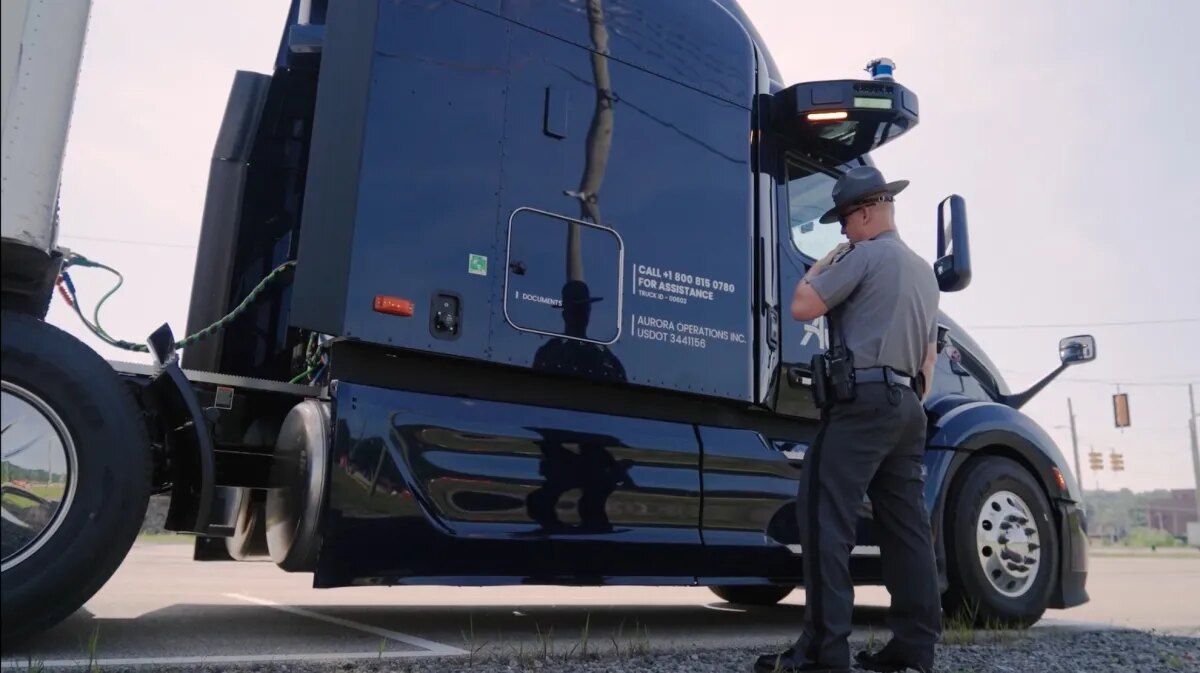
The Federal Motor Carrier Safety Administration has granted Aurora Innovation, Kodiak AI and other autonomous truck developers a five-year exemption that permits cab-mounted warning beacons in place of roadside reflective warning devices. The decision removes a practical regulatory obstacle for driverless heavy trucks that must stop because of a mechanical problem.
Under the federal rule applied to conventional big rigs, a human driver who stops on the road must activate hazard lights and place reflective warning triangles within 10 minutes to alert other road users. A driverless vehicle has no person available to carry out that task, creating a mismatch between the requirement and autonomous operations.
A five-year alternative to warning triangles
The exemption allows companies to use high-visibility warning beacons mounted on the truck cab rather than deploy reflective triangles. Aurora had treated the requirement as a significant commercialization hurdle, first seeking an exemption from federal safety regulators and then taking its challenge to the District of Columbia Court of Appeals after its request was denied. Developers had operated under a temporary waiver while awaiting a decision.
Aurora said the cab-mounted system can immediately alert other road users without requiring a person to enter a hazardous roadside environment. Daniel Goff, Kodiak AI’s vice president of external affairs, said the change will help the sector move toward autonomous freight operations that could improve delivery efficiency and safety.
Operational impact for autonomous trucking
The ruling concerns a narrow but essential incident-response scenario: a self-driving truck that has pulled over cannot rely on the established manual process for securing the roadside. By approving an alternative, the FMCSA gives autonomous freight operators a defined five-year basis for equipping vehicles with warning beacons as they develop and run routes.
The decision lands as autonomous trucking firms broaden real-world freight activity. Kodiak AI, for example, has introduced a 435-mile autonomous route between Dallas and Laredo, Texas, with carrier Charger USA, hauling refrigerated and dry freight for consumer packaged goods and food-and-beverage customers.
The broader transportation technology ecosystem is also drawing attention at industry events, including AI scaling at TechCrunch Disrupt 2026 where Amazon, Replit and Tether are set to address AI scaling, while autonomous developers focus on the physical operating constraints that determine whether a service can run safely.
What fleet leaders should examine
The exemption does not eliminate the need for disciplined roadside-response procedures. Operators still need to determine how a beacon-equipped vehicle will communicate its status, how first responders will approach it and how the process will work across the jurisdictions and routes they serve.
For fleet and logistics businesses, the practical implication is to evaluate cab-mounted warning beacons alongside safety protocols, emergency-response training and route-specific compliance requirements before relying on driverless truck operations at larger scale.