


Genesis AI secures $500 million for Eno humanoid robot
Genesis AI funds a push into dexterous robot work
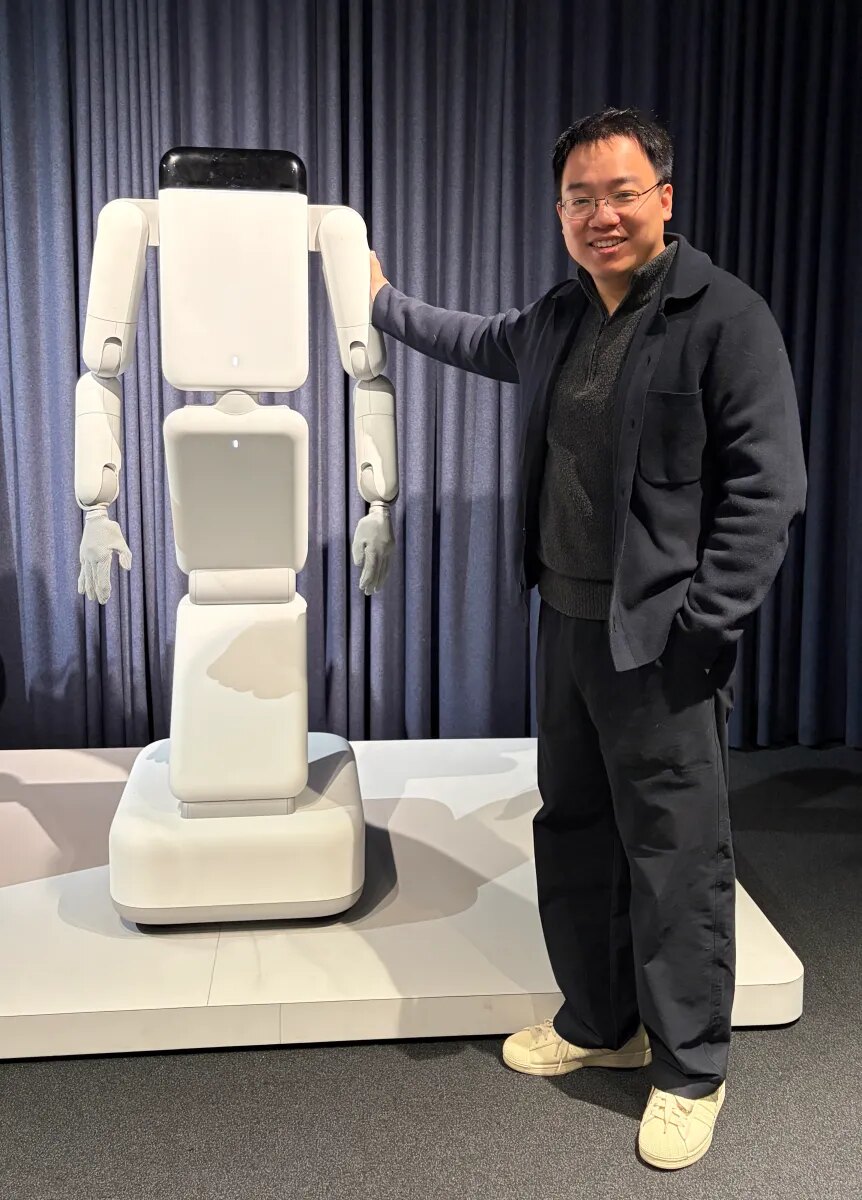
Genesis AI has raised a $500 million Series A to advance Eno, its flagship humanoid robot, and the physical AI model that operates it. Khosla Ventures, Premji Invest and Eclipse led the round. The company, founded in 2024 by CEO Zhou Xian and president Théophile Gervet, had announced a $105 million seed round in July 2025.
At its Silicon Valley facility, Genesis demonstrated off-the-shelf robotic arms carrying out a packing sequence: lifting two small cardboard boxes, scanning them, placing them in a larger box, closing and taping it, then applying a printed label. On a repeat run, the system dropped a box and struggled to peel a small adhesive label from the printer tape.
That contrast illustrates the operational challenge facing physical AI companies: turning a controlled demonstration into automation that can cope with variations in objects, placement and handling. A Genesis executive described such failures as “hiccup data” that can be used to improve the model.
Glove data and simulation underpin the strategy
Genesis is pursuing vertical integration, combining proprietary data collection, a generative AI model and its own humanoid hardware. Its emphasis is dexterity: the ability to manipulate objects with robot hands rather than only navigate or move items in simple environments.
More than 100 workers around the world wear sensor-enabled gloves and headset cameras while performing tasks. The setup captures force data alongside visual information for the company’s training dataset. Genesis says force data is important for effective manipulation, and its robots use the same sensor-equipped gloves. Their hands are designed around the proportions of human hands.
The startup also relies on simulation. Adviser Minchen Li co-authored a physics algorithm that Genesis uses to generate millions of high-fidelity models of robot experience. Xian said the company’s model is more capable when running on Eno than in the arm demonstration, although Eno was not ready to demonstrate those abilities to TechCrunch.
Production remains a hardware test
Genesis said it has built 30 to 40 Eno robots and is piloting them with a handful of undisclosed customers. It has selected a mass-manufacturing contractor to begin work in the United States next year, and says the design for the mass-produced version has been finalised. The company did not disclose expected production volume.
Hardware remains a constraint. Genesis said its dexterous hands currently last only a few weeks of regular work before replacement is required. Xian also identified mechanical design and the supply chains for industrial-grade machines as bottlenecks.
For businesses evaluating humanoid robotics, the funding and pilot activity signal accelerating development, but procurement decisions still need to test handling accuracy, exception recovery, component replacement and production readiness in the intended workflow.