


Glimpse launches Explore to speed CT-based quality inspection
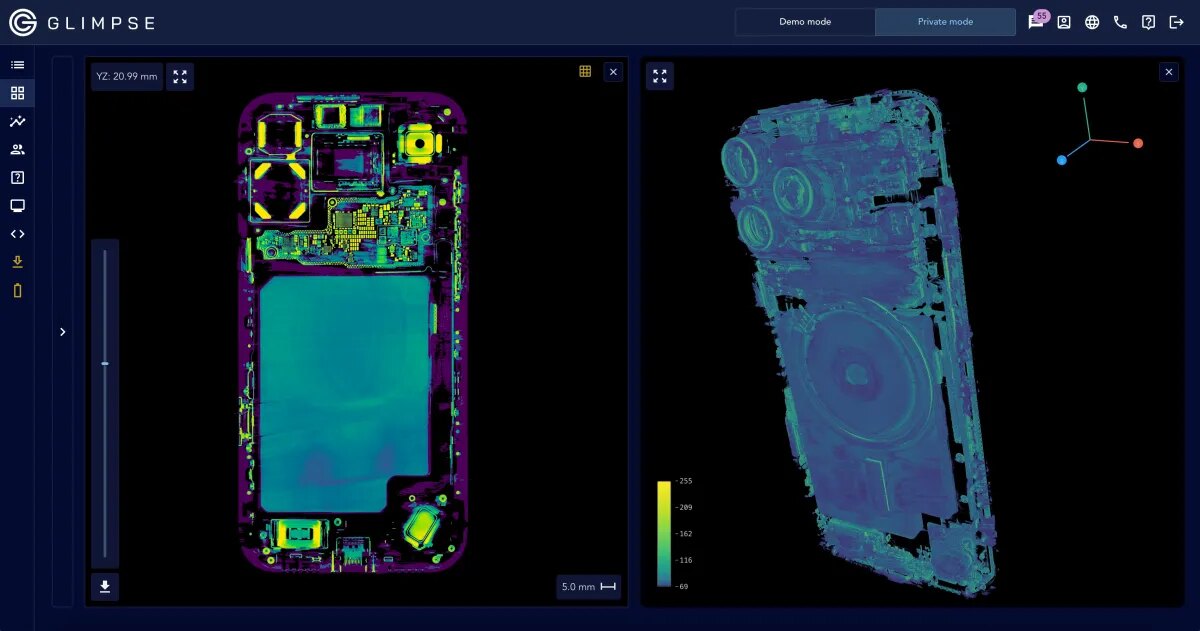
Glimpse has launched Explore, a product that applies the startup’s CT image-processing software to quality-control work in aerospace, automotive, electronics and medical-device environments. The company says its technology can increase battery-cell inspection throughput by 10 to 30 times on manufacturers’ existing CT scanners, potentially raising output from a handful of cells per day to tens of thousands.
Glimpse, which serves more than 100 customers including Anker, Lucid and the U.S. Navy, says it generates revenue in the mid-seven-figure range. Its existing business includes customers on both the buying and selling sides of the battery market. The company is also developing a customer “super scanner” with partners that, it says, could complete a scan in one or two seconds.
Making CT scans usable for production quality control
Computed tomography can reveal internal defects that conventional external inspection cannot see, but scan speed has limited its use for broad statistical sampling in manufacturing. Eric Moch, Glimpse’s co-founder and CEO, said major quality problems could often have been identified with CT scanning, yet conventional workflows have been too slow for that role.
The company cited the Chevrolet Bolt recall affecting vehicles made between 2017 and 2022 as an example of the cost of battery manufacturing failures. A problem at an LG battery factory led to improperly installed components inside cells and ultimately cost LG $1.9 billion. Glimpse positions higher-throughput inspection as a way to identify defects before they develop into such large-scale quality events.
Edge processing, cloud access and measurement alerts
Glimpse has built its own image-processing pipeline around deep-learning algorithms. Much of the initial computation runs on edge computers deployed at a customer site, where the system compresses scans and cleans up images before sending output to the cloud. Glimpse says the resulting images can load in a web browser within seconds rather than requiring minutes or hours.
Its dashboard pairs scanned images with measurements chosen by the customer. For a battery cell, that could include the distance between layers. When a measurement begins to depart from the expected range, the software flags the change and highlights it in the relevant scan so users can inspect the defect visually. The algorithms also incorporate customer input and retrain over time.
Scan-on-demand option broadens access
Explore extends this approach beyond batteries to laboratory and development settings in several hardware industries. Customers without their own CT equipment can send parts to Glimpse for scanning at its Boston-area facility. The company said it is opening a second Scan On Demand centre in the San Francisco Bay Area.
For manufacturers, the immediate consideration is whether CT inspection can be applied to the components and measurements most associated with quality risk. A service model may allow teams to test that workflow without buying a scanner, while companies with installed equipment can evaluate whether faster processing supports more representative sampling and earlier intervention.