


Google introduces WeatherNext 3 with 5km AI weather forecasts
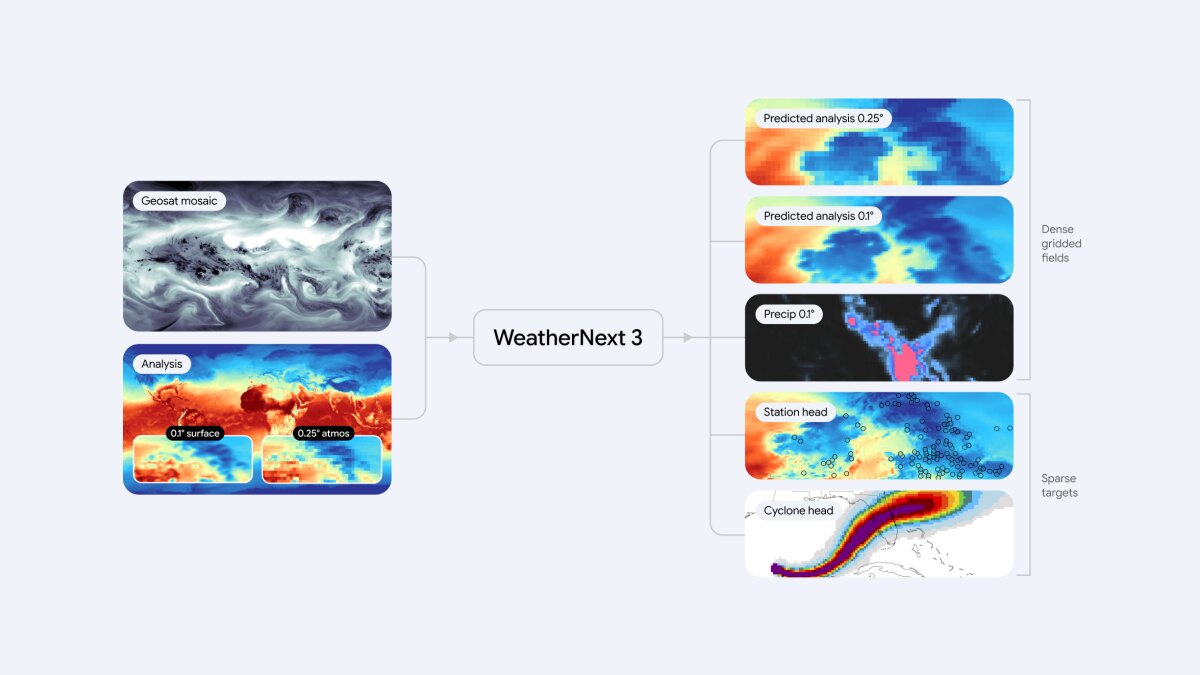
Google DeepMind and Google Research have released WeatherNext 3, a new artificial-intelligence weather forecasting model that Google says will begin supplying core weather variables to Search, Google Maps and Gemini. The model will also be available to users and researchers through Google’s cloud platforms.
Google says WeatherNext 3 achieved the strongest results among the leading systems assessed on Operational WeatherBench, a comparison tool developed by startup Brightband. The benchmark examines measures including temperature, wind speed and humidity, and Google says the model surpassed other deep-learning systems from Google, Microsoft, Nvidia and the European Centre for Medium-Range Weather Forecasts, as well as traditional forecasts from the US National Weather Service and ECMWF.
Higher resolution and more frequent updates
WeatherNext 3 forecasts key variables at a 5km resolution, compared with the 15km to 25km areas commonly associated with earlier AI forecasting models. Its rain evaluations are 60% better than those of WeatherNext 2, while the new system produces hourly forecasts rather than the standard six-hourly prediction cycle.
The release addresses persistent limits of AI weather models: broad geographic output, difficulty forecasting rain and continued reliance on structured datasets prepared by government agencies. Google’s researchers said the new model was trained to forecast conditions at particular weather data stations, which provides more granular output and makes it possible to compare results with ground-truth measurements from those stations.
Model design and data inputs
WeatherNext 3 has 2.4 times more parameters than its predecessor. Google also changed the targets used by decoder heads to produce more useful outputs. DeepMind had previously adapted its modelling work to visualise cyclone paths; the latest design extends that approach by targeting specific weather stations.
The model can issue updates more often because it ingests weather-satellite observations collected in real time each hour. Google describes it as the first AI model to directly incorporate raw observations for a high-resolution global forecast. Weather startup WindBorne said its WeatherMesh 6 system has incorporated raw data from weather balloons and other sources since late 2025, while Google noted that its own forecasts provide higher resolution globally.
Both approaches still rely on national weather datasets for forecasting, meaning direct data assimilation remains incomplete. Yet AI weather systems are already appearing in products from European and US weather agencies, where faster and lower-cost modelling could widen access to quality forecasts. For businesses, more frequent local estimates of wind, rain and cloud cover can be relevant when planning renewable-energy operations and other weather-sensitive work.