


Mamdani presses cities to set accountability rules for AI
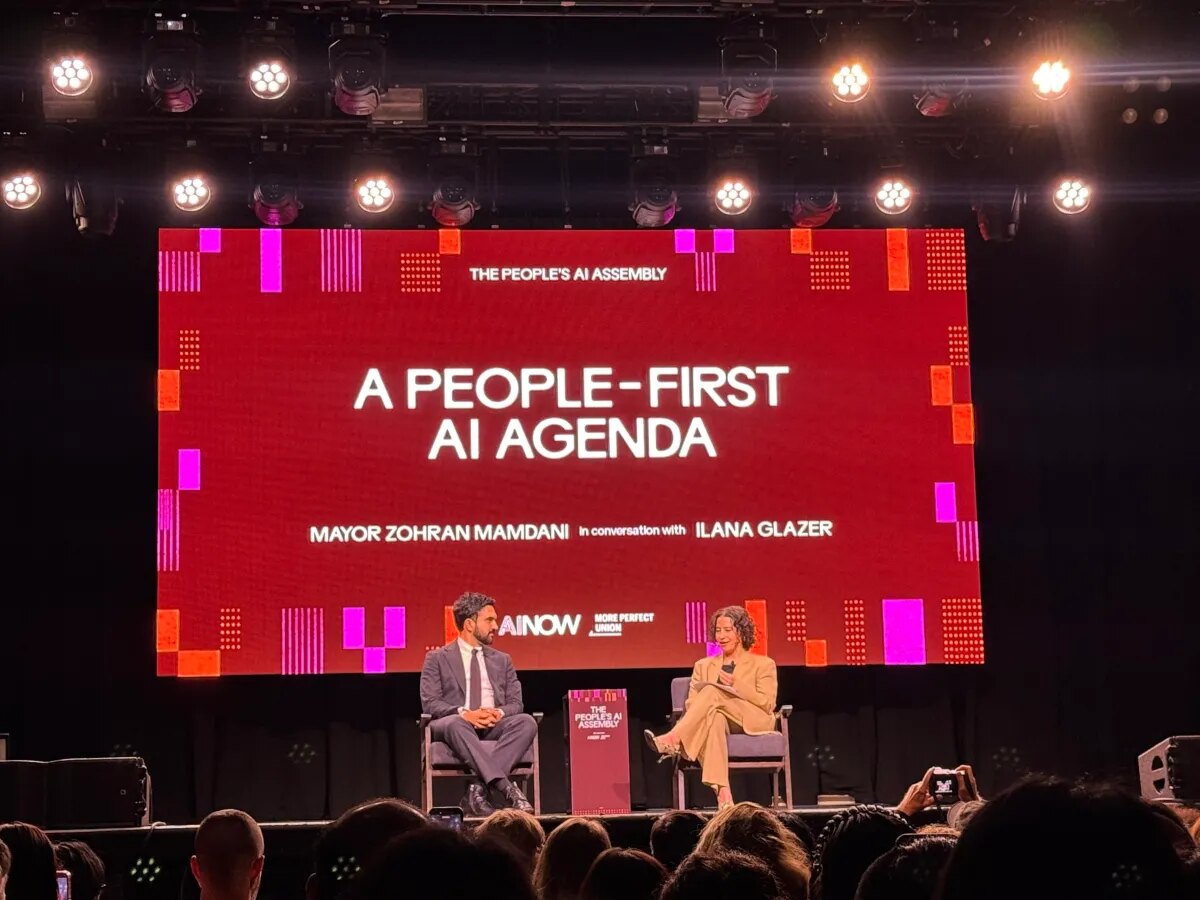
New York Mayor Zohran Mamdani used the AI Now Institute’s People’s AI Assembly in Manhattan to argue that public authorities should not treat artificial intelligence as an unavoidable force. Interviewed by actor and activist Ilana Glazer at Webster Hall, Mamdani said federal policymakers had shown a “complete abdication of federal law” on AI and urged New Yorkers to demand accountability from technology companies.
The mayor’s remarks followed two city-level initiatives aimed at concrete uses of AI. Last month, he ordered a ban on AI use in elementary and middle schools. Over the summer, his administration introduced a policy that would require landlords, brokers and real-estate platforms to disclose clearly when property-listing photos or videos were generated with AI.
City policy focuses on schools and housing listings
Glazer, who is a parent, said AI’s arrival in classrooms felt non-consensual and questioned why it had to be accepted in schools. Mamdani’s school restriction and the proposed real-estate disclosure requirement challenge the assumption that institutions and the public must accept new AI systems simply because they are available.
The housing proposal is intended to protect prospective tenants and buyers from being misled by synthetic visual material, a risk the mayor described as being “house-phished.” Its focus is not on banning listings technology broadly, but on making the use of AI-generated images and videos visible to people making property decisions.
Mamdani rejects the inevitability argument
At the event, Mamdani said there is a “creep” to AI deployment and an intent to overwhelm people until they feel they have no choice. He criticised what he called reckless technology adoption without a reckoning with its limitations, and rejected portrayals of AI as infallible or beyond public scrutiny.
He also linked the accountability debate to the commercial interests surrounding major AI developers. Mamdani said companies can invoke claims that only builders of the technology are qualified to regulate it while avoiding scrutiny that could affect a future public valuation. Anthropic is expected to enter public markets this year, while OpenAI has said it plans to go public in 2027.
Federal approach remains central to the debate
Mamdani said national AI discussions are often framed as competition with China, pushing human concerns aside. He contrasted that framing with the need for a different post-administration framework for discussing AI and deciding what accountability public institutions are willing to impose.
President Donald Trump’s Superintelligence Task Force, announced earlier this month, largely emphasises allowing powerful AI companies to self-regulate rather than establishing new federal restrictions. Mamdani’s position places cities in a more active role while national rules remain limited.
For businesses, the practical implication is to document where AI touches customers, employees and high-stakes decisions, disclose synthetic content where it may mislead, and establish governance that does not depend on future federal action.