


Maven Robotics raises $100 million for warehouse palletizing
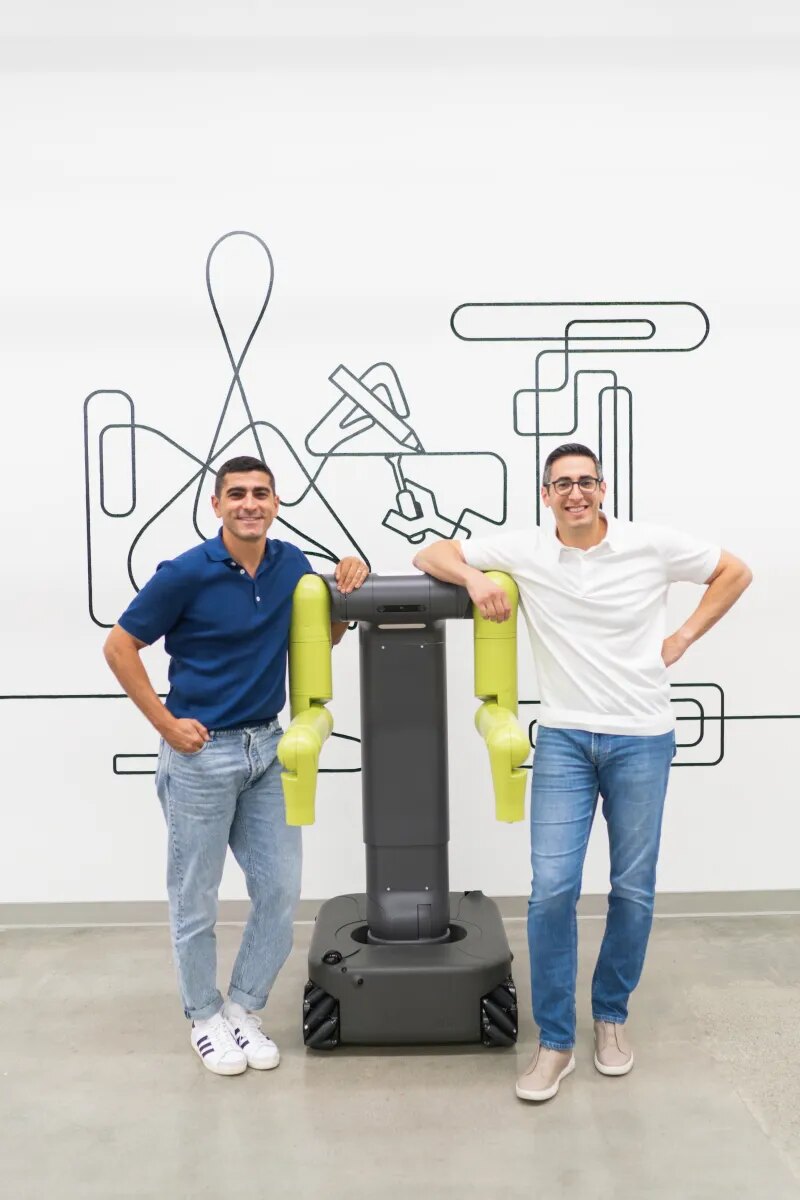
Maven Robotics has emerged from stealth with a $100 million financing round led by RoboStrategy and joined by LocalGlobe, Vine Ventures and XTX Markets Ventures. The Santa Clara startup plans to build 250 third-generation robots and begin designing a fourth-generation platform for industrial work.
Co-founder and CEO Hamza Derbas said the company already has as many as eight robots operating for 16 hours a day, with uptime of 99% or higher. Maven began in 2024, when Derbas and his brother Khalid, now the company’s CFO, sought a consumer-goods logistics customer that was evaluating four rival robotics suppliers.
Rather than presenting a general robotics pitch, the founders asked to inspect factories and warehouses, then focused on workflows where they could deliver immediate value. Maven won the contract and has spent two years working with that customer and several other partners.
Mixed palletizing is the initial deployment target
Maven’s robots use wheeled bases, can move at up to 10 miles per hour and have two arms capable of lifting up to 30 kilograms. Their principal task is mixed palletizing: taking boxed goods arriving from different factories and assembling new, store-bound pallets with the required product mix.
The workflow addresses distribution centres where retail demand can change shortly after goods are placed on shelves. Warehouse workers typically pick different items and build the new pallet manually. Maven’s systems use vacuum suction equipment to pick and arrange boxes, while connecting the task from a warehouse management system through to outbound truck loading.
The company’s emphasis is not a single robot capability but an end-to-end industrial workflow. A live feed at Maven’s Santa Clara facility showed two robots working at a customer site while employees moved around them, illustrating that the deployment is intended to operate alongside existing warehouse staff and processes.
Data loops support the next set of tasks
Derbas previously spent nine years at Apple’s special projects group after a career in automotive engineering focused on electric vehicles. Maven is also drawing on experience from autonomous-vehicle programmes, where operating hardware generates data used to retrain and redeploy systems.
Maven describes a cycle in which information from deployed robots returns within minutes or hours for retraining, evaluation, ablation studies and updated model weights before another deployment. The company says it will collect more data to expand its capabilities in material handling, then move toward automation and fabrication.
To build data for manipulation tasks, Maven expects to use its own systems and third-party providers. It has also developed pincer-like gloves that let people imitate the intended form factor of its robot grippers. Although it presents its machines as general-purpose robots, the company’s stated approach is to progress task by task.
Industrial return shapes the strategy
Derbas argues that industrial reliability and return on investment should determine robot design, contrasting Maven’s wheeled platform with more complex bipedal machines. Investor Jack Pearson of RoboStrategy similarly highlighted the company’s industrial-systems background and focus on operating conditions rather than a research culture centred on a specific architecture.
Maven estimates the palletization market at $80 billion, but says later tasks will require manipulation capabilities that do not yet exist. For businesses considering warehouse automation, Maven’s rollout underlines the value of defining a sizeable workflow, integrating it with operational systems and measuring uptime before extending robots to broader tasks.