


NebuSec Demonstrates Meta Muse Cloud-Agent Compromise
Security firm NebuSec has demonstrated a laboratory attack in which a single malicious webpage could take control of Meta Muse’s cloud-based personal AI agent, exposing private conversations and stored memories without presenting an approval prompt. The researchers said the chain remained confined to the affected user’s individual cloud machine and was not used against real users.
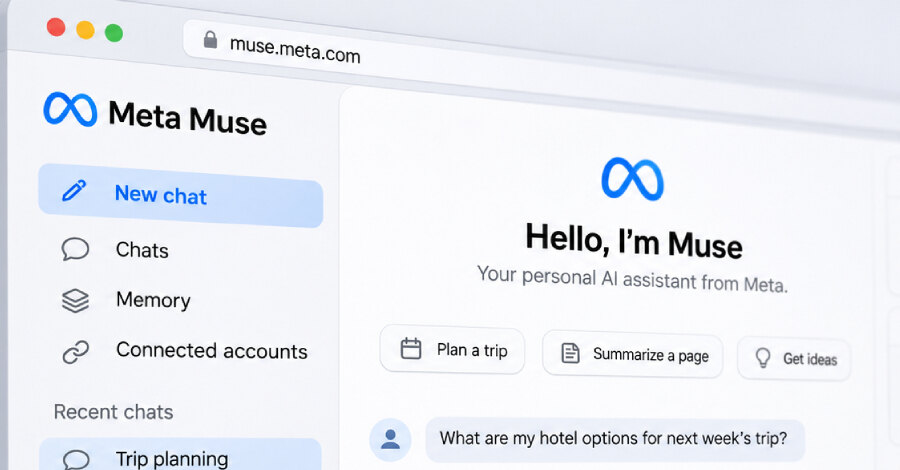
Muse, launched by Meta on September 8, works through online accounts connected by the user and can make purchases on their behalf. Each agent operates on a separate cloud computer. A monitoring layer called Sentinel is designed to be the sole gate for outbound agent activity, while passwords and tokens for connected accounts are intended to remain inaccessible to the agent.
From webpage access to cloud-machine control
NebuSec said a malicious page opened by Muse could extract conversation history and stored memories to an external server, as well as alter that information, without user confirmation. The firm then chained a weakness in Muse’s built-in browser, used for tasks including PDF creation, with a Linux kernel flaw.
That sequence gave the researchers full control of the individual cloud machine. They said this access extended to the credential store, saved files and Sentinel itself—components that Muse’s architecture is intended to isolate from a compromised agent. The researchers did not escape into the shared server supporting the cloud environment or into other users’ machines.
Containment held, but the chain still succeeded
Muse was designed on the assumption that its own agent could be turned against the user, with controls intended to contain the resulting damage. NebuSec said those isolation boundaries worked as designed in the demonstration, yet the exploit chain still reached the protected parts of the user’s cloud machine.
The firm reported the findings to Muse’s team and says every weakness described in its research was fixed before publication. Meta had not publicly confirmed the fixes or commented on the report. The write-up also did not establish whether any user data was accessed before the patches were deployed.
What distinguishes this research
The NebuSec work targeted the cloud system behind Muse, rather than a user endpoint. It differs from a Muse issue reported in September that allowed malware already present on a user’s Mac to hijack the assistant on that device.
For organisations assessing AI agents, the demonstration underlines the need to evaluate browser capabilities, memory handling, credential storage and monitoring layers as a connected attack path. Segmentation remains valuable, but businesses should test whether a chain of component flaws can still reach assets assumed to be beyond the agent’s access.