


MIT Human Insight Collaborative expands research on AI and society
MIT’s Human Insight Collaborative (MITHIC) has supported 67 projects across 31 MIT units and committed a total of $5.5 million since launching in 2024. Roughly one-third of the projects address artificial intelligence, society, and humanity, as faculty examine how generative AI is changing learning, work, creative practice, and social relationships.
The initiative brings scholars, artists, educators, and researchers together around human dimensions of major technological and social challenges. MITHIC is working across the Institute, including with the Social and Ethical Responsibilities of Computing (SERC), at a time when MIT faculty have raised concerns about AI’s effects on how people think, learn, and relate to one another.
Education concerns frame the research agenda
MIT’s recent report on AI and education found that students are going to office hours less often, spending less time working through problem sets, and spending less time with one another. The report warned that AI is eroding the “creative friction” associated with an MIT education, including debate and challenge among students, professors, and teaching assistants.
Heather Paxson, a MITHIC faculty co-lead and professor of anthropology, said the AI-and-society agenda extends beyond individual ethical choices and worker retraining. It also considers how AI reshapes sociality and how people relate to one another. An AI and Society Forum, co-organized by MITHIC, the School of Humanities, Arts, and Social Sciences, SERC, and the MIT Generative AI Impact Consortium, focused on jobs, democracy, and AI.
Seth Mnookin, MITHIC faculty co-lead and head of MIT’s Comparative Media Studies Program/Writing, argued that the questions raised by AI cannot be answered by technologists alone. He positioned the humanities, arts, and social sciences as necessary participants in examining a consequential technological shift.
Projects connect AI to democracy, cognition, and creative work
Through the SHASS+ Connectivity Fund, MITHIC supports projects pairing a scholar from the School of Humanities, Arts, and Social Sciences with a researcher elsewhere at MIT. Political science professors Adam Berinsky and Charles Stewart III, working with MIT Sloan Assistant Professor Chara Podimata, are studying large language models as intermediaries of democratic knowledge.
Their work on the 2026 U.S. midterm elections showed that Alaska voters using Anthropic’s Claude for pre-election research may have received incomplete information about candidates and their views. The researchers are examining what this information environment looks like across user demographics, political identities, and geographies.
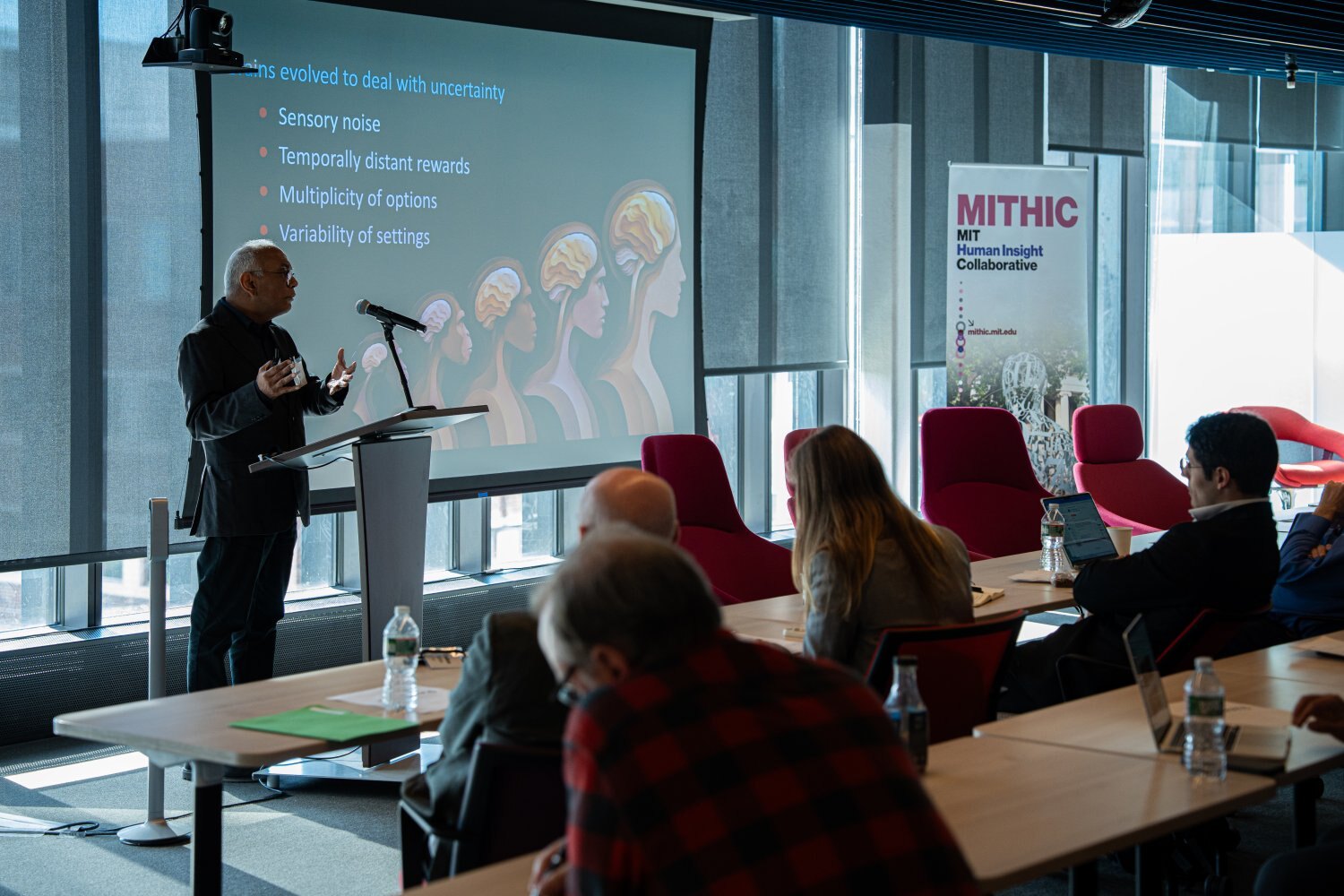
Eric Klopfer, professor of comparative media studies/writing, and Pawan Sinha, professor of brain and cognitive sciences, are measuring AI’s near- and long-term effects on cognition. Their research asks whether generative AI increases information consumption while offloading cognitive function, or whether it can support cognition when used in a creative process. The pair convened an MIT event titled “AI and the Brain.”
In arts and technology, Anna Huang and Joe Paradiso are exploring human-AI improvisation in music. Their project examines how AI changes creative process and live performance, with MIT musicians, ethnomusicologists, and engineers testing improvisation frameworks and discussing authorship, musical direction, and ensemble dynamics.
New courses and institutional support
Graham Jones and Arvind Satyanarayan used MITHIC funding to launch 6.S061/21A.S02, Humane User Experience Design. The course asks students to consider how AI systems enter socio-cultural relationships through their ability to mimic human thought and speech, including the tension between systems that are beneficial and those that appear humanlike.
MITHIC’s Education Impact Fund has also supported a revitalized Computing and Society concentration and faculty resources on generative AI and writing. Looking ahead, MITHIC and SERC plan events pairing humanists or social scientists with colleagues from individual disciplines, beginning with mathematics, to examine how AI affects knowledge production and training. For businesses, the practical implication is to evaluate AI deployment alongside productivity metrics by examining its effects on collaboration, judgment, learning, and the information people rely on to make decisions.