


MIT-IBM collaboration links AI and quantum theory to deployment
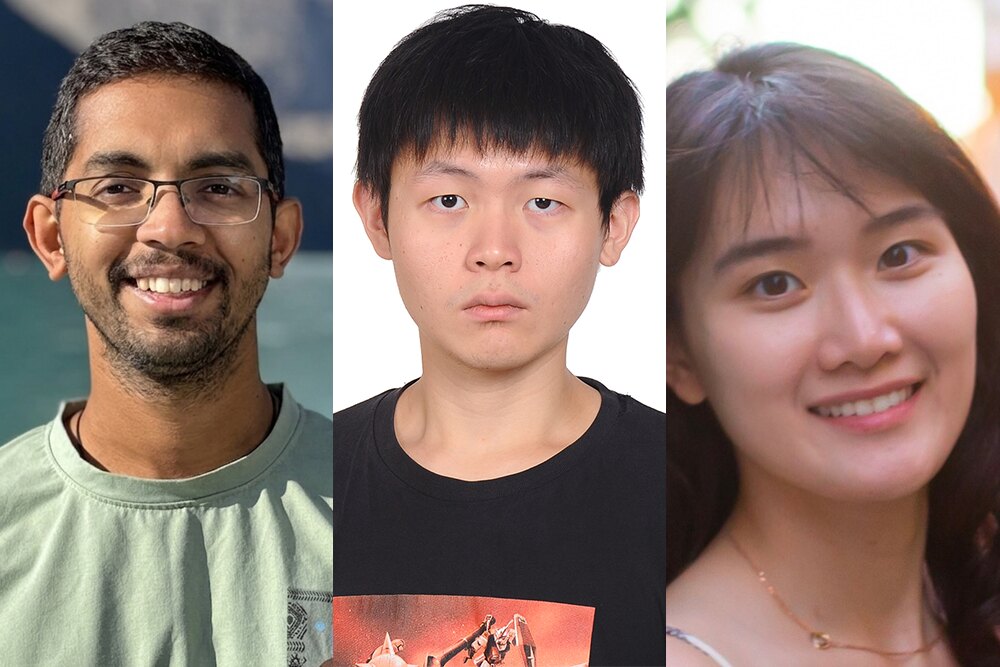
Three MIT affiliates who worked with the MIT-IBM Computing Research Lab have taken research careers into IBM, applying work in quantum machine learning, reinforcement learning and trustworthy AI to systems with practical constraints. Srinivasan Arunachalam, Zhang-Wei Hong PhD ’25 and Irene Ko PhD ’24 each collaborated with the lab during their time at MIT.
Their projects span agent improvement, large-language-model inference safety and quantum algorithms designed with near-term hardware in mind. The lab, formerly the MIT-IBM Watson AI Lab, provided a setting for academic researchers and IBM staff to define research questions that could lead to industry applications.
Reinforcement learning moves toward enterprise agents
Hong began his MIT PhD in 2020 in the Department of Electrical Engineering and Computer Science, working with Associate Professor Pulkit Agrawal. His graduate research improved value-function learning in reinforcement learning using the Atari game “Montezuma’s Revenge” to predict and optimise an agent’s policy performance.
With the lab, Hong developed approaches intended to ground AI in more realistic settings and improve reward feedback. He applied those ideas to robotics, large language models and reinforcement learning for science. At IBM, he is investigating test-time training for agents and foundation models, alongside infrastructure for an agentic framework supporting enterprise tasks including chart reading and database-query tool calling.
His work also examines evolutionary computing for exploration optimisation and neuroscience-informed model improvement at deployment time. Hong describes the aim as a framework in which model weights can improve online during deployment.
Trustworthy inference and quantum constraints
Ko worked with IBM researchers from the start of her PhD, which was funded through MIT-IBM. Her research focused on safe, robust, accurate and fair AI, first in neural networks and later in foundation models and LLMs. After graduating in 2024, she joined IBM Research as a research scientist.
Her current work targets trustworthy methods that are not widely deployed in AI inference platforms. Rather than relying on low-rank adapters that add steps to monitor and modify model behaviour, vLLM Hook accesses internal signals such as hidden states and activations during LLM decoding. The vector acts on transformer modules to analyse safety scores, including the likelihood of prompt injection and hallucination.
Ko developed the lightweight vLLM inference-engine plugin framework to program model internals, an approach she says could reduce costs compared with other methods. The work is intended to bridge development and deployment in trustworthy AI.
Arunachalam came to MIT as a postdoctoral researcher in 2018, working in Professor Aram Harrow’s group. Collaboration with Isaac Chuang and IBM researcher Kristan Temme led him to focus more closely on research that could be implemented on near-term quantum devices. That meant accounting for nearest-neighbour architectures, noise and simpler observable measurements.
From rigorous results to operational choices
Arunachalam’s work includes a paper on Hamiltonian learning that offered rigorous guarantees for learning quantum-system dynamics, and a paper on quantum kernels that presented theoretical evidence for advantages over classical kernels under widely believed hardness assumptions. Across all three careers, the common thread is translating rigorous research into questions shaped by deployment conditions.
For businesses evaluating advanced AI or quantum programmes, the practical implication is to connect research teams with production requirements early, so that safety monitoring, inference design, hardware limitations and measurable use cases guide technical work before deployment decisions are made.