


Nvidia leaders to examine AI model choices at Disrupt 2026
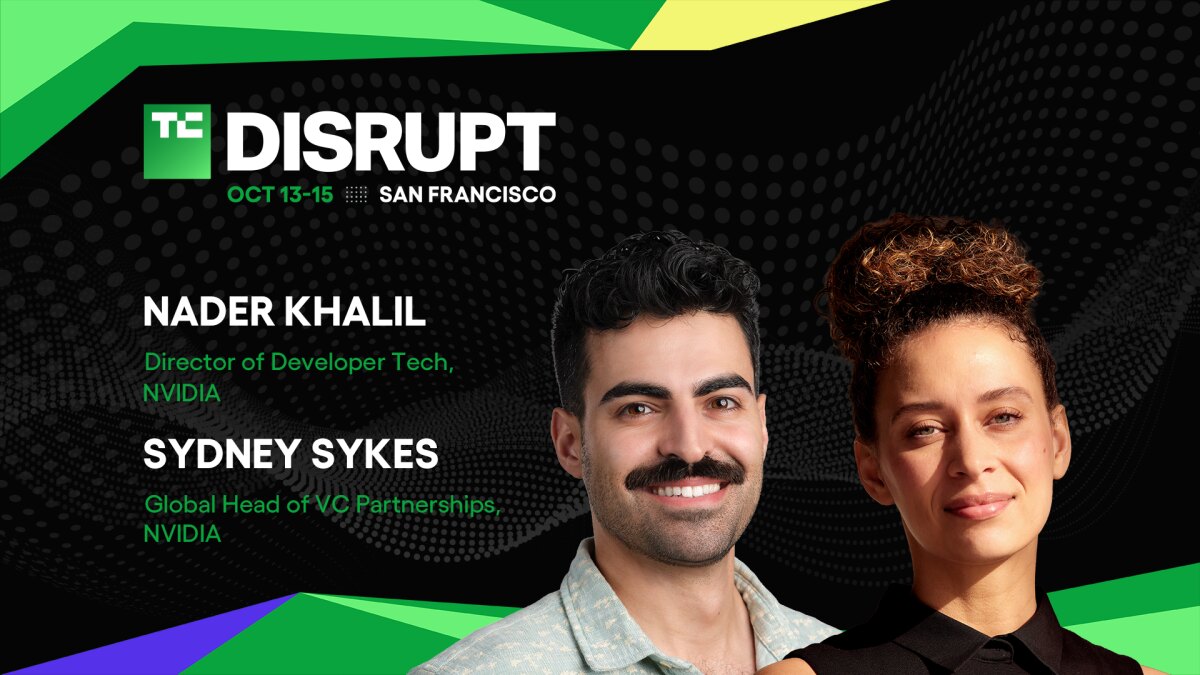
Nvidia’s Nader Khalil, Director of Developer Tech, and Sydney Sykes, Global Head of VC Partnerships, will lead a session on open and proprietary AI at TechCrunch Disrupt 2026. “The Open vs. Closed AI Debate Is Just Getting Started” is scheduled for the Builders Stage during the October 13–15 event in San Francisco.
The discussion will address a foundational product decision for AI startups: whether to use a proprietary frontier model, build on an open model, fine-tune a model, run workloads locally, combine several models, or revise that approach as capabilities and economics change. TechCrunch frames the choice as one that can affect costs, infrastructure, margins, differentiation, speed and control.
Model selection is a commercial decision
The session is not positioned as a philosophical dispute over open source. It will focus on where open and proprietary approaches make commercial sense as model performance, pricing and deployment options evolve. Questions include whether lower cost should decide between models with similar results, how data control changes the calculation, and whether owning more of the stack creates defensibility or an additional maintenance burden.
Nvidia CEO Jensen Huang has argued that the future is not proprietary versus open, but proprietary and open. That framing reflects the possibility of hybrid architectures, particularly where businesses need different models for different workloads or want to retain the option to change providers.
The wider Disrupt programme also includes Anthropic and OpenAI at the AI Stage in a look at how leading model developers approach the next stage of AI, placing Nvidia’s session within a broader discussion of the stack on which startups are being built.
Open-model progress adds complexity
Nvidia said in July that 145 papers accepted at ICML 2026 cited its Nemotron open models and datasets. The company also pointed to research using other Nvidia open model families in robotics, autonomous vehicles and biomedical research. At the same time, proprietary frontier laboratories continue to advance model capabilities, making the selection process less straightforward rather than eliminating it.
Nvidia is investing in the open ecosystem through products including Nemotron 3 Super, an open 120-billion-parameter model launched in March for agentic workloads. The source notes that companies are already combining it with proprietary models instead of treating the two routes as mutually exclusive.
Builder and investor perspectives
Khalil brings an infrastructure perspective to the stage. Before joining Nvidia, he co-founded Brev.dev, an AI infrastructure company Nvidia acquired in July 2024. Brev.dev focused on simplifying access to GPU infrastructure across environments, while Nvidia documentation described tools for deploying AI software across public cloud, private cloud and on-premises infrastructure without dependence on a single compute source.
Sykes brings the venture ecosystem perspective as Nvidia’s Global Head of VC Partnerships. Together, the two roles create a discussion spanning what developers need to build and what businesses need to become investable and scalable.
For founders, investors and business leads, the practical implication is to assess model strategy alongside data control, procurement, security, deployment work, workload economics and provider flexibility. The relevant advantage may lie in proprietary data, workflow, distribution, customer relationships, product experience or specialised technology—not simply in the model selected.