


OpenAI outlines how Forward Deployed Engineering scales AI deployments
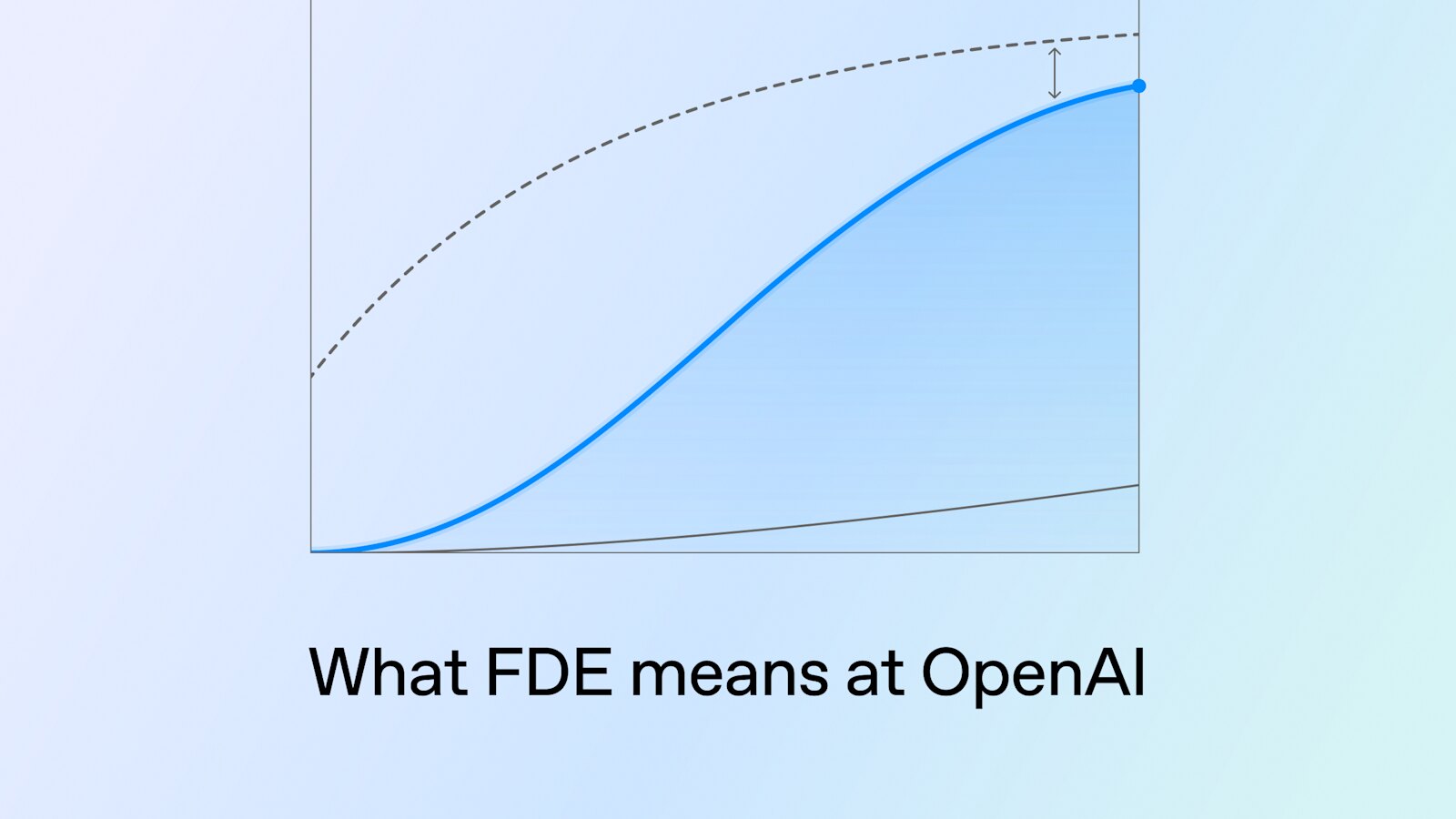
OpenAI has set out how its Forward Deployed Engineering (FDE) team works with enterprises to turn AI prototypes into dependable production systems, then reduce the custom work required for later deployments. Founded in early 2025, the team focuses on what OpenAI calls the “deployment gap” between apparent model capability and what people can reliably use in day-to-day work.
Colin Jarvis, OpenAI’s Head of Forward Deployed Engineering, describes an approach built around customer outcomes rather than demonstrations. FDEs work alongside customer teams to understand difficult operational problems, build and evaluate solutions, and feed findings back to Product and Research. The stated goal is deliberately self-limiting: make a class of work repeatable enough that future customers need less bespoke engineering.
From field support to semiconductor verification
John Deere is one example. Its See & Spray precision weed-control technology uses cameras and machine learning to identify and spray weeds rather than treating an entire field, reducing chemical use by up to 70%. OpenAI APIs were deployed to provide farmers with personalised support, including setup guidance, recommendations and signals that equipment may not be achieving its full potential.
In a separate mid-2025 engagement, around 15 FDEs worked with a large semiconductor customer on more than 10 use cases intended to make verification AI-native. The work covered directed test generation, root-cause analysis and debugging, and an architecture assistant. Verification can account for roughly 70% of effort in a project in this industry, OpenAI said.
FDEs embedded with the customer’s verification team, built evaluations with engineers and created custom harnesses for individual tasks. Within three to six months, the use cases reached production and early user adoption. OpenAI reported about 48% time savings from AI-based directed test generation, a 22% median performance improvement through kernel optimisation, and debugging work compressed from weeks into hours.
Replacing bespoke implementations with common primitives
Once workflows showed value, the next task was to make them easier to deploy and maintain. OpenAI rebuilt applications around Codex, moving use cases to a common harness. Custom applications became plugins and skills based on shared Codex primitives, while Codex also replaced separate terminal interfaces and command-line tools.
The company said this removed roughly 90% of custom code from each project. In one August 2026 example, an initial deployment took two months, while expansion to a second team took one day. New connectors or MCP servers, fresh evaluations and reusable skills enabled subsequent teams to be onboarded more quickly.
OpenAI applies the same pattern beyond engineering. Its Presence product for enterprise voice and chat agents developed through customer deployments, and one customer now handles more than half of its calls with AI. With Thrive Holdings, FDEs and researchers built Tax AI for Crete’s accounting firms; during a pilot, it processed 7,000 tax returns and raised throughput by about 50%.
Using deployment work to expose model limits
FDE work also identifies problems that current models cannot solve. For a large telecommunications customer, voice represented around 90% of customer-service volume. OpenAI initially measured performance at about 60% on key production evaluations, with function calling and instruction following needing improvement.
FDE, the customer and Research worked together for six months, using successive model snapshots against the customer’s requirements. Scores on the key evaluations rose from about 60% to 80% and then above 90%, the level OpenAI said was needed for production. The resulting voice model supports that customer, other custom customer-service deployments and managed deployments through Presence.
For businesses, the practical implication is to define measurable production outcomes early, build evaluations around real workflows and preserve what works as reusable components. A successful AI deployment is not only a finished application; it can also establish a repeatable operating model and expose the capability gaps that must be addressed before broader rollout.