


PHP patches critical vulnerabilities across supported releases
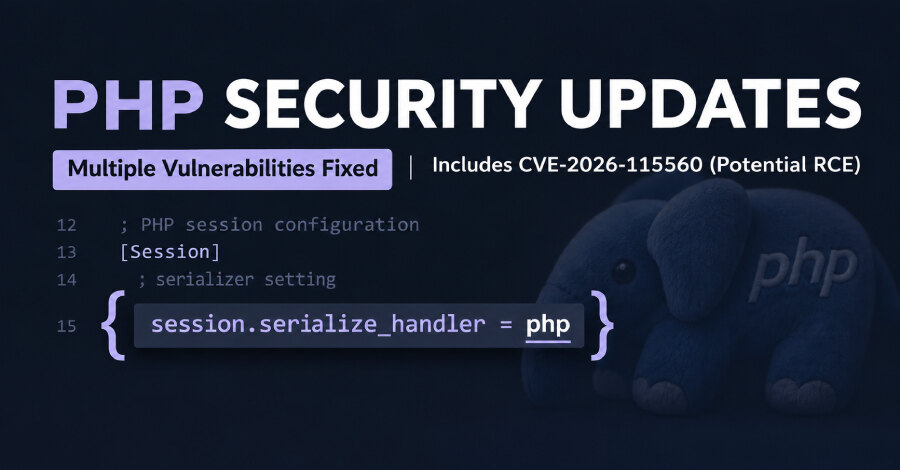
The PHP Foundation has released security updates for eight vulnerabilities, including seven critical flaws that carry CVSS scores of 9.2. The issues are fixed in PHP 8.2.36, 8.3.37, 8.4.28, 8.5.13 and 8.6.0, although individual fixes vary by branch.
The vulnerabilities could lead to remote code execution, memory corruption, session corruption, denial of service or local privilege escalation in affected deployments. PHP maintainers had warned in advance that the issues affect supported versions under specific conditions, including non-default configurations and less common deployment patterns.
Remote code execution risks span several components
CVE-2026-115560 is an improper input validation issue rated 9.2 that may permit remote code execution, file modification, session corruption or denial of service. It is fixed across the listed PHP 8.2 through 8.6 releases.
Several other bugs are use-after-free vulnerabilities. CVE-2026-129182 may cause memory corruption and possible full remote code execution, while CVE-2026-129474 affects PHP 8.5 and later and depends on application-specific conditions, control over sufficient request data, a reachable magic-method call and a fatal error at the relevant moment.
CVE-2026-129481 can disrupt session cleanup and potentially corrupt memory, crash a reused PHP worker or enable remote code execution. CVE-2026-129496 could allow an unauthenticated remote attacker to crash PHP workers or execute arbitrary code with their privileges. Both have fixes in the applicable maintained branches.
Session files and persistent backends require review
Depthfirst named CVE-2026-126714 “phpAfterShell.” The TOCTOU flaw can execute arbitrary code with the PHP worker’s privileges when an attacker can influence session data, interrupt a write at a useful point and exploit a suitable deserialization gadget chain.
The issue concerns file-based PHP sessions. An interrupted pwrite() or ftruncate() update can leave a session file containing a prefix of new serialized data and a tail from the previous session. When the application subsequently calls session_start(), PHP can interpret leftover bytes as session entries and serialized objects. Depthfirst said this can be chained with a PHP-native deserialization-to-RCE finding.
PHP states that applications unable to patch immediately should disable session upload progress. The affected-session scenario applies to applications running vulnerable PHP versions with file-based sessions.
CVE-2026-129289 is another 9.2-rated flaw involving inconsistent interpretation of HTTP requests. It can result in attacker-controlled PHP code running as the worker without user interaction or a non-default PHP configuration, but requires a front end with persistent backend connections and an application path that opens php://input without fully reading it. PHP identifies nginx with fastcgi_keep_conn, Apache mod_proxy_fcgi with enablereuse, retained FastCGI connections in HAProxy and LSAPI as relevant examples.
Upgrade and validate exposure
The remaining issue, CVE-2026-129291, has a CVSS score of 8.8 and may permit local privilege escalation. Exploitation requires local code execution in an FPM worker, an affected pool with catch_workers_output enabled, the epoll event backend, and the ability to manipulate worker lifetimes while retaining inherited pipe descriptors.
Teams using PHP 8.2.x, 8.3.x, 8.4.x or 8.5.x should upgrade to the latest patched release in their branch and confirm the deployed version on every application host. They should also identify file-based session use, session upload progress, persistent FastCGI or other backend connections, and FPM settings so remediation can be prioritised around the exposed configurations.