


Physical AI confronts its training data and reliability challenge
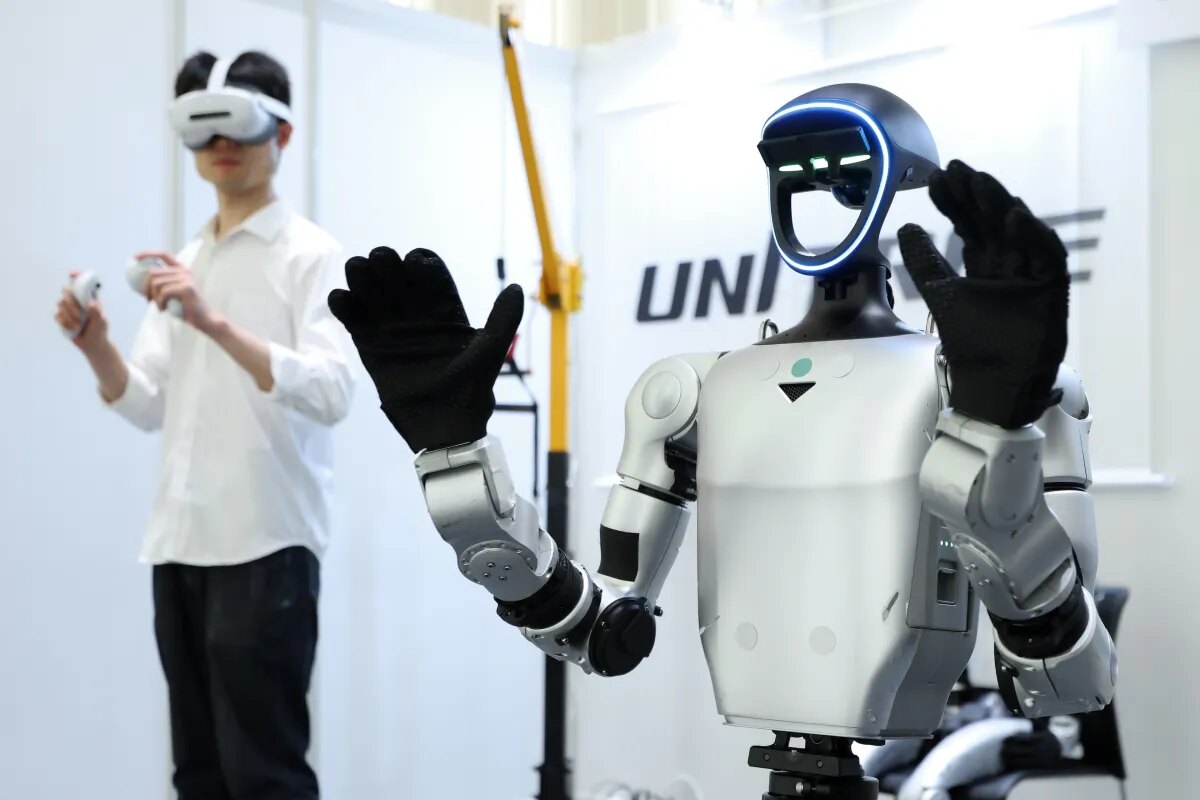
Physical AI developers are attracting major investment, but the sector’s practical limitations were underscored after Chinese robot maker Unitree lost nearly half its value shortly after reaching a $66 billion valuation in its public-market debut. The central issue is not simply robotic movement: machines are becoming more physically capable while still lacking the dependable intelligence needed to carry out value-creating work.
That tension was apparent at Actuate, a conference for developers building AI systems for robots. Organizer Foxglove said the event had grown threefold since 2023 and drew 1,500 attendees. Yet a booth sign from physical AI infrastructure company Avala pointed to what it called “the robotics data crisis”: insufficient high-quality training data for models.
Why robot intelligence remains difficult
Efforts to create robots that can handle any task remain distant, while end-to-end learning for narrower jobs has not consistently produced reliable commercial products. Developers are pursuing methods familiar from frontier AI work: broader datasets, different training regimes and stronger reinforcement-learning scenarios.
Harry Mellsop, a founder of simulation-tools startup Antioch, characterized physical AI as being in its “GPT-2 era,” before the step-change associated with ChatGPT. His view is that further progress will require more data and compute, including GPUs optimized for ray tracing to create high-fidelity simulations.
Autonomous vehicles are further ahead partly because companies can collect relevant data from cars driven by people. Their primary task is also avoiding contact rather than manipulating varied objects and environments. Much of the tooling used by robot-model developers emerged from autonomous-vehicle companies; Foxglove itself was founded by former Cruise employees.
Vehicles, humanoids and deployment trade-offs
Companies rooted in autonomous driving are now extending their machine-learning tooling into humanoid research. Tesla is pursuing that route with Optimus, while Wayve and Uber have established robotics labs focused on humanoid form factors. Wayve chief executive Alex Kendall said data, simulation and ML operations infrastructure will probably be shared across vehicles and robotics, although simulator world models will require different post-training for different embodiments.
Kendall argued that it is too early to commit to one hardware platform because sensors and other components are changing quickly. Genesis AI chief executive Théophile Gervet took the opposite view, saying there are opportunities to co-design hardware and AI rather than rely on a brain strategy alone.
Task-focused companies are already putting robots to work. Gritt is building solar farms, Agility is deploying robots in industrial settings and Bedrock is autonomously operating excavators. Gervet argued that customers do not value a general-purpose robot operating at an 80% success rate. A vertical focus can provide revenue and real-world deployment data, even if that data lacks the diversity needed to advance a general-purpose model.
Data operations become a competitive layer
Bedrock CTO Kevin Peterson said excavation is a starting point for understanding “manipulation in the wild,” with an eventual aim of extending an intelligence layer across construction machines. The volume of visual and lidar data makes managing those deployments difficult. Foxglove announced a product built on Nvidia’s Cosmos open-weight world model that lets engineers use natural-language queries to search data, create evaluations and build simulations for faster triage and debugging.
The immediate business implication is to judge physical AI by reliable performance in a defined operational setting, alongside the quality of the data and evaluation pipeline behind it. Broad humanoid promises may shape long-term research, but deployment data, simulation capability and measurable task outcomes remain the more concrete basis for adoption decisions.