


OpenWrt patches critical DHCPv6 flaw that could give attackers root control
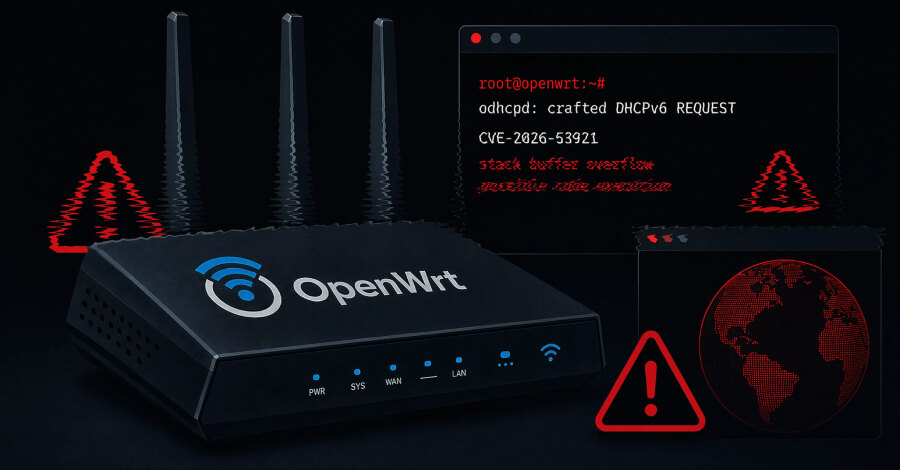
OpenWrt released versions 24.10.8 and 25.12.5 on July 28, 2026, to fix CVE-2026-53921, a critical DHCPv6 vulnerability rated 9.8 under CVSS 3.1. An unauthenticated attacker who can reach the DHCPv6 service may exploit the flaw to execute code as root.
Why the DHCPv6 vulnerability is dangerous
The issue affects odhcpd, OpenWrt’s DHCP and router-advertisement daemon. A crafted DHCPv6 REQUEST sent to UDP port 547 can cause data to be written beyond a fixed 512-byte stack buffer. Because odhcpd runs as root, successful exploitation could compromise the router rather than merely terminate the service.
Risk is amplified by the characteristics of embedded hardware. OpenWrt notes that such devices often lack stack canaries and address space layout randomization, making practical code execution more realistic. Public Python proof-of-concept code covers both documented overflow paths.
Affected versions and additional fixes
The vulnerable code includes odhcpd master at commit e432dd6 and earlier versions containing dhcpv6_ia_handle_IAs() and build_ia(). OpenWrt corrected the writes by checking the remaining response-buffer capacity before appending data. Users on the 24.10 branch should install 24.10.8; those on 25.12 should move to 25.12.5.
The 24.10.8 release also addresses other pre-authentication defects in odhcpd, three HTTP request-smuggling bugs in uhttpd, and CVE-2026-62948, a hostname-injection flaw that can produce stored XSS in the LuCI leases page. CVE-2026-62947 fixes authenticated path traversal in cgi-io that could expose root-readable files under specific permissions.
Separate LuCI command-injection, path-traversal, XSS and CSRF fixes identified during an AI-assisted Hacker House audit were still under review on July 28 and were not included in 24.10.8. No exploitation of the disclosed issues had been reported in the wild at that date.
For businesses, the priority is to inventory OpenWrt gateways, deploy the supported firmware, update packages installed outside the firmware image and remove unused LuCI applications. Administrators should also review delegated permissions and ensure no luci-app-commands entry is simultaneously public and parameterised.
OpenWrt security in 2026: an update checklist for administrators
For teams maintaining OpenWrt in 2026, installing the corrected release is the first step. Administrators should also verify the firmware branch, separately installed packages and exposed management features across every gateway.
Choose the corrected firmware for your branch
OpenWrt users on the 24.10 branch should install 24.10.8, while systems on the 25.12 branch should move to 25.12.5. Start with an inventory so that secondary gateways and other embedded devices are not missed.
- Record the firmware version running on every OpenWrt gateway.
- Install 24.10.8 on devices that remain on the 24.10 branch.
- Move 25.12 systems to version 25.12.5.
- Confirm the installed version after each device restarts.
Review packages and management access after updating
A firmware update does not replace a configuration review. Check packages installed outside the firmware image, remove unused LuCI applications and review delegated permissions. Pay particular attention to any luci-app-commands entry that is both public and parameterised.
- Update packages that were installed separately from the firmware image.
- Remove LuCI applications that are no longer required.
- Review delegated permissions and publicly accessible management features.
- Do not leave a parameterised luci-app-commands entry publicly available.
Keep the July 2026 disclosure in context
The 24.10.8 release also addresses other odhcpd and web-interface defects described in the disclosure. Additional LuCI findings were still under review on July 28, 2026, and were not included in that release. No exploitation of the disclosed issues had been reported in the wild by that date, but public proof-of-concept code makes timely patching important.
Frequently asked questions
Which OpenWrt versions fix CVE-2026-53921?
The corrected releases named in the disclosure are OpenWrt 24.10.8 and 25.12.5. Select the release that matches the branch used by the device.
Can CVE-2026-53921 be exploited without authentication?
Yes. An unauthenticated attacker who can reach the DHCPv6 service may trigger the flaw with a crafted request to UDP port 547.
Is installing the firmware update the only required action?
No. Administrators should also update separately installed packages, remove unused LuCI applications and review delegated permissions and exposed commands.
Was CVE-2026-53921 being exploited in July 2026?
No exploitation had been reported in the wild as of July 28, 2026. However, public proof-of-concept code was available, so absence of reported attacks should not be treated as a reason to delay updating.