


Relativity Networks raises $22m for hollow-core data center fiber
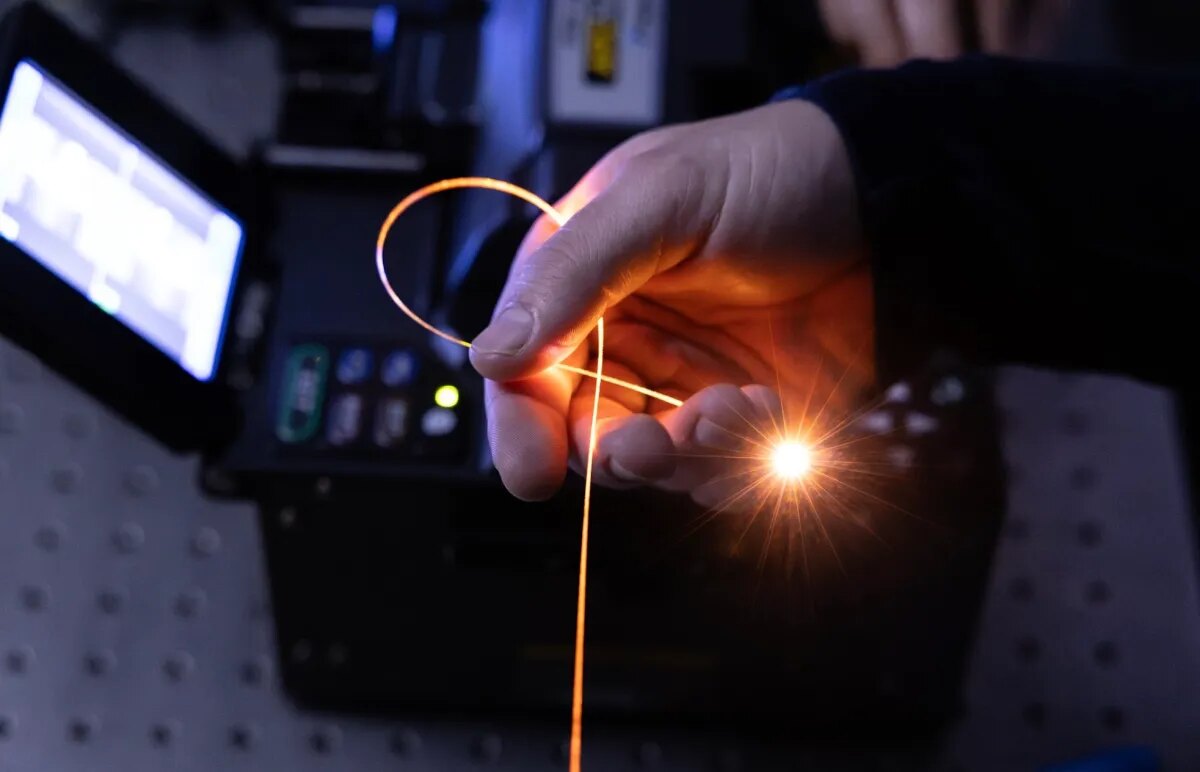
Relativity Networks has raised $22 million through SAFE notes to advance hollow-core fiber for data centers, while also securing a $40 million follow-on order from an unnamed leading hyperscaler. Investors in the funding include Rhapsody Venture Partners, Bell Ventures Inc. and Faster Than Glass LLC.
The company says its technology can transmit data 30% faster than conventional fiber. That proposition targets an increasingly important constraint for AI infrastructure: connecting compute spread across large campuses and, in some cases, separate data center sites.
Fiber latency becomes a geographic issue
Conventional fiber-optic cable transmits light through glass. Relativity Networks’ hollow-core fiber instead carries light through a vacuum chamber at the center of the line, bringing transmission closer to the theoretical limit of light speed.
Chief executive Jason Eisenholz estimates that a signal travelling one kilometre takes roughly five microseconds in conventional fiber. With hollow-core fiber, he says, the time can fall to about three and a half microseconds. The improvement is measured in microseconds, but the accumulated delay matters when GPUs are physically far apart.
AI compute was once concentrated in a single GPU rack, making fiber latency comparatively easy to overlook. Today, data center campuses can extend across hundreds of acres and dozens of buildings. Developers are also constrained by political conditions and available grid capacity when selecting sites.
Connecting capacity across campuses
Eisenholz identifies multi-campus deployments as a key use case. Operators can combine existing facilities so they function as a synchronized system while reaching power capacity available in different locations. In latency terms, a 30% reduction in transmission time could allow developers to cover distances roughly 30% greater before latency becomes a problem.
This networking question sits within the broader expansion of AI infrastructure, including the cloud capacity commitments represented by Anthropic’s planned AWS infrastructure spending and its planned AWS spending. Relativity Networks argues that the next stage of data center design will focus not only on compute and internal networking, but also on the geography over which systems can operate together.
Planning implication for operators
For businesses building or expanding distributed AI environments, the relevant consideration is no longer solely the availability of GPUs within one building. Power access, campus location and the latency budget between sites must be evaluated together, particularly where separate facilities are intended to operate as one compute system.