


Runware launches transportable pods for distributed AI inference
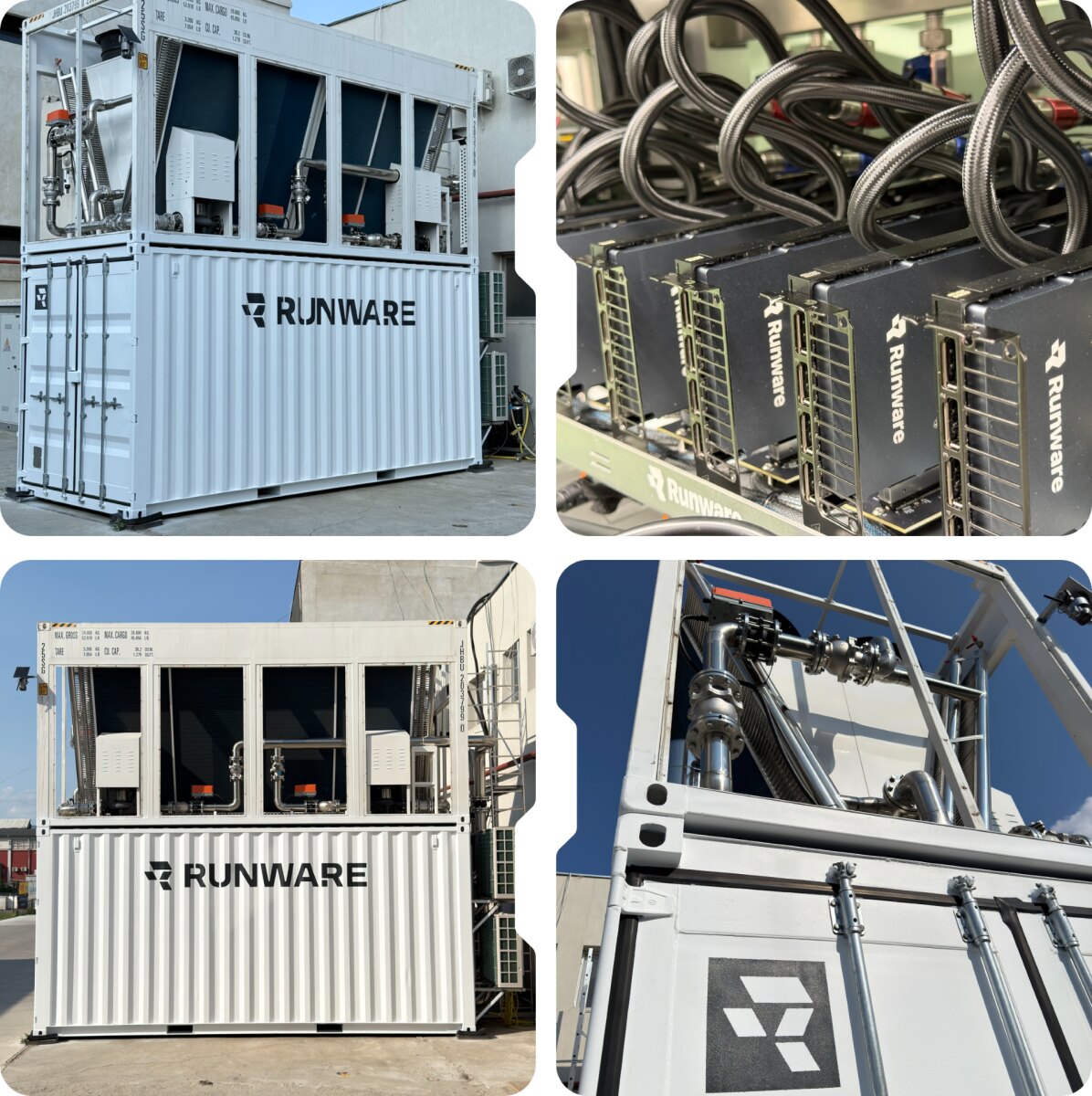
AI infrastructure company Runware has launched the Sonic Inference Pod, a modular data center designed as a single transportable unit. Co-founder and CEO Flaviu Radulescu said 10 pods are in deployment across the U.S., Europe and Asia-Pacific, while 160 sites are currently available to power them.
The company positions the Pod as a flexible complement to hyperscalers' large, fixed data center projects. Runware says it can deliver higher-quality inference at lower cost than other serverless inference platforms and GPU clouds, while adding capacity through new units rather than expanding one facility.
Capacity built and distributed in smaller units
Radulescu said each Pod can be deployed anywhere power is available and adapted quickly when new hardware arrives. Runware uses closed-loop cooling rather than water, and says a unit can be built in days, compared with the months or years required for a traditional data center.
Every Pod participates in a single network. Requests are routed to available capacity closer to users, and traffic moves to another unit if one goes offline. That design confines a failure to one Pod instead of taking down an entire fixed facility. Customers seeking dedicated hardware can reserve complete Pods.
The approach sits within the broader tension between growing inference demand and energy constraints on AI infrastructure shaping where new capacity can realistically be placed. Radulescu argues that demand is rising faster than facilities can be constructed, making deployment speed central to Runware's model.
Inference services remain the core business
Runware already supplies inference to customers including Higgsfield AI and Wix. The company announced a $50 million Series A in December to build infrastructure for companies generating images, and regards the Pod expansion as part of its wider mission to provide inference rather than as a standalone product.
Large AI laboratories are pursuing a different scale. OpenAI and SpaceX continue to develop data centers across the U.S.; reports say OpenAI is close to a $500 billion agreement involving a data center in Ohio. Radulescu does not view such projects as direct threats because Runware differentiates its system through mobility, distributed routing and rapid capacity additions.
Engineering and resource constraints
Building this hardware internally is not necessarily straightforward for customers. Radulescu said the relevant talent pool is small and warned that a circuit-board design error can add months of redesign, simulation, fabrication, testing and delivery.
The resource impact of AI infrastructure remains contentious, particularly where communities report higher utility costs around data centers. Runware ultimately wants its units to operate on renewable power without drawing on resources communities need, although Radulescu acknowledged that this is not yet the present reality.
For now, the company emphasizes no water for cooling, avoiding transmission losses by locating compute nearer demand, and using existing power rather than requesting new grid capacity. For businesses evaluating inference infrastructure, the practical implication is to assess deployment time, geographic placement, failover, cooling, hardware refreshes and access to power alongside the price of compute.