


ShieldBreak PoC alleges bypass of Microsoft Defender RoguePlanet fix
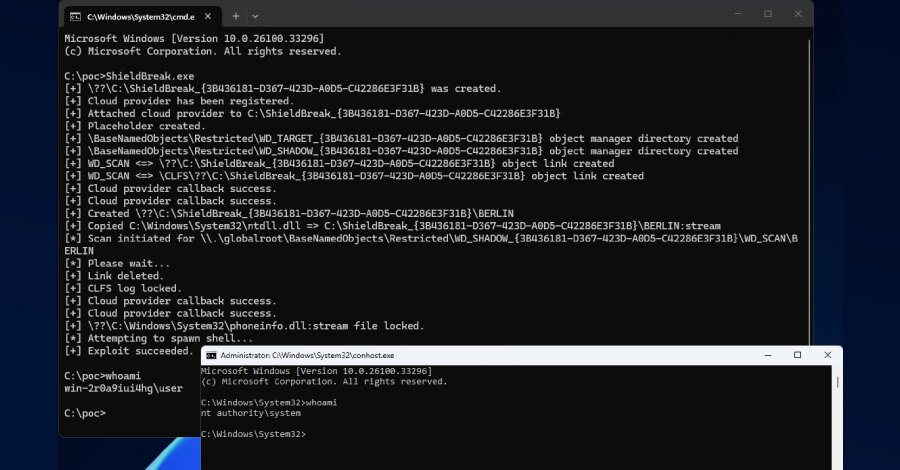
Security researcher Chaotic Eclipse, also known as INFINITE NIGHTMARE, MSNightmare and Nightmare-Eclipse, has released a proof of concept called ShieldBreak that is claimed to bypass Microsoft’s patch for CVE-2026-50656, known as RoguePlanet. The vulnerability affects Microsoft Defender for Windows and, if exploited successfully, could allow an attacker to obtain a shell with SYSTEM-level privileges.
CVE-2026-50656 has a CVSS score of 7.8 and was described as a race condition. The issue could enable arbitrary code execution or other unauthorised actions once SYSTEM access is obtained. Microsoft identified it as a privilege-escalation vulnerability in the Microsoft Malware Protection Engine, mpengine.dll.
Claimed patch bypass on current Windows releases
RoguePlanet was disclosed by the researcher in June 2026, and Microsoft issued a patch almost a month later. Chaotic Eclipse now characterises ShieldBreak as a full bypass of that remediation, stating that Microsoft did not properly patch the underlying vulnerability.
The researcher said the proof of concept was tested on the latest Windows 11 25H2 Canary-channel version and Windows Server 2025, with a claimed 100% success rate. Windows 10 and its corresponding server editions are not supported by the proof of concept, but the researcher said those systems are vulnerable to ShieldBreak as well. Microsoft had said it was aware of an earlier report involving its defence-in-depth updates and was investigating.
Context from Microsoft’s wider security release
The ShieldBreak claim emerged as Microsoft shipped patches for 421 security flaws, 236 of them in Windows. The release included CVE-2026-62832, also rated 7.8, a Windows User Profile Service privilege-escalation issue disclosed by Chaotic Eclipse as LegacyHive. Microsoft said an authenticated attacker with credentials for another local account could use a specially crafted application to load another user’s registry hive, potentially accessing or modifying that user’s data and gaining administrator privileges without user interaction.
Windows administrators also need to account for CVE-2026-68820, an actively exploited zero-day in the Windows Ancillary Function Driver for WinSock that can grant SYSTEM privileges. CISA added the vulnerability to its Known Exploited Vulnerabilities catalogue and required US federal agencies to apply fixes by August 25, 2026. The same release remediated CVE-2026-72971, a publicly disclosed tampering vulnerability in the Windows Container Isolation FS Filter Driver, unionfs.sys.
Business implication
The latest disclosure reinforces the need to validate patch deployment and prioritise Windows systems where local privilege escalation could amplify an initial compromise. Organisations should track Microsoft’s response to the ShieldBreak claim while treating the actively exploited WinSock issue as an immediate remediation priority, alongside the wider patterns of Windows risk in Windows vulnerabilities and ClickFix attack chains that can compound endpoint exposure.