


Signal enables screenshot blocking against mobile AI agents
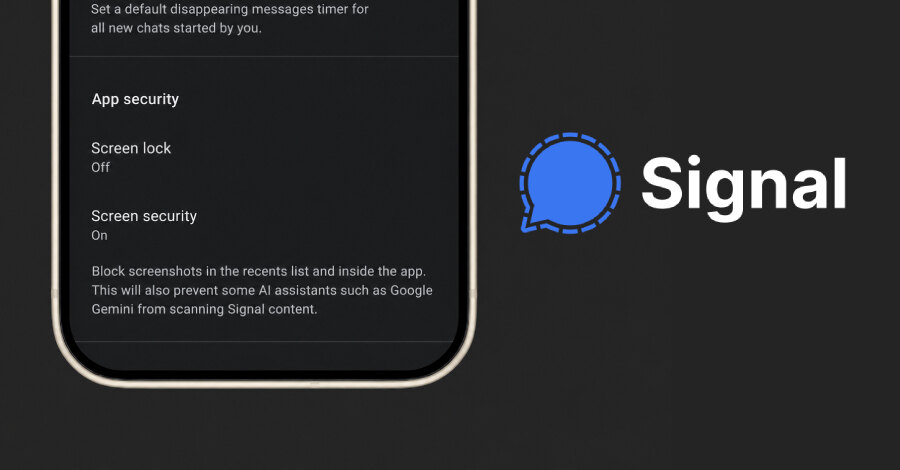
Signal has enabled screenshot restrictions by default on Android and iOS to limit operating-system AI agents’ ability to read private conversations. The encrypted messaging service says the measure applies to agentic systems integrated with iOS 27 and to Android versions where Signal can detect an AI assistant attempting to inspect its screen.
The change extends a Windows 11 setting introduced in May after Microsoft released Recall. Signal Foundation president Meredith Whittaker described agentic integrations in Android, iOS and Windows as an existential threat to Signal’s privacy model because the systems can scan what appears on screen.
Screen access moves data outside Signal’s controls
When an operating-system agent captures Signal content, it can make that information available to the agent so it can answer requests or perform tasks. Signal warns that captured content may be stored locally or on remote servers, outside the platform’s control, potentially affecting every participant in a conversation.
Users can turn off the restriction through Settings > Privacy > App Security, selecting “Block Siri AI” on iOS or “Screen security” on Android. Signal cautions that disabling the option may expose users’ and contacts’ content to AI agents and weaken its privacy guarantees.
Signal says the remedy has limits
The company explicitly calls its screenshot control incomplete. Preventing screenshots does not stop an AI agent from using other routes to application data, including retrieving content already stored on a device through the file system. Signal says app developers lack robust controls for preventing agents from eroding application-level privacy.
Its concerns follow Reuters reporting that Meta’s Muse AI agent accessed Signal messages on an Apple computer and an Android device despite the availability of Meta’s official Connector tool. On macOS, Muse reportedly used accessibility and screenshot capabilities to open Signal, capture images, extract text and reproduce it in the Muse app. On Android, it reportedly read messages through access to device push notifications.
Requested operating-system safeguards
Signal is asking platform providers for a simple, documented way for an app to opt out of AI data access and processing across screen reading, file-system access, notifications, APIs and other operating-system frameworks. It also wants clearer technical documentation about how AI agents access and process data.
Apple released iOS 27.2 with an “Excluded Apps” option for controlling which apps Siri, Search and suggestions can access. Google Gemini allows users to disconnect apps in Connected Apps settings, while Apple has previewed more granular Mac controls for data shared with applications, including those using AI agents.
For businesses, the practical implication is to treat AI-agent permissions as a privacy-control issue: review screen, accessibility, notification, file and connected-app access on managed devices, and retain Signal’s protections when sensitive conversations are conducted.