


SilentAir Used Telecom Signaling to Divert SMS Codes in Asia
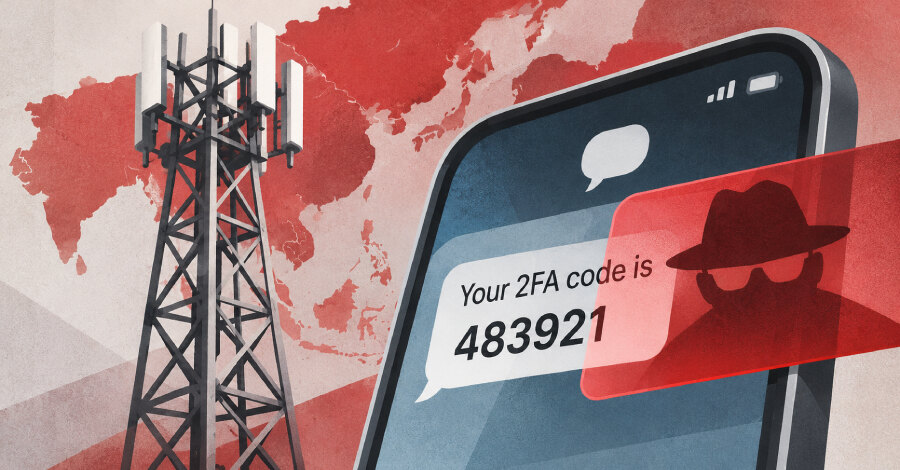
Enea has identified a previously unknown espionage group it calls SilentAir, which used compromised equipment inside Asian mobile operators to intercept selected users’ calls and text messages. The company located the group’s attack sources in at least six Asian countries, observed intercepted SMS two-factor authentication codes after successful diversions, and assessed with high confidence that the operation was state-level.
Taiwan was SilentAir’s principal target area, although Enea also observed activity affecting networks across Southeast and East Asia and, at times, East Africa, Central Asia, the Middle East and Europe. Some targets were political and government VIPs in their own countries. Enea said it had disrupted the activity for now, while cautioning that the actor could return.
False location updates enabled message diversion
Mobile operators use SS7 and Diameter signaling to route calls and texts and to support roaming. This signaling passes through the IPX, an inter-operator environment built on a high degree of trust. SilentAir injected attacks into the IPX from hijacked operator equipment.
For an interception attempt, the actor sent an UpdateLocation request, or a Diameter equivalent, to a target’s home network. The request falsely asserted that the compromised equipment was serving the subscriber’s handset. If accepted, the target’s calls and messages could be redirected to the attackers’ infrastructure.
Enea observed that some diversions succeeded and that 2FA codes were intercepted immediately afterwards for certain targets. The timing indicates an attempt to access accounts associated with those subscribers, but the report does not establish that any account takeover occurred. It also provides no comparable evidence that voice calls were intercepted.
Interception represented 18.3% of the SilentAir activity Enea observed. In the company’s earlier research, the corresponding share for a typical surveillance company involved in signaling attacks was 2.1%. In rare cases, equipment in several countries acted together against high-value targets, a pattern Enea said indicates a single controller.
Silent SMS and evidence of compromised operator systems
SilentAir also transmitted silent SMS messages at very large scale, mainly to subscribers in Taiwan. These messages do not normally appear on a phone or generate an alert. Enea said daytime messages largely went to subscribers on other networks and appeared to test whether a diversion had worked: delivery to the compromised equipment rather than the handset would show that the attacker was receiving the target’s texts.
Most messages sent at night were directed at Taiwanese users. Their purpose is unconfirmed, though Enea considers that they may have checked whether earlier diversions remained in place while devices were less likely to register again with their legitimate network. The texts contained motivational or promotional English-language phrases that Enea viewed as a disguise in case a network stripped the silent-message setting and exposed them as ordinary spam.
The investigation initially left two possibilities: attackers could have spoofed operator signaling addresses, or they could have taken over systems within each network. Enea later saw equipment inside one operator both send and receive attack commands, confirming the second explanation. It subsequently recovered traces of unauthorized access, although it could not analyze the malware it believes SilentAir used.
Attribution remains limited and defenses must span protocols
Enea linked SilentAir to China only with low confidence. Its assessment cites the operation’s focus on Taiwan, the absence of observed targeting of Chinese networks or subscribers, and an activity pattern aligned with a UTC+8 working day, weekends and Chinese holidays. The company also considered a possible connection to Liminal Panda, but said the evidence was insufficient to tie the groups together.
The report notes partial similarities with SCTPE, a Linux kernel-level tool also known as SIGweaver that can send and receive SS7 and Diameter traffic. However, Enea said SilentAir responded to messages it had not sent, which the known SCTPE program cannot do, and described SilentAir’s operational security as stronger than Liminal Panda’s.
For operators, Enea recommends deploying GTP-C and GTP-U firewalls that share intelligence with SS7 and Diameter controls, going beyond baseline signaling-security guidance, treating the full IPX as untrusted, and detecting signaling abuse within internal networks. The practical implication is that telecom security teams need joined-up monitoring across interconnect, roaming and core-network protocols rather than relying on trust at the operator boundary.