


Tines webinar outlines faster exposure assessment after CVE disclosures
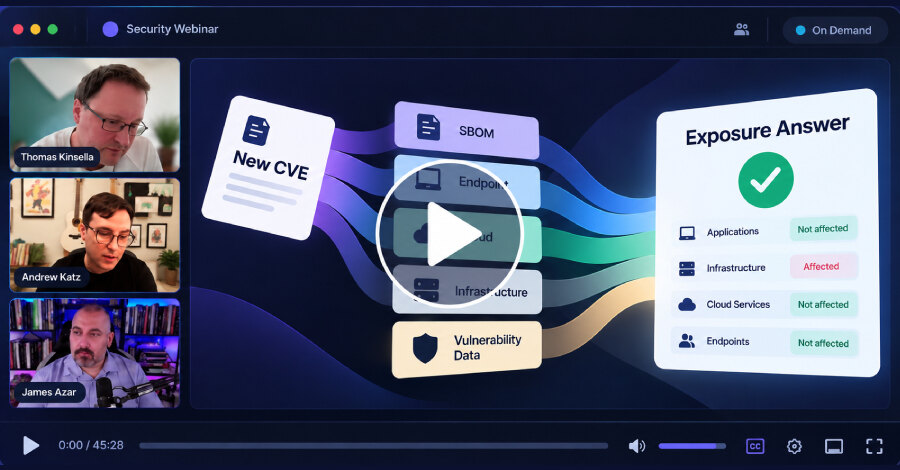
Tines is promoting a live expert webinar, “Outpacing AI-Era Attacks Starts With Faster Time to Answer”, focused on helping security teams determine more quickly whether a newly disclosed CVE affects their environment. Tines Co-founder and CCO Thomas Kinsella and Senior Security Operations Engineer Andrew Katz will present the company’s approach to bringing exposure information into a single interactive view.
The central operational question is simple but often difficult to answer: after a major vulnerability is disclosed, are we actually exposed? Teams may need to move among vulnerability scanners, endpoint tools, cloud inventories, software bills of materials, repositories and application data before they have enough context to act.
Joining exposure data around the CVE
The webinar describes a dashboard and workflow designed to reduce the time between disclosure, exposure assessment and response. Rather than rebuilding the same picture manually whenever a vulnerability emerges, teams can create repeatable workflows that collect the relevant evidence.
Tines says the approach can connect SBOM data with vulnerable packages, endpoint data with installed applications and versions, cloud inventory with affected resources, and vulnerability information with the systems where it is material. The intended result is a faster, evidence-based determination that a CVE either affects the organisation or does not.
- SBOM data can identify vulnerable packages.
- Endpoint records can establish installed applications and versions.
- Cloud inventory can identify potentially affected resources.
- Vulnerability data can be connected to the systems requiring attention.
AI assistance alongside deterministic automation
The session also addresses the division of work between AI-assisted analysis and deterministic automation. Tines positions AI as a tool for reasoning through complex inputs and helping teams build workflows. After workflows have been reviewed and approved, deterministic automation can perform repeatable actions without requiring analysts to repeat the same manual steps.
This distinction is relevant as AI accelerates vulnerability discovery and research. The article frames the challenge not only as finding vulnerabilities, but as reducing the interval from disclosure to a reliable exposure decision and then to a response.
Practical implication for security teams
For vulnerability management, security operations, cloud security and application security teams, the stated value is less time spent gathering evidence and a shorter path to action. Organisations can use the webinar’s model to identify which data sources answer exposure questions, bring that context into a reviewed workflow, and make repeatable decisions faster when the next CVE is disclosed.