


Stormshield Maps Trigram Campaign Targeting Developers
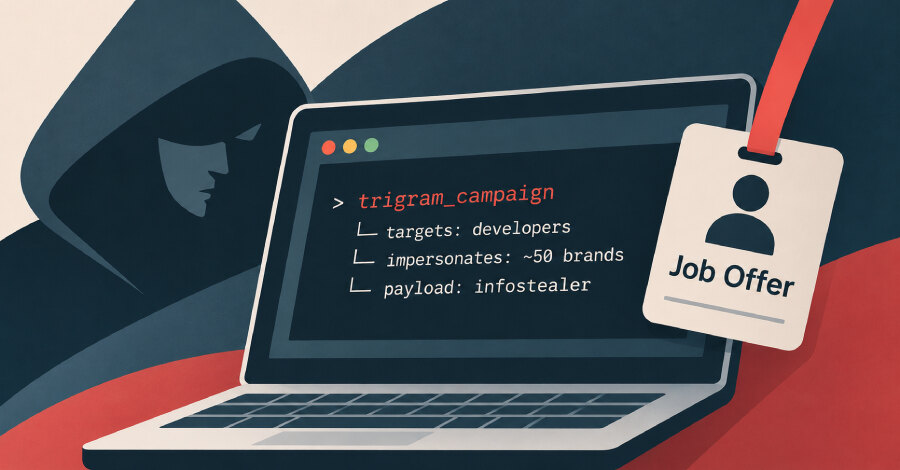
Stormshield has detailed Trigram, a large-scale malware campaign that impersonates about 50 brands in the artificial intelligence and blockchain sectors to trick developers into running information stealers. The activity targets organisations and professionals across Europe and the United States, using recruitment, conference-invitation and package-tracking scenarios alongside compromised code repositories.
The French cybersecurity company assesses with high confidence that Trigram is a continuation of the cluster tracked as UNK_DeadDrop. It also identified technical and infrastructure overlaps with activity attributed to Kimsuky, while the reported technique overlap does not by itself prove the identity of the operators.
Developer workflows become the delivery mechanism
One branch used a forged commit in the antd-img-crop GitHub repository on October 31, 2026. A prebuild hook named prebuild.js executed when a developer ran npm run build; the npm package itself was not impacted. The JavaScript downloader then ran a fake installer, set up Node.js and retrieved an encrypted in-memory next stage through a GitLab dead drop.
Other delivery paths included a fake Amber Group careers portal and a sideloaded Visual Studio Code or Cursor extension called google-dev-tools.google-update-support. SafeDep reported that the malware can harvest browser passwords and cookies, keychains, cryptocurrency wallets, SSH keys and .env files across macOS, Linux and Windows, before installing a remote-access agent disguised as Google software.
Controlled phishing and tailored payloads
Trigram recruitment sites fingerprint visitors and apply IP-based geofencing. Eligible visitors are asked to submit personal details and an invitation code, with code states including “Already used,” “Locked to another IP,” and “Invalid code.” Stormshield said this design indicates a focus on pre-identified targets rather than indiscriminate traffic.
After an initial technical check, the site changes the behaviour of its Copy button so that it places a malicious command in the clipboard; the same substitution can occur when a victim uses Ctrl+C. Windows targets receive a PowerShell command to run v.cmd, Linux targets a bash command for u, and macOS targets a bash command for verify_m.
Those loaders retrieve install_guard.js, prepare an execution environment and check for Node.js. If version 18 or later is absent, they download Node.js version 20.18.1 for the host architecture. The resulting stealer gathers system metadata, browser credentials, cryptocurrency wallets and sensitive local files.
Infrastructure supports targeting and monitoring
Stormshield described a management platform called rms-platform, hosted on 170.205.30[.]27:8000, that tracks victim actions, bot traffic and takedowns of lookalike domains. API routes indicated capabilities to scrape GitHub profiles, send phishing messages, issue access codes, manage decoys, export collected data and monitor cryptocurrency wallets.
The campaign abuses GitHub and GitLab for code and configuration hosting, Brevo, Resend, Mailgun and Smartlead for email delivery, and FullStory for visitor-session recording. For businesses, the practical implication is to require independent verification of recruitment tests, conference requests and copied terminal commands, and to investigate unexpected repository commits or build-hook changes before developers execute them.