


Microsoft Details Unicode Tag Evasion in High-Volume Phishing
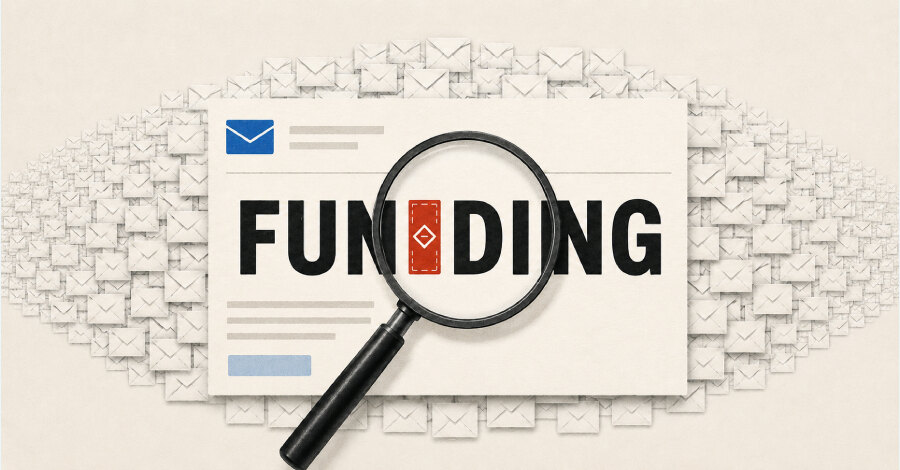
Invisible Unicode characters used to evade email filtering
Microsoft has warned of a high-volume phishing campaign that inserted invisible Unicode tag characters into financial lure words to bypass email security controls. The activity reached an estimated 1 million to 2.37 million messages on weekdays, with its highest volume recorded on February 26, 2026.
The campaign entered its high-volume phase in early February 2026 and continued for roughly three months before dropping sharply after May 15. Microsoft observed a weekly rhythm: the operation was nearly silent at weekends and resumed at full scale on Mondays.
Rather than displaying a visibly altered word, attackers split terms inside the message with non-rendering characters. Microsoft illustrated the method with “funding”: a Unicode tag code point can be placed between “fun” and “ding.” The recipient still sees the expected term, and systems that discard or normalize the character may also reconstruct it. A detector looking for the literal contiguous string, however, may miss it.
Why the Unicode Tags block matters
The technique is related to ASCII smuggling, in which invisible or non-rendering Unicode content conceals text within apparently harmless material. Microsoft said the most abused range was the Unicode Tags block, U+E0000 to U+E007F. It contains a shadow copy of printable ASCII characters and was originally intended for language tagging, but is now largely deprecated.
Microsoft framed the campaign as an example of AI-era evasion techniques being adapted to conventional phishing and spam. Invisible Unicode has been discussed as a way to hide content from people while exposing it to AI models or parsing systems. In this operation, the characters were used to disrupt the parsing of financial keywords by email filters.
The messages used hundreds of disposable, finance-themed sender domains and imitated business-loan, line-of-credit and advance-funding themes commonly associated with fraud and credential-harvesting attempts. Microsoft assessed the activity as connected to a broader campaign that used the ActiveCampaign marketing and automation platform to send AI-generated phishing emails aimed at Small Business Administration loan applicants.
Shared infrastructure can complicate reputation controls
Emails from the finance-themed domains were relayed through ActiveCampaign, with outbound body links routed through its click-tracking domains, acemlnd[.]com and activehosted[.]com. Microsoft noted that mail originating from a reputable shared marketing platform can resemble legitimate marketing traffic because of established IP reputation and authentication, making reputation-based filtering more difficult.
ActiveCampaign said it tested moderation on messages containing invisible Unicode characters and obtained the same verdict as for unobfuscated equivalents. It also said heavy use of the technique is treated as a suspicious signal.
For security teams, the practical implication is to test detection rules against interleaved invisible Unicode characters, not only visible keyword variants. Normalizing and inspecting relevant Unicode code points before literal or regular-expression matching can help expose lures that otherwise appear ordinary to users and some filtering pipelines.