


Armory Castle used vCenter zero-day to obtain administrator access
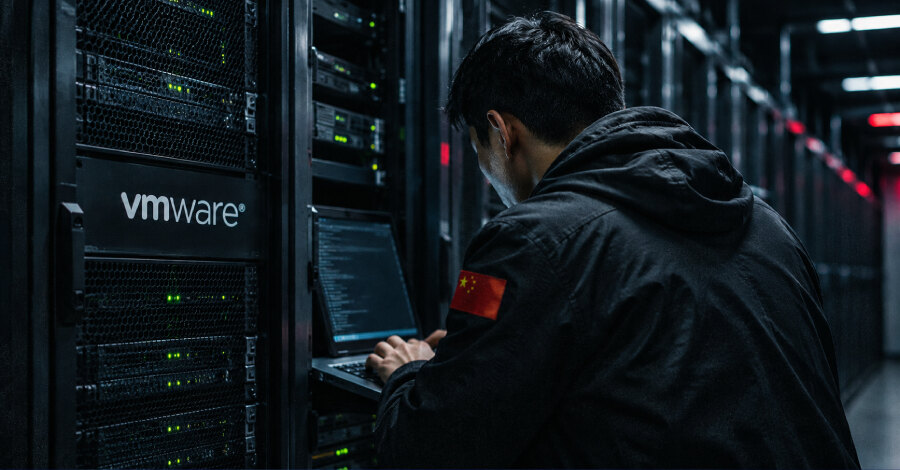
Suspected China-linked cyber-espionage group Armory Castle, formerly tracked as UNC5221, exploited a critical VMware vCenter Server zero-day in early September 2026 to gain administrator access and steal data. The flaw, CVE-2026-123890, has a CVSS score of 9.8 and was patched by Broadcom on November 19, 2026.
Google Threat Intelligence Group and Mandiant attributed the activity to Armory Castle. They described CVE-2026-123890 as an unauthenticated Secure Remote Password (SRP-6a) session-key disclosure vulnerability over DCE/RPC in VMware Directory Service.
Successful exploitation creates an authenticated session as administrator@vsphere.local. That level of access can allow an intruder to execute commands and acquire files, including the data.mdb database, through the Directory Service process, vmdird.
BONESAW targets vCenter authentication and SSO
Google observed the group using a Golang utility called BONESAW to weaponise the vulnerability against an internal vCenter Server. The tool can exfiltrate an arbitrary Lightning Memory-Mapped Database, hijack the SAML Security Token Service and create a Single Sign On administrator account.
Armory Castle also used SAWSNAKE, another Golang utility, to bypass vCenter SAML authentication and generate session cookies after BONESAW had run. Google said this enabled Golden SAML attacks against vCenter, including forged authentication tokens, multi-factor authentication bypass and impersonation of users.
The recovered BONESAW binary carried a build timestamp of July 13, 2026. Google noted that build metadata can be altered before compilation, but said the timing suggested the group may have known of the flaw before disclosure of CVE-2026-59309 on July 29.
Intrusion combined Remote Support access with ESXi activity
The same campaign exploited a then-zero-day in BeyondTrust Remote Support, CVE-2026-102764, rated 9.3. The attackers used the Remote Support device for reconnaissance, administrative control, persistence and deployment of the BARECLAW proxy tunneller before moving laterally to a Linux appliance.
From there, the group escalated to root and used nmap to identify VMware services on ports 9080, 5480 and 2012. Port 2012 is the control-interface RPC port for vCenter SSO and was integral to the remote exploitation route used by BONESAW.
Google identified JSP web shells SLIMSAVAGE and CAGEMATCH, the BEARBONES C backdoor and the Slack-controlled LAZYBONES Go backdoor in the operation. After BEARBONES opened a listener on TCP port 33992, the group created a local vCenter administrator account named sps-<REDACTED>@vsphere.local, enabled SSH through the VAMI API and connected through SSH.
In the final stage, the attackers enumerated the ESXi file system, mounted VMFS volumes, added an SSH public key to root's authorized keys and downloaded archived data over HTTP to the Remote Support appliance. Broadcom's fixes include VMware Cloud Foundation and VMware vSphere Foundation 9.1.x.x in 9.1.1.0200, 9.0.x.x in 9.0.2.0200, VMware vCenter 8.0 in 8.0 U3m, and VMware Cloud Foundation 5.2.5; vCenter 7.0 customers on extended support must contact Broadcom Support.
For businesses, the immediate implication is to apply the relevant update, review vCenter SSO and local administrator accounts, check VAMI-driven SSH changes, and investigate Remote Support and ESXi activity for the indicators described by Google.