


MIT and UBC present WorldParticle for unified physical simulation
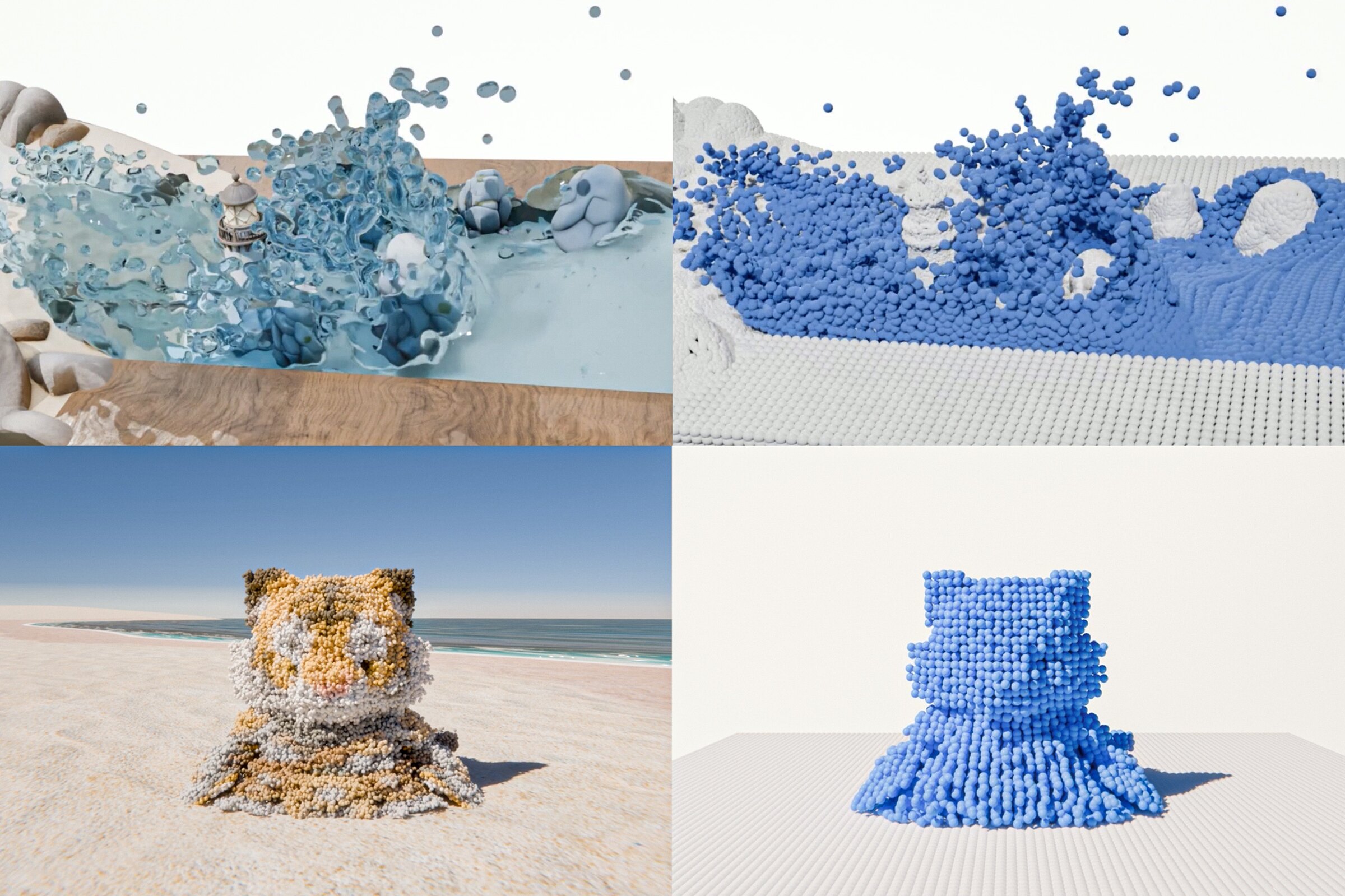
MIT, the University of British Columbia and collaborators have introduced WorldParticle, a deep-learning system designed to simulate multiple kinds of matter with one AI architecture. The researchers demonstrated the model across six physical phenomena, including deformable objects, granular materials and proteins; they report that it modeled protein structural changes about 100 times faster than numerical simulators.
The system is intended to replace the usual collection of purpose-built tools, where a scientist may use one solver for fluids and another for protein folding. Its creators say the approach could eventually help model coupled processes, such as fluid interacting with a deformable solid, without requiring separate simulators for each physical regime.
Particles provide a common representation
WorldParticle represents everything it models as three-dimensional particles, whether the input is a dune of sand or a protein molecule. This Lagrangian representation tracks particle positions and velocities through space and time. A neural network receives the particles’ 3D positions and physical properties, then predicts their positions and properties in the next simulation frame.
Peter Yichen Chen, a former MIT postdoctoral researcher and now an assistant professor at UBC, compares the architecture to ChatGPT’s sequential prediction process. Instead of predicting the next word, WorldParticle predicts how particles move one step at a time. The reported simulations progress in one-second increments.
Conventional particle-based simulations start with governing equations for a specific material or process. Researchers then translate those equations into a form a numerical solver can use, repeating the work for every new type of problem. WorldParticle is designed to learn how to solve governing equations more generally, rather than requiring a new model and solver for each use case.
Handling forces and scaling the model
Before each step, the system separates external forces affecting the physical system, including impulse forces such as those produced when an ocean wave hits a seawall. It predicts the particles’ initial states and then integrates those forces back into the simulation to correct the prediction. The researchers say this design enables adaptation to unseen materials, environmental conditions and forces.
Scale is a central constraint because complex objects can require millions of particles. The team therefore used a merging method to combine and compress particles while retaining fine-grained behavioural detail. Minghao Guo, an MIT postdoctoral researcher and co-corresponding author, said the work required detailed engineering and architectural adjustments to make the system generalizable and scalable.
Results and potential applications
In the reported evaluations, WorldParticle achieved higher accuracy than numerical simulation methods across the tested phenomena. For granular material, it captured a collapsing object forming a pile, whereas some baseline methods left sand particles suspended in the air. The researchers identify soft-robot manipulation, RNA evolution and astrophysical events such as galaxy mergers as possible future applications.
The work will be presented at the ACM SIGGRAPH Conference and Exhibition on Computer Graphics and Interactive Techniques in Asia. For businesses that depend on simulation, the practical implication is to identify cases where interactions between different materials require multiple specialised tools, since a unified particle model may offer a route to evaluating those systems within one framework.