


AI Menu Images Reveal a Homogenisation Problem for Restaurants
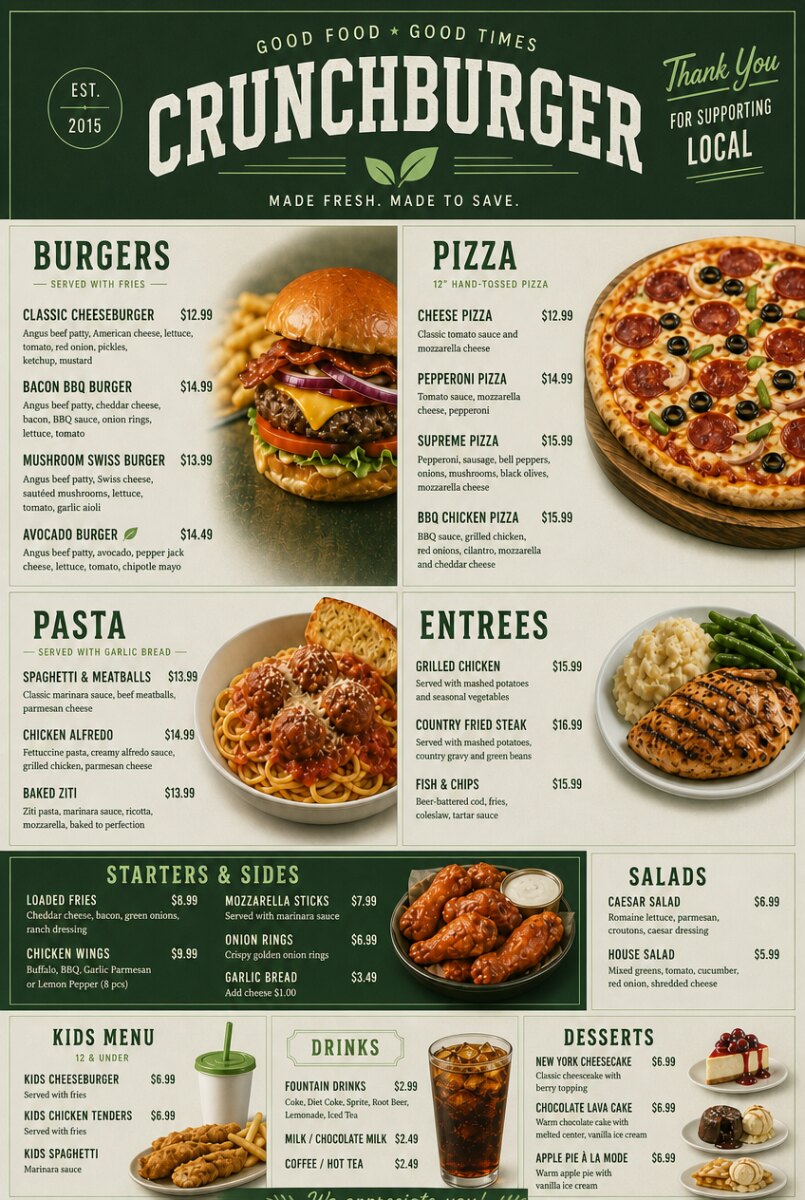
AI-generated menu art is making restaurant food look strangely alike
Restaurants are adopting generative AI to produce menu illustrations, yet the resulting food images can appear excessively smooth, symmetrical and subtly wrong. The effect ranges from implausibly melted cheese to more ordinary-looking dishes whose artificial qualities only become apparent on closer inspection.
Alex Lisle, chief technology officer at content-verification company Reality Defender, describes some of the images as resembling an attempt to make food without understanding its essential principles. The underlying issue is not limited to an obvious visual error. It is a recurring aesthetic: perfectly rounded ice-cream scoops, highly polished surfaces and food arrangements that feel less like a real meal than an idealised advertisement.
Training patterns favour familiar commercial aesthetics
Large language models and diffusion models are trained on vast datasets and identify patterns that help them respond to a prompt such as a request for a burger restaurant menu. Lisle said the results can resemble a Chili’s menu from 2015 because that type of work formed part of the corpus from which models drew their function.
When asked to make fast-food menu imagery, a model is likely to reference familiar designs associated with chains including Wendy’s, Burger King and McDonald’s. Those brands already share visual conventions, while commercial food photography is designed to make every component look maximally appetising. Generative output can intensify that tendency towards a polished, standardised result.
Lee Rainie, director of the Imagining the Digital Future Center at Elon University, said dataset optimisation for pleasing and non-offensive output can turn into homogenisation. In images and language, AI tends to “shave off the edges,” reducing distinctive features in favour of broadly acceptable patterns.
Repeated edits can deepen the visual problem
The same smoothing may increase when a restaurant repeatedly revises an AI-created menu, changing prices, item names or other small details. An experiment shared on X used ChatGPT to create a restaurant menu and then edited it 100 times; the food progressively looked less natural. The article’s replication of that experiment found similar results.
Lisle distinguishes this convergence from model collapse. Model collapse describes the more severe risk of models training excessively on their own generated output until quality breaks down. Convergence is less extreme, but it can still degrade outputs as similar AI-generated material reinforces the same limited visual style.
Customer discomfort carries a business cost
Researchers at the University of Duisburg-Essen in Germany found an uncanny-valley effect in AI-generated food images: pictures that were almost realistic prompted more disgust and unease than images that were clearly artificial. Rainie said people can have a difficult-to-articulate but recognisable sense that an image was generated rather than real, helping explain backlash to restaurant AI menus.
For restaurant operators, generated menu artwork is therefore not merely a production shortcut. Teams should assess whether imagery remains believable and appetising after revisions, because visual sameness and near-realistic distortions can erode customer confidence in the menu and the business presenting it.