


Bavaria Honors Daniela Rus for Three Decades of Physical AI Research
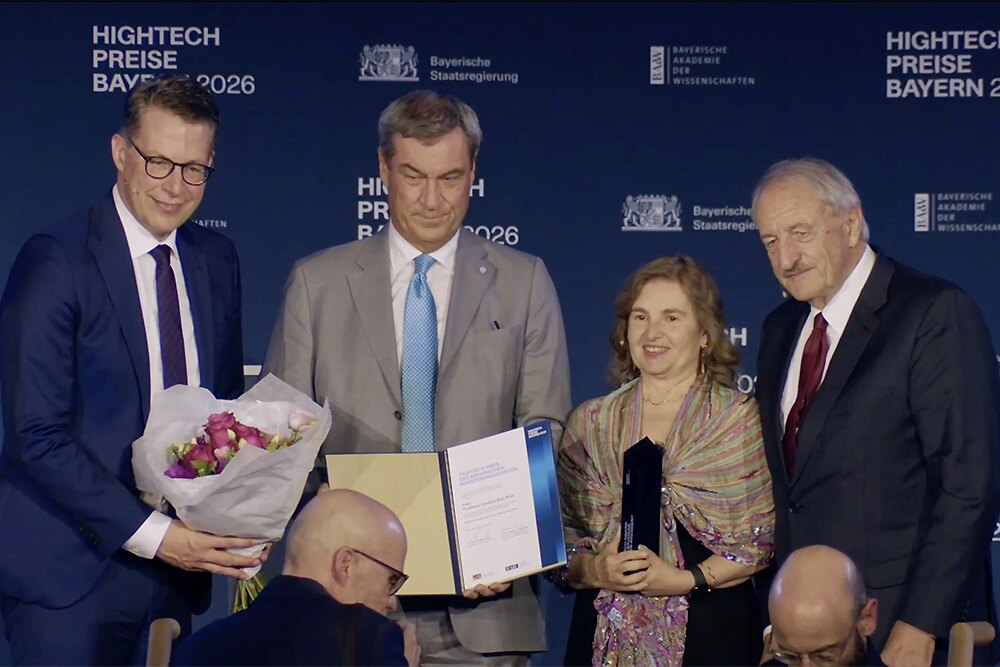
On July 23, 2026, Daniela Rus, director of MIT’s Computer Science and Artificial Intelligence Laboratory (CSAIL), received the High-Tech Prize of the Bavarian Minister-President at Munich’s Herkulessaal. Jointly conferred by the Bavarian State Government and the Bavarian Academy of Sciences and Humanities, it is Germany’s most highly endowed technology and engineering award.
Why physical AI matters
The committee recognized four strands of Rus’s 30-year research program: self-organizing robot collectives, soft robotics, autonomous mobility, and brain-inspired AI. The common objective is to build machines that can reason, adapt, and remain useful in real environments that were not fully scripted in advance.
This work reaches transportation, agriculture, medicine, homes, and environmental monitoring. That agenda intersects with AI-generated virtual training environments for robots, while Rus’s emphasis on explainable behavior addresses the reliability required when robots leave simulation and work alongside people.
Robots designed for real constraints
At CSAIL’s Distributed Robotics Laboratory, Rus’s group helped create an ingestible origami robot capable of retrieving swallowed button batteries from a child’s digestive tract. The team also developed small autonomous boats that can assemble into bridges and platforms, turning urban waterways into reconfigurable infrastructure.
Rus also helped invent liquid neural networks, inspired by the compact nervous system of a millimeter-long worm. One such network can steer through an unfamiliar environment with as few as 19 control neurons. The research led Rus, Ramin Hasani, Alexander Amini, and Mathias Lechner to establish Liquid AI, which develops models around the hardware limits of the devices running them.
“It’s not a battle between humans and machines. Both form a system that solves problems that neither humans nor machines can solve alone.”
What businesses should take from it
For companies evaluating robotics, the award highlights a practical shift: model scale alone is not the decisive metric. Adaptability, explainability, safe physical interaction, and efficient operation on constrained hardware determine whether an autonomous system can progress from a controlled demonstration to dependable deployment.