


Google makes Universal Cart available to US shoppers
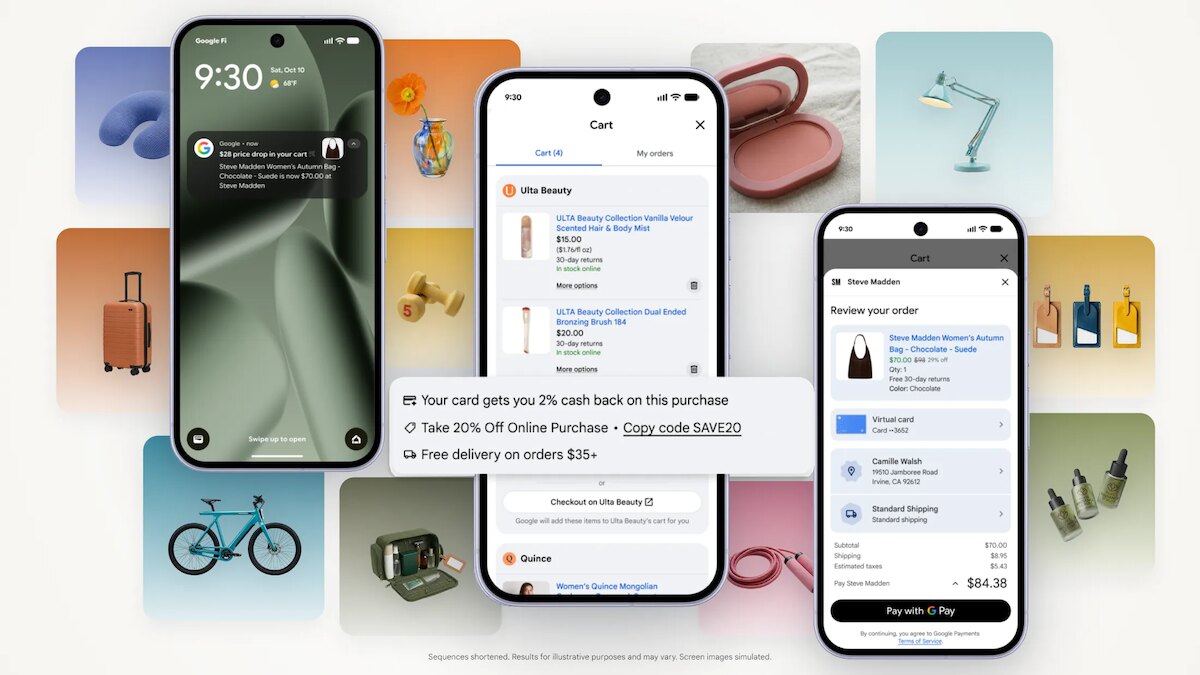
Google has made Universal Cart available to users in the United States, bringing a cross-retailer shopping list to Google Search and the Gemini app. The feature lets people save products they discover, return to those items later and follow their progress without having to locate the same listings again.
Universal Cart is intended to act as a central place for products found while browsing. Google says it can collect items from multiple retailers, so users can keep track of potential purchases even when they were discovered on different sites or through different Google shopping experiences.
Price, stock and payment support
Google says Universal Cart can notify shoppers when the price of a saved product drops or when an item that was out of stock becomes available again. These alerts add price and availability monitoring to the saved-cart function rather than limiting it to a static product list.
The company also says the tool can consider credit-card perks when helping a user decide how to pay and can surface relevant promotional codes. The stated goal is to provide more tailored assistance during the purchasing process, from product discovery through payment.
Checkout built on UCP
Checkout in Universal Cart is tied to Google’s Universal Commerce Protocol, or UCP, an open standard introduced earlier this year. Google describes UCP as a way for AI agents and retailers to work together across stages of the shopping journey, including checkout.
The launch expands Google’s AI-powered commerce work alongside conversational product discovery in Search’s AI Mode and Let Google Call, an AI-agent feature that contacts nearby stores to check whether an item is in stock. The approach also follows experiments in which Flipkart shopping through Gemini and AI Mode connects Flipkart shopping with Gemini and AI Mode in India, showing Google’s effort to bring commerce functions into its AI interfaces.
What retailers should watch
Amazon, OpenAI and other companies are also introducing agentic commerce features as they seek uses for chatbots beyond answering questions. Universal Cart places Google’s latest consumer-facing shopping function within that competitive effort.
For retailers, the practical implication is that accurate product availability, prices, promotions and checkout information may matter across Google’s surfaces as well as on their own storefronts, since shoppers can save and revisit items through a shared cart experience.