


Meta releases Muse desktop agent for Mac applications
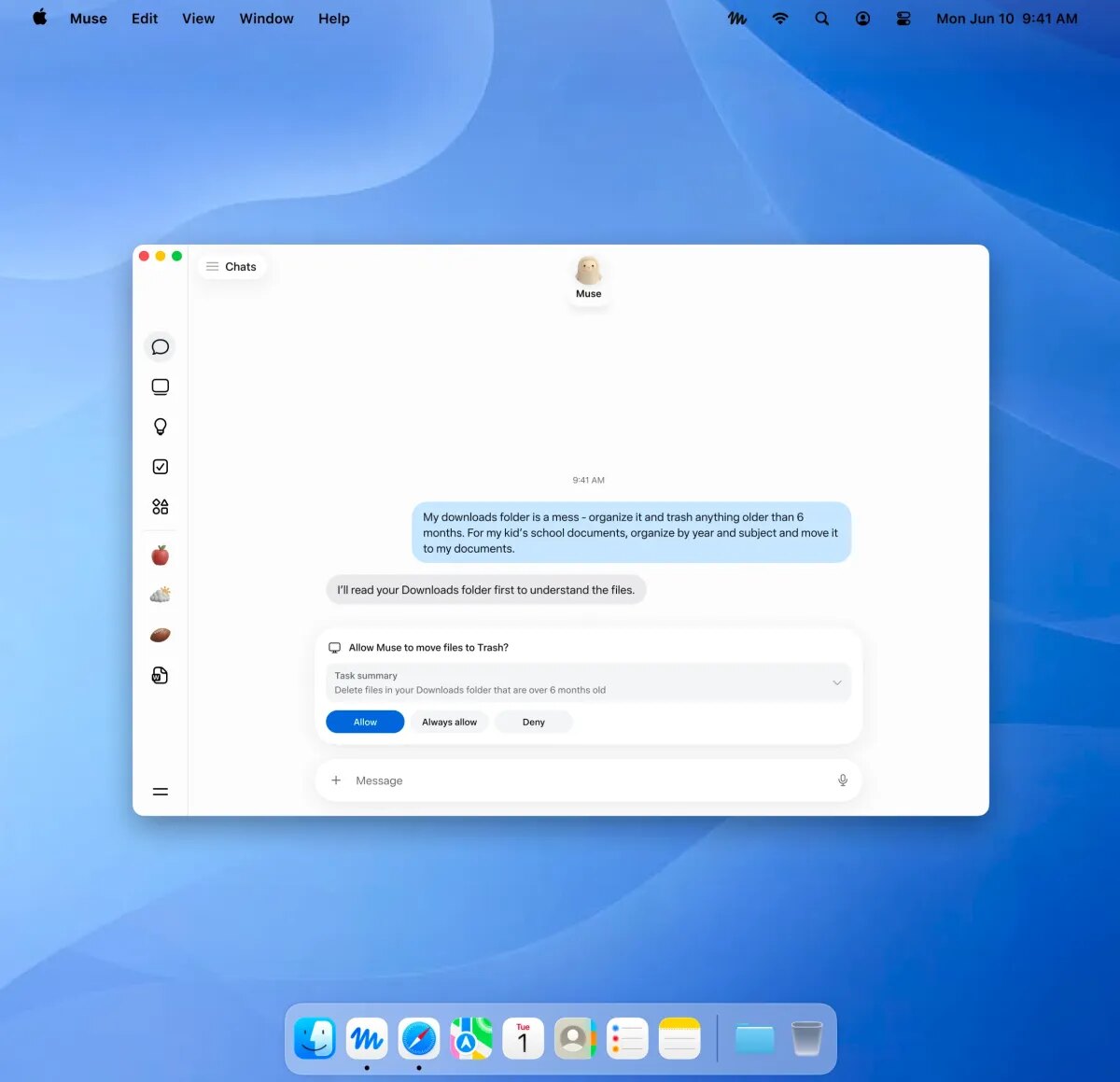
Meta has released its Muse AI assistant for Mac, bringing the agent from mobile and the web into desktop workflows. Muse can interact with files, messages, calendar entries, notes and mail within their native applications on a Mac.
The company says access is controlled on an opt-in basis. Muse also asks users for approval before taking actions that Meta classifies as sensitive, placing permission decisions alongside the agent’s ability to act across applications.
Muse moves from chat to desktop tasks
The Mac launch follows Muse’s rollout on mobile and the web earlier this month. The service quickly reached the top of the U.S. App Store charts, while Muse reaches second place after 83,000 downloads documents its second-place position after 83,000 downloads, indicating an early audience for Meta’s consumer-facing agent.
On the desktop, the product is intended to carry out work directly in the apps where information and tasks reside. The stated scope includes files, messages, calendars, notes and email rather than a standalone chat experience limited to answering prompts.
Meta’s announcement stresses that the user remains in control of the data Muse can reach. The requirement for approval before sensitive actions is particularly relevant where an agent may encounter personal correspondence, schedules, stored documents or other material that users do not want handled automatically.
Competition accelerates around consumer agents
The release comes as companies race to establish consumer AI agents as a new computing interface. The trend is putting pressure on the app industry and software-as-a-service businesses, while raising broader questions about how people may interact with devices and software.
Meta is not alone in pursuing that market. Other major players offer consumer-oriented agentic AI, and some services have gained attention by making agents available through text messages. Poke, an early breakout product in the segment, was acquired by Cognition in July. Instinct, another frequently discussed assistant, is reported to be raising funding at a $10 billion valuation.
Muse and Instinct both introduced voice calling this week, underscoring the pace of feature releases. Mark Zuckerberg described the Muse team as “shipping fast” when announcing the Mac app.
What businesses should take from the Mac release
For organisations evaluating desktop agents, the immediate issue is governance rather than novelty. Teams should identify which applications and data categories an agent may access, use opt-in permissions deliberately, and retain approval steps for sensitive actions before putting these tools into routine business workflows.