


ShieldCrash PoC alleges bypass of Microsoft Defender ShieldBreak fix
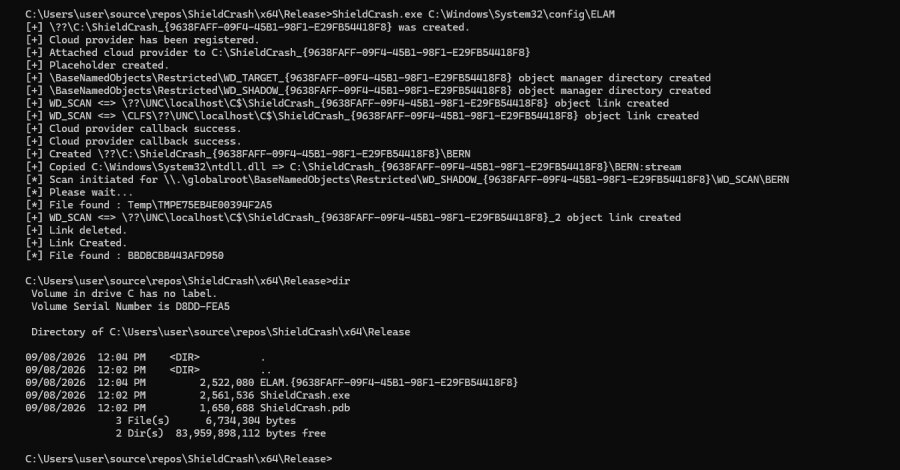
Security researcher Chaotic Eclipse has released a proof of concept for a new Microsoft Defender zero-day dubbed ShieldCrash. The researcher describes it as a bypass of the patch for CVE-2026-69414, known as ShieldBreak, a vulnerability with a CVSS score of 7.8 that was reported last month.
The PoC is said to demonstrate an arbitrary file read running as SYSTEM on a device with the latest version of Windows installed. Chaotic Eclipse said all supported desktop versions of the operating system are affected under specific conditions.
A claimed gap in the ShieldBreak remediation
Microsoft recently issued an update for its Malware Protection Engine to address CVE-2026-69414. The company lists the fix in Malware Protection Engine version 1.1.26080.3, which it said requires no customer action. Systems on which Microsoft Defender has been disabled are not affected by the original issue.
Chaotic Eclipse said Microsoft addressed several aspects that would prevent the initial exploitation path, but missed a condition through which the same underlying problem can still be triggered. The ShieldCrash PoC is intended to demonstrate that claimed remaining path rather than describe a separate, unrelated flaw.
Microsoft said it updates malware definitions and the Malware Protection Engine frequently in response to changing threats. It also said the default configuration of its antimalware products helps keep enterprise and consumer systems updated automatically, while its documentation recommends automatic updating.
Endpoint security remains a moving target
The report arrives amid a series of PoC releases by the same researcher involving endpoint security products. In recent weeks, Chaotic Eclipse also published exploits affecting CrowdStrike Falcon Sensor, Kaspersky, Avast Antivirus and NVIDIA, using the names FalconFlank, HardBreacher, PrettyPrague and GreenSection.
Kaspersky and Avast have patched HardBreacher and PrettyPrague, respectively. CrowdStrike told The Hacker News that it was investigating the FalconFlank report. These disclosures underline that endpoint agents themselves require prompt vendor review and disciplined update management.
What security teams should do
Organizations using Microsoft Defender should confirm that the Malware Protection Engine is receiving automatic updates and inventory the engine versions deployed across supported Windows endpoints. Security teams should also monitor Microsoft’s guidance on the ShieldCrash claim and assess whether their endpoint monitoring can identify suspicious attempts to access files with SYSTEM-level context. The practical business implication is that automatic updates are essential, but teams still need evidence that updates have reached every managed endpoint and that newly reported bypasses are being tracked.