


Minimax integrations in Serbia matter not when two programs simply start exchanging records, but when a specific repeated entry disappears from the workflow. The accountant does not have to create the customer again, the manager does not copy an online-store order into a spreadsheet, the warehouse employee does not reconcile stock across several screens, and ready sales data reaches the accounting environment under clear rules.
The problem is usually visible immediately: a price changed in one place but remained unchanged in another; an incoming document arrived by email and its details are typed in manually again; the CRM shows a completed sale while accounting has not yet received the required information. The purpose of integration is to remove this gap without taking control of exceptions and financially significant decisions away from employees.
When a technical connection becomes a business project
Moving a record from system A to system B is not enough. It can also transfer an outdated price, an incorrect unit of measure, incomplete details, or create a duplicate. That is why a project starts with describing the process: where data originates, who is responsible for its accuracy, which event authorizes transfer, and what happens if the target system rejects an operation.
The practical test of usefulness is straightforward: implementation should remove a measurable manual step or substantially reduce repeated verification. For example, a confirmed order becomes the basis for preparing a document, a stock change follows an established route, and an error automatically becomes a task for the responsible employee. Non-standard adjustments and accounting-sensitive decisions remain under human control.
What is known about Minimax capabilities
Minimax provides for connecting external applications through a REST API. This environment may include online stores, POS solutions, and other business systems. The technical ability to exchange data provides a basis for synchronizing customers, products, orders, invoices, and stock data, but it does not confirm ready compatibility for every specific configuration. Available methods, permissions, fields, and limitations on both sides still need to be checked before implementation.
According to information published on 6 November 2025, more than 50,000 accountants and entrepreneurs in the region used Minimax. This is a regional figure, not one limited exclusively to Serbia. For a company considering a Minimax integration in Serbia, what matters more is the availability of an intended connection mechanism and the ability to design a flow around its own sales, documents, and accounting rules.
A standard connector may cover a simple scenario with a stable catalogue and one sales channel. Where a business has its own CRM, online store, Ananas, several warehouses, or special pricing rules, an individual design is usually required. It should not be assumed in advance that all systems already align with each other: compatibility is confirmed only after technical validation.
What VMTech does for companies in Serbia
VMTech develops integrations for companies in Serbia that use Minimax within an existing business process. The work can cover controlled transfer of data on customers, products and services, orders, invoices, prices, stock, documents, and statuses. The public description does not disclose clients, transaction volumes, or indicators from individual projects.
VMTech treats this work as part of automation of repetitive business processes. First, a manual operation is selected; then the source of truth, direction of exchange, and error rules are defined. A limited pilot follows. This order helps avoid carrying an unstable process into every connected system at once.
Exchange may be built through APIs, webhooks, files, FTP, or databases, depending on the technical capabilities of the participants. The transfer method is secondary. The project is defined by the business event, the data set, confirmation of a successful operation, and a clear procedure for handling exceptions.
Data mapping and the source of truth
Before development, a map of entities and fields is needed. It shows which system owns each kind of information and is entitled to change it. Without this, a price may be overwritten in turn by two applications, statuses cease to match, and a spreadsheet for manual reconciliation becomes a parallel database.
- Customers: where the primary record is created, which details are mandatory, and how a duplicate is identified.
- Products and services: who owns the code, name, unit of measure, tax category, and active status.
- Orders: which status permits processing and what happens on cancellation, return, or partial fulfilment.
- Invoices and documents: which event starts preparation, who checks the result, and where the link to the originating sale is stored.
- Prices: where a value is approved and how discounts, sales channels, and effective periods are handled.
- Stock: which system holds the actual quantity and how reservation, shipment, return, and adjustment are processed.
- Statuses: which states correspond to one another and which transitions may be performed automatically.
For a number of typical connections, a matching product code is a mandatory condition for matching. If one product has different identifiers in the store, marketplace, and accounting system, a separate cross-reference table is needed. A procedure is also defined for new items: who confirms the link and what happens to an unknown code.
The direction is documented for every field: into Minimax, out of Minimax, or both ways. Two-way exchange needs conflict rules. If a price changes in two systems almost simultaneously, the integration must apply the established priority rather than silently retain the last value received.
Preparing documents without repeated entry

One practical scenario is preparation of a primary accounting document based on a confirmed sale or delivered service. Customer details, line items, quantities, agreed prices, and the link to the original order are assembled under approved rules. After completeness is checked, the data enters the accounting flow without retyping the same fields.
A safe process separates states: order received, data checked, document prepared, exception confirmed by an employee, and result accepted by the target system. The standard route can be automated. An unknown customer, amount discrepancy, missing product code, or non-standard adjustment should stop the operation and assign a responsible person.
Sending the same event again must not create a second invoice or change stock again. Operations therefore receive stable identifiers, and the integration layer checks whether an action was already completed. The log should show what data was sent, under which rule, what response was received, and to whom an exception was assigned.
Recognition of incoming documents
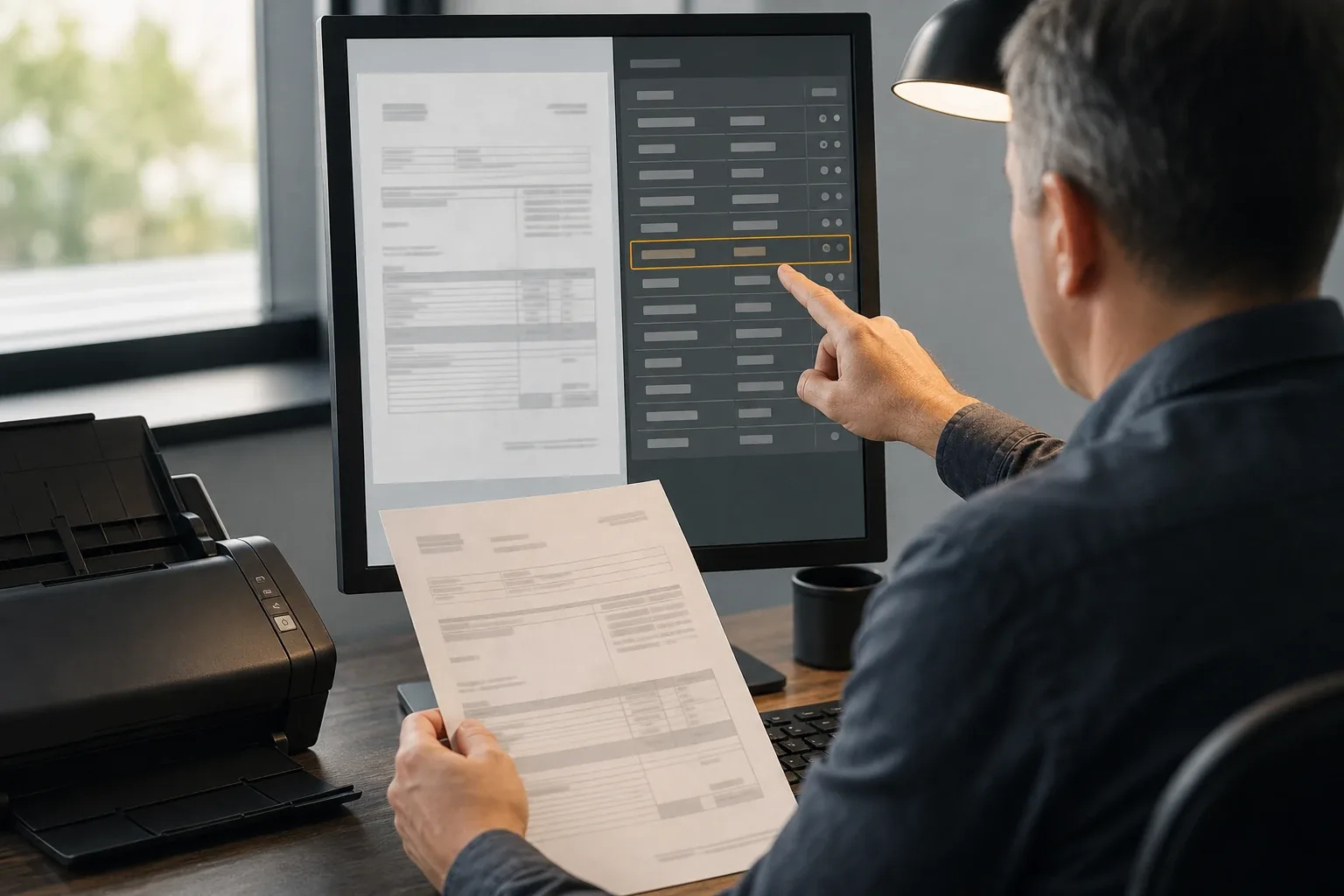
Incoming documents arrive as files, scans, photographs, and email attachments. An employee opens the document, identifies its type, finds the counterparty, transfers the date, number, amount, and line items, and then reconciles the result. A recognition system can extract available fields and prepare a structured record for review.
Recognition cannot be treated as an error-free accounting decision. Its result depends on image quality, document structure, language, and table layout. Critical fields, the total amount, whether the counterparty is known, and a possible duplicate are therefore checked. A threshold is set for uncertain values, after which the operation goes to an employee.
If checks pass, a primary accounting document may be prepared under pre-agreed rules. If values conflict, the employee receives the original file and marked problem fields. A person resolves the exception but does not have to enter all the content again.
Ananas and Minimax in one sales environment
In a connection with Ananas, the first step is to establish where master data for products, prices, and stock resides. One seller maintains the catalogue in the accounting system, while another does so in an online store or separate operational solution. There is therefore no single exchange direction for all companies.
A possible flow is as follows: a product is matched by a stable code, the approved price is sent to the required channel, available stock accounts for reservation, and a new order enters the operational environment and participates in document preparation. Separate rules are needed for returns, cancellations, bundles, temporary outages, and conflicting updates.
VMTech works on Ananas seller automation tasks; related context is presented in the RichAnanas seller workflow project. This does not mean that every arrangement is already compatible with Minimax. A specific connection must be checked against catalogue structure, access rights, statuses, and the required direction of transfer.
CRM, sales, and accounting without parallel spreadsheets
A CRM stores the enquiry and sales history, an operational system manages fulfilment, and Minimax participates in the accounting environment. When one order has different statuses in all three places, employees begin maintaining a shared spreadsheet for reconciliation. It soon becomes another data source dependent on one person.
A proper integration connects events instead of thoughtlessly copying records. A verified customer is transferred after required details are completed. A confirmed sale starts document preparation. A new status returns to the CRM so the manager sees the actual state. An error creates a clear task with a reason and context.
This architecture is discussed in more detail in the article on creating a CRM and ERP connection without manual data transfer. The same order applies to Minimax: first the business event and the owner of information, then the technical exchange method.
A chatbot or voice AI assistant as an entry point
A conversational interface can receive a request, clarify permitted information, and send a structured result to a CRM or operational process. After a conversation, the contact, enquiry topic, order number, and need for a follow-up can be saved, after which an employee can be assigned or a permitted scenario can start.
Such an assistant does not replace an accountant and should not have uncontrolled access to financial or personal data. It requires minimum permissions, permitted actions, an operation log, and mandatory escalation to a person. A user's free-form phrase must not automatically become a financially significant document without review.
An example of connecting a voice channel with process and analytics is shown in the AI Call Center 24/7 project. In a Minimax integration, such a channel should be treated as a source of a structured request, not as a separate accounting environment.
How to calculate benefit and payback
Before estimating anything, establish a baseline: how many orders, documents, and changes are processed monthly; how much time entry and reconciliation take; how often duplicates and discrepancies occur; who corrects errors; and what a delay costs. Without these data, a promise of savings remains an assumption.
- Calculate the operation volume for the selected scenario.
- Measure entry, review, and correction time.
- Assess the cost of working time and consequences of errors.
- Separate standard cases from exceptions.
- Include development, infrastructure, monitoring, and support.
- Compare costs with the expected reduction in manual processing over the same period.
Based on VMTech experience and economic estimates, in suitable processes with enough repeated volume, integration costs may be recovered during the first two to three months. This is not a guarantee or a universal benchmark. Such a period is possible when the process is stable, rules are defined, standard operations are numerous, and repeated entry genuinely takes significant working time.
Payback will take longer with low volume, poor source data, frequent process changes, a high share of unique cases, or complex infrastructure. Sometimes the calculation shows that integration is not needed yet: it is more reasonable to clean reference data, standardize statuses, or automate one small part first.
Safe phased implementation
Connecting sales, stock, CRM, documents, and every channel simultaneously is risky: it becomes hard to isolate an error and verify assumptions. It is better to select one flow with a clear owner and measurable result, such as transferring confirmed orders or preparing one document type.
- Audit: describe current actions, systems, participants, and exceptions.
- Field map: specify formats, mandatory fields, source of truth, and conflict rules.
- Capability check: clarify methods, permissions, limitations, and test conditions.
- Pilot: implement one limited flow using test or anonymized data.
- Repeat protection: introduce identifiers and idempotent operation handling.
- Monitoring: track delays, rejections, queues, and discrepancies.
- Exceptions: assign owners, retry rules, and response times.
- Expansion: add new entities after the pilot operates stably.
Permissions are granted according to the least-privilege principle. Secrets should not be stored in shared spreadsheets or correspondence, and logs should not indiscriminately copy full personal and financial data. For critical operations, technical execution is separated from human confirmation.
When integration is not justified
If a company processes only a few similar documents per month, development and maintenance costs may exceed savings. If employees perform one process differently, the working order should first be aligned. Automating an unstable process spreads discrepancies faster; it does not remove them.
The project should be postponed if reference data contain duplicates, products lack stable codes, the owner of prices is not defined, or no one is responsible for errors. It is also unrealistic to expect people to disappear entirely: standard operations are automated, but new document types, adjustments, and sensitive decisions require control.
Checklist before discussing a project
A large technical specification is not required for an initial engineering assessment. It is enough to describe one real data route, from the appearance of an order or document to the outcome in the accounting process.
- Systems, stores, marketplaces, and working spreadsheets in use.
- Data to exchange: customers, products, services, orders, invoices, prices, stock, documents, and statuses.
- Approximate monthly volume of operations and documents.
- Manual steps and employees’ actual time.
- People responsible for sales, warehouse, operations, IT, and accounting.
- Critical deadlines, peak periods, and acceptable delays.
- Returns, adjustments, duplicates, and other known exceptions.
- A measurable outcome: which repeated entry or reconciliation should be removed.
- Constraints around access, storage, logging, and data minimization.
With this information, it is possible to identify a priority flow, the pilot boundaries, technical questions to validate, and result metrics. This turns a Minimax integration from an abstract software connection into a managed change to a specific sales and accounting process.


