


Nvidia Builds Its AI Advantage Around Data Centre Orchestration
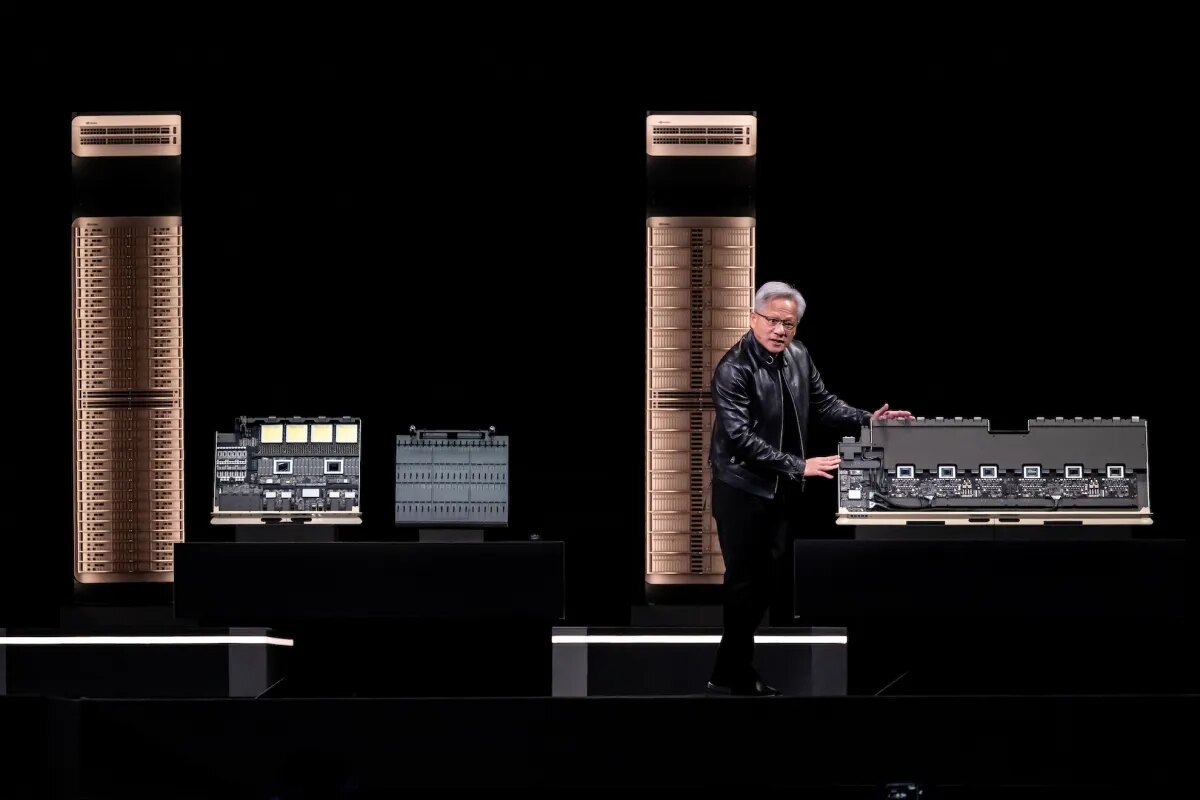
Nvidia is extending its AI infrastructure strategy beyond standalone GPUs as it rolls out the Vera Rubin architecture. The platform combines the Rubin GPU with the Vera CPU, Groq 3 LPX inference accelerator, and dedicated storage and networking racks, targeting the operational demands of AI data centres that are growing towards gigawatt scale.
The change comes as hyperscalers including Amazon and Google develop their own chips, putting greater attention on how durable Nvidia’s GPU lead will be. Nvidia’s proposition is increasingly the surrounding system: hardware intended to ensure that compute, memory, storage and network resources deliver data where it is needed without leaving accelerators underused.
Data movement becomes an infrastructure constraint
Jason Hardy, Nvidia’s vice president of storage technology, said the Vera CPU addresses the limits on memory available within a single server or compute platform. As deployments add computing power and memory capacity, data still needs to arrive at GPUs at the appropriate time. That coordination becomes more important as operators seek lower tokens-per-watt figures.
Hardy said Nvidia had seen up to a threefold improvement in relevant operations where the Vera CPU provides acceleration. The stated aim is to allow flash storage to deliver its available performance without becoming constrained by a bottleneck in the path to the GPU.
This systems-level challenge builds on the pressure described in AI compute competition and infrastructure economics as competition reshapes the economics of AI compute, while making efficient operation of a megascale data centre a distinct technical requirement.
Competing approaches to efficiency
OpenAI has approached the same issue differently with its Jalapeño chip. The company said it designed Jalapeño to minimise data movement and communication delays by keeping an entire workload within one connected system. That design is intended to reduce movement of data and keep a complete request fast and efficient from beginning to end.
Nvidia’s approach relies on specialised components that orchestrate traffic across a broader system rather than avoiding that traffic through one integrated chip. In both cases, the focus is on improving efficiency through data handling, not solely through additional processor cycles.
What the shift means for buyers
Nvidia is not guaranteed to control this new infrastructure layer. It will still face rival chipmakers and hyperscalers, just as it does in GPUs. But the competitive question is expanding from the accelerator itself to the ability to make the complete data-centre system operate efficiently.
For businesses planning AI capacity, procurement and architecture reviews should therefore examine data orchestration, storage performance and networking alongside GPU specifications, because platform efficiency increasingly depends on how those components work together.