


Amazon Decoys Reveal AI-Agent Searches for Keys in AI Applications
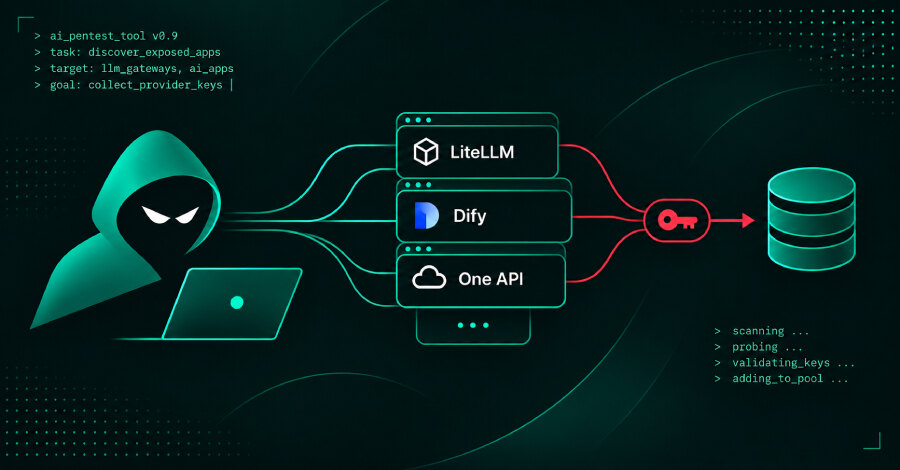
Amazon Threat Intelligence says AI agents targeted internet-exposed applications including LiteLLM, Dify, One API, New API and RAGFlow in campaigns designed to obtain AI-provider API keys. Records collected by Amazon’s MadPot decoy network described hundreds of targets, credential checks and shared pools of working keys that could be used to run models for further searches.
The team said it could not verify the activity the agents claimed to have completed on systems outside MadPot. It assessed with moderate confidence that the operators were separate China-linked groups, citing evidence including Simplified Chinese prompts and China time-zone settings. Amazon also assessed with moderate confidence that the agents ran on ARTEX, an open-source AI penetration-testing tool.
Playbooks focused on exposed AI application controls
The captured records contained product-specific playbooks for LLM gateways, proxies and AI application builders. Named targets included Veloera, Sub2API, FastGPT, Langflow, Open WebUI, LobeChat and Ollama, alongside LiteLLM, Dify and One API family products. The apparent objective was to extract provider keys stored in systems that often consolidate credentials for several AI services.
Techniques listed in the playbooks included default administrator credentials, incomplete deployments that an outsider could take over, unauthenticated management or provider-settings endpoints, and secrets exposed in client-side JavaScript, source maps, debug routes and environment files. The records also referenced the isCliRequest authentication bypass in One API family systems and server-side request forgery through URL-fetch functions to reach cloud metadata services.
When cloud credentials were found, the agents prioritized managed services hosting AI models, secret stores and application identities, with premium AI models favoured over general cloud access. They also searched internet-scanning services, certificate-transparency logs, GitHub repositories, package registries, container layers, notebooks, model-hosting spaces, paste sites and Telegram channels for leaked keys.
ARTEX activity also appeared in Cloudflare investigations
Cloudflare said its incident responders had handled multiple investigations involving ARTEX or tools built from it over the previous eight weeks. In more than one case, an attacker entered a customer environment at a major cloud provider and moved directly to the customer’s Cloudflare account. Cloudflare identified non-expiring, broadly privileged static CI/CD tokens as the common root cause.
In one ARTEX case, a compromised account-level API token lacked IP restrictions and rate limiting. Cloudflare observed 400 database-dump requests in an hour, though it did not say whether data was returned. Investigators also found newly created Worker scripts named artex-*, artex-pgrecon-*, artex-pgw-* and artex-do-*, with activity exceeding 69 requests per minute across several parts of the account.
Patch, rotate and restrict access
Amazon said the techniques were not new, but AI agents increase an attacker’s speed and persistence. Langflow versions before 1.3.0 are affected by CVE-2025-3248, while version 1.3.0 is the fixed release. For RAGFlow, NVD lists version 0.24.0 and earlier as affected by CVE-2026-28797; version 0.25.0 renders templates in the sandbox recommended by the advisory’s SSTI fix notes.
The practical business implication is to treat AI applications, gateways and inference endpoints as production systems: replace default credentials, complete deployments securely, patch affected software, locate and rotate exposed secrets, and require authentication for management interfaces. Teams using Cloudflare should set token expiry dates, restrict allowed client IP addresses and investigate the Worker-script naming patterns associated with ARTEX activity.