


Airbound raises $37 million for autonomous delivery drone development
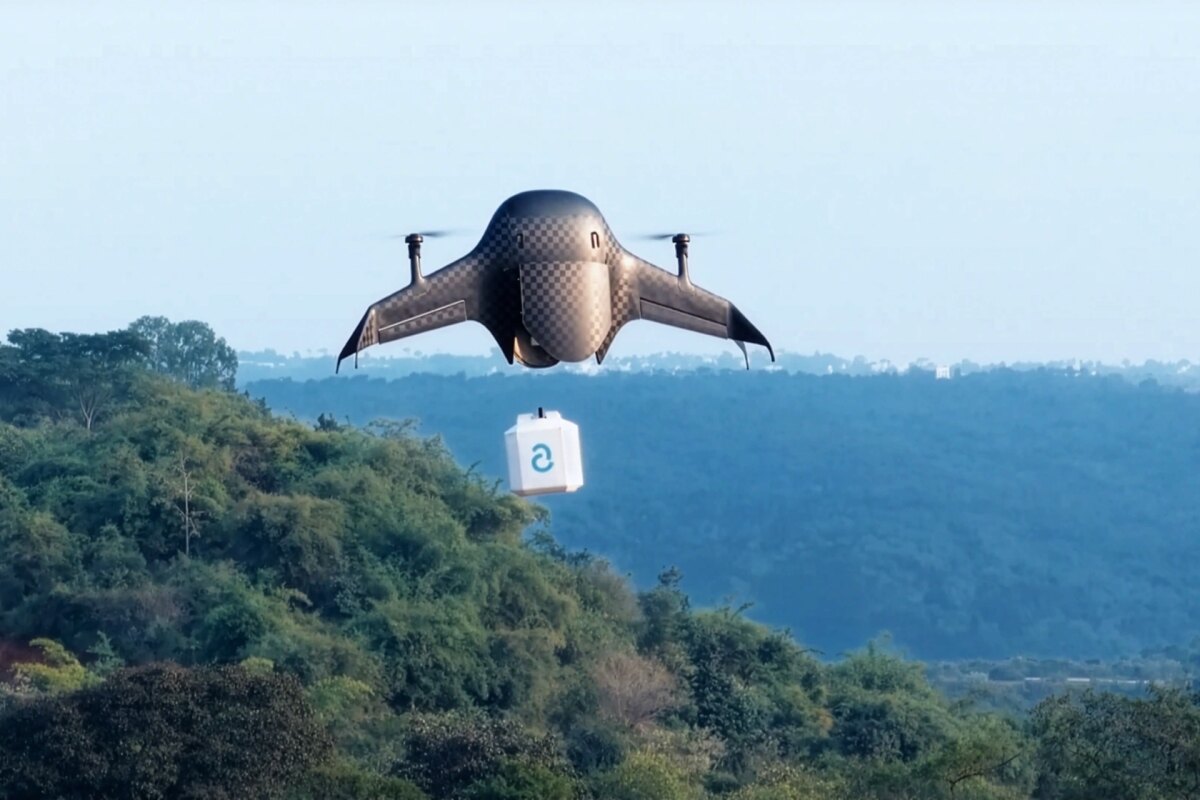
Indian autonomous-drone startup Airbound has raised a $37 million Series A round led by Greenoaks, with participation from DoorDash, Lachy Groom, Lightspeed and Humba Ventures. The funding follows an $8.65 million seed round less than a year ago and brings the three-year-old company’s total capital raised to nearly $50 million.
Airbound is developing vertical-flight drones intended to make moving certain goods by air as affordable as transporting them by truck. Founder and CEO Naman Pushp said the company is trying to reduce the cost burden created when conventional aircraft use a substantial share of their energy carrying their own weight rather than freight.
A lighter aircraft design for small deliveries
The company’s current aircraft, TRT, weighs about 3.3 pounds and carries around 2.2 pounds of payload. Its next model, now in development, is expected to weigh about 6.6 pounds while carrying as much as 11 pounds, Pushp said.
Airbound uses a rocket-like tail-sitter configuration: the drone takes off and lands vertically while upright, then transitions to horizontal flight. The company intends to preserve vertical takeoff and landing as it develops larger aircraft, avoiding reliance on runways.
Founded in 2023, Airbound says it has completed more than 13,000 autonomous flights in Bengaluru and Guntur in southern India. More than 1,000 of those flights were conducted with hospital network Narayana Health, carrying diagnostic samples between healthcare facilities.
Healthcare operations and a larger network ambition
On the Narayana route, a single active drone transports samples roughly 2.5 miles in about seven minutes. Pushp said the equivalent road movement can take three to five hours once the wait to consolidate samples for truck transport is included. The partnership is expanding to Narayana’s Banashankari hospital in Bengaluru, which was designed without an on-site diagnostic laboratory or blood bank and will connect to centralised facilities through Airbound’s drones.
Airbound has also signed an agreement with the Andhra Pradesh government to work toward a three-city delivery network for retail, e-commerce and healthcare. The eventual objective is 10,000 flights a day, requiring between 250 and 1,000 aircraft depending on route length; Pushp expects the figure to be closer to 250. The agreement is not a government contract or subsidy, and the state is working with Airbound on the regulatory framework.
Regulatory approvals remain the constraint
Airbound designs and manufactures its aircraft at a 43,000-square-foot Bengaluru facility, keeping airframe work and other core systems in-house. Pushp said manufacturing would not be the primary bottleneck as the company expands, although he did not disclose production capacity or the number of aircraft built.
The more significant limitation is approval for beyond visual line of sight operations. BVLOS certification is critical for delivery networks operating beyond an operator’s direct view, and those constraints have limited Airbound’s ability to generate substantial commercial revenue. Despite a team of more than 150 employees, the startup remains broadly pre-revenue. For businesses assessing aerial logistics, the immediate opportunity lies in time-sensitive, defined routes, while scalable deployment still depends on aircraft capability and regulatory permission.