


AMD KVM nested virtualization flaw exposes host memory
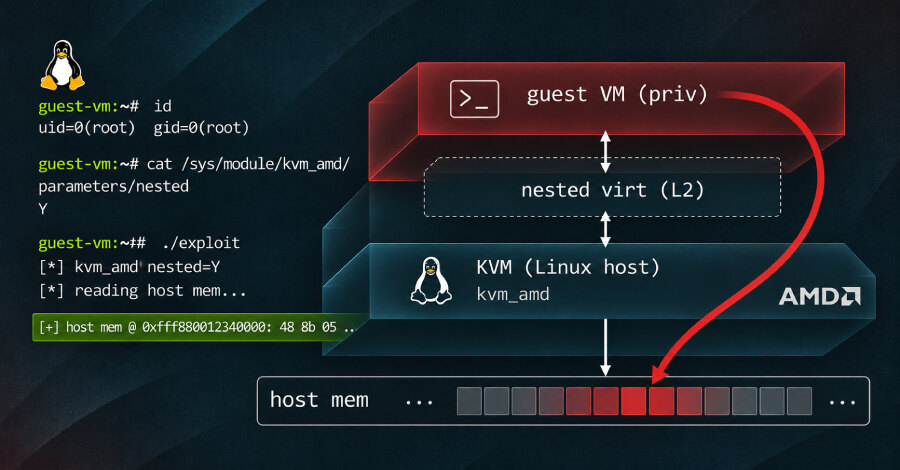
Linux KVM vulnerability CVE-2026-99312 allowed a guest virtual machine to access host memory on AMD-based systems with nested virtualization enabled. In a DigitalOcean test, researchers at Terra Security read about 127 GB of host RAM from a VM they controlled; the first returned data included the host kernel version banner.
The issue is limited to KVM hosts using AMD processors and nested virtualization. Intel-based KVM hosts are not affected because the vulnerable code exists in KVM’s AMD nested-virtualization support. Exploitation requires root-level control of a guest VM on a vulnerable host, rather than network-only access.
How the KVM isolation failure works
KVM uses nested page tables to translate guest memory addresses into physical host memory. Each virtual CPU retains a pointer to the relevant table. When an INIT reset stops a nested VM, KVM can return to the outer VM’s control block without restoring that page-table pointer.
The result is a pointer to memory that the kernel has already freed. Once the kernel reuses that page, a guest can populate it with chosen entries and the processor may follow those entries as though they were legitimate nested-page-table mappings. Terra Security said this made physical pages across the host accessible, explaining the roughly 127 GB memory read in the cloud test.
In a separate write test on the researchers’ own bare-metal AMD server, the guest altered 32 selected bytes in a live host-kernel memory page. A witness module in the kernel confirmed the modification. The cloud read test and local write test demonstrate different impacts, while reported severity assessments also vary: the Linux kernel CVE team assigned 8.8, Red Hat initially assessed the issue as Moderate at 5.6, and DigitalOcean treated it as critical in its shared environment.
Fixes and immediate mitigations
The upstream correction resets the memory-management state on every INIT. Fixed releases include stable kernel 7.3.5 and long-term kernels 6.18.64 and 6.12.118. The affected logic entered the 6.1 kernel in 2022 and was also carried into 5.15.81 and 6.0.11. Terra Security attributes the defect to a 2022 fix for CVE-2022-3344 that restored an outer VM control block but omitted the page-table pointer.
Updating operating systems inside guest VMs does not address the exposure. Administrators must install a fixed host kernel and reboot the host; an installed kernel does not protect a running host until that reboot occurs. At publication, Debian listed its release kernels as vulnerable with a fix only in unstable, Ubuntu listed vulnerable kernels without a fixed package, and Red Hat deferred fixes for Enterprise Linux 9 and 10 while marking Enterprise Linux 8 as unaffected.
What operators should check
If an immediate host update and reboot are not possible, administrators can disable nested virtualization through the kvm_amd module configuration with options kvm_amd nested=0, then reboot. The active setting is visible in /sys/module/kvm_amd/parameters/nested; a value of 1 or Y means nested virtualization is enabled. This mitigation prevents VMs from running VMs of their own, so tenants using that capability need advance notice.
The incident follows other KVM and guest-isolation concerns tracked in Linux and virtualization exposures, where Linux and virtualization exposures illustrate why host-level patching and configuration review matter. For businesses operating AMD KVM infrastructure, the practical priority is to inventory nested virtualization, schedule the host-kernel reboot, and disable the feature where operationally acceptable until fixed kernels are running.