


OpenAI Adds Visual Ads Next to ChatGPT Image Results
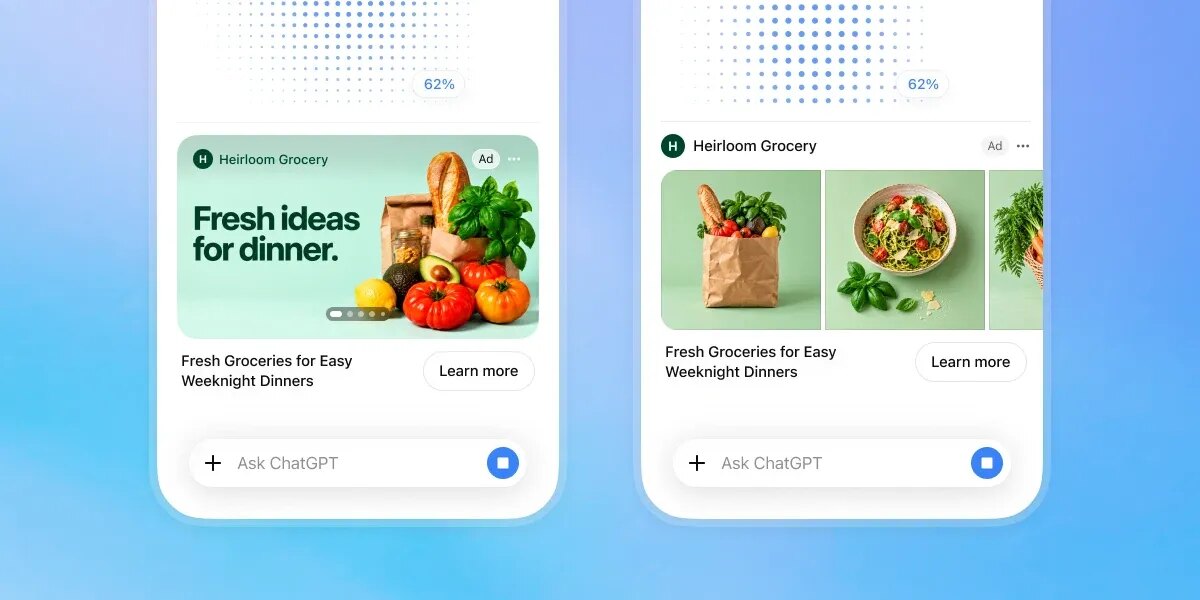
OpenAI will start showing visual display advertisements alongside images generated by ChatGPT in the United States later this month. The initial test will feature products and services from a first group of advertisers, with ads clearly labelled and separate from the assistant’s answers. OpenAI says the advertising will not affect what ChatGPT returns to users.
The format expands OpenAI’s advertising offering as it seeks to support ChatGPT’s free and low-cost subscription tiers. Advertisers will be able to use visual creative in a context where users have requested image generation, rather than relying only on conventional text-led chatbot interactions.
A broader advertising and measurement push
OpenAI introduced advertising earlier this year and expanded it to India in August. The company has said that, as its advertising products reach more markets, brands could ultimately address ChatGPT’s 1.2 billion weekly users. For now, the visual-ad test is restricted to the US.
The company is also enlarging the measurement ecosystem around ChatGPT ads. Its click-attribution partners include AppsFlyer, Triple Whale, Adjust, DV Rockerbox, Northbeam, Branch, Singular, Kochava, Airbridge and Tenjin. Full-funnel and advanced measurement partners include Fospha, Measured and INCRMNTAL.
That advertising infrastructure sits alongside product-development efforts in ChatGPT: ChatGPT’s expanding platform model points to an expanding platform model, while the new display format gives brands another way to reach users within the service.
Testing suitability and geographic impact
OpenAI has partnered with Haus, Measured and WorkMagic to help advertisers explore geo-based experiments around ads. It is also developing brand-suitability evaluation pilots with DoubleVerify and Integral Ad Science, intended to help advertisers understand the environment in which ChatGPT advertising appears.
The company’s announcement comes as competition among AI applications intensifies, including Meta’s free Muse agentic AI app. The new ad format may broaden monetisation for lower-cost access, but it also places commercial content directly beside a generative result, making labelling and response independence important details for users and advertisers.
For businesses, the practical implication is to treat the US test as an early channel evaluation: assess whether image-generation requests match campaign objectives, and require attribution, geo-testing and suitability evidence before committing larger budgets.