


Database RCE Proofs of Concept Challenge Low-Privilege Assumptions
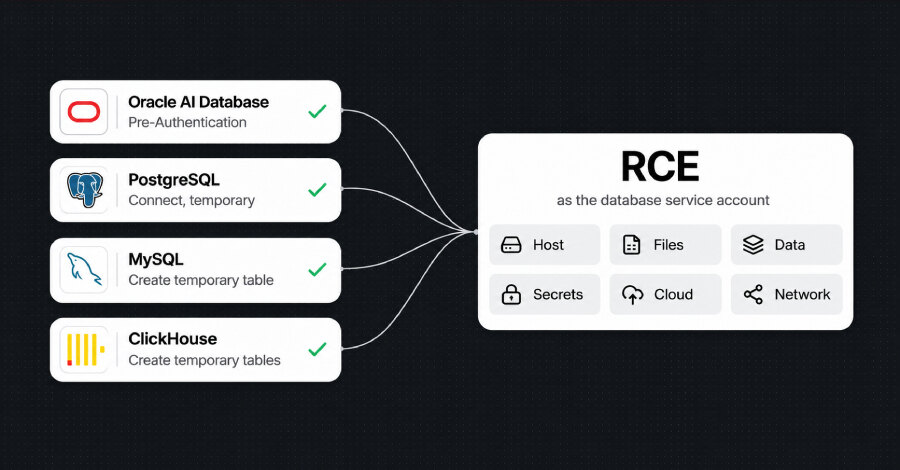
Depthfirst researcher Zheng Yu has published proof-of-concept remote code execution chains affecting PostgreSQL, MySQL, Oracle Database and ClickHouse. The work shows that database accounts unable to read application tables may still reach memory-corruption flaws in engine code through ordinary SQL operations. Four of the reported issues have CVEs and vendor fixes; the ClickHouse issue has neither an assigned CVE nor a confirmed fixed version.
No reported chain has been observed in an attack, and the full exploit paths have not been independently reproduced. Even so, the research is significant because it shifts attention from what a database account can read to what code paths its permitted actions can invoke.
Table permissions do not define engine exposure
Yu's central point is that SQL privileges govern access to tables and schemas, not the memory-unsafe C and C++ code used to parse, plan and execute queries. A seemingly constrained account can still create objects or submit input that reaches a vulnerable component. PostgreSQL's default TEMPORARY privilege, along with rights to create temporary tables in MySQL and ClickHouse, can provide the required entry point.
For PostgreSQL, CVE-2026-116331 permits an account able to create database objects to execute code as the operating-system user running the database server. The issue was fixed on November 12 in versions 18.7, 17.12, 16.16, 15.20 and 14.25. Yu's analysis describes a standard login role creating the required objects in its own temporary schema, without accessing application data, then exploiting type confusion to gain control of the server.
MySQL, Oracle and ClickHouse exposure
MySQL Server and Cluster CVE-2026-101786 affects versions 26.7.0 through 26.7.1 and was fixed on October 20. Oracle rated the issue as requiring high privileges, but the researcher reports code execution on a 26.7.0 image using an account limited to creating temporary tables and unable to read existing tables.
Oracle Database is different because the reported chain starts without a database account. It combines an Oracle Text flaw, CVE-2026-114819, with a GraphQL interface issue in Oracle REST Data Services, CVE-2026-91609, through an exposed web endpoint. Oracle fixed the Oracle Text issue, rated 9.9, in its November update and fixed the REST Data Services flaw in October. Oracle rates neither vulnerability as individually exploitable without a login.
For ClickHouse, Yu reports an integer-overflow write while processing a binary row format. A user who sets format_binary_max_string_size to zero can reach the condition; the researcher reproduced a shell on version 26.7.5.10. Operators should seek remediation guidance directly from ClickHouse because no CVE or confirmed fixed release has been identified.
Actions for database operators
Teams should apply the available PostgreSQL, MySQL and Oracle updates, then review privileges that allow temporary object creation rather than focusing only on table reads. Removing unneeded TEMPORARY and broad temporary-table rights can reduce exposure to the demonstrated paths, although it does not address the Oracle chain that begins before authentication. The practical implication is that database access reviews should account for executable engine surfaces as well as the data each account is permitted to view.