


Eka Robotics raises $150M for force-aware robot manipulation
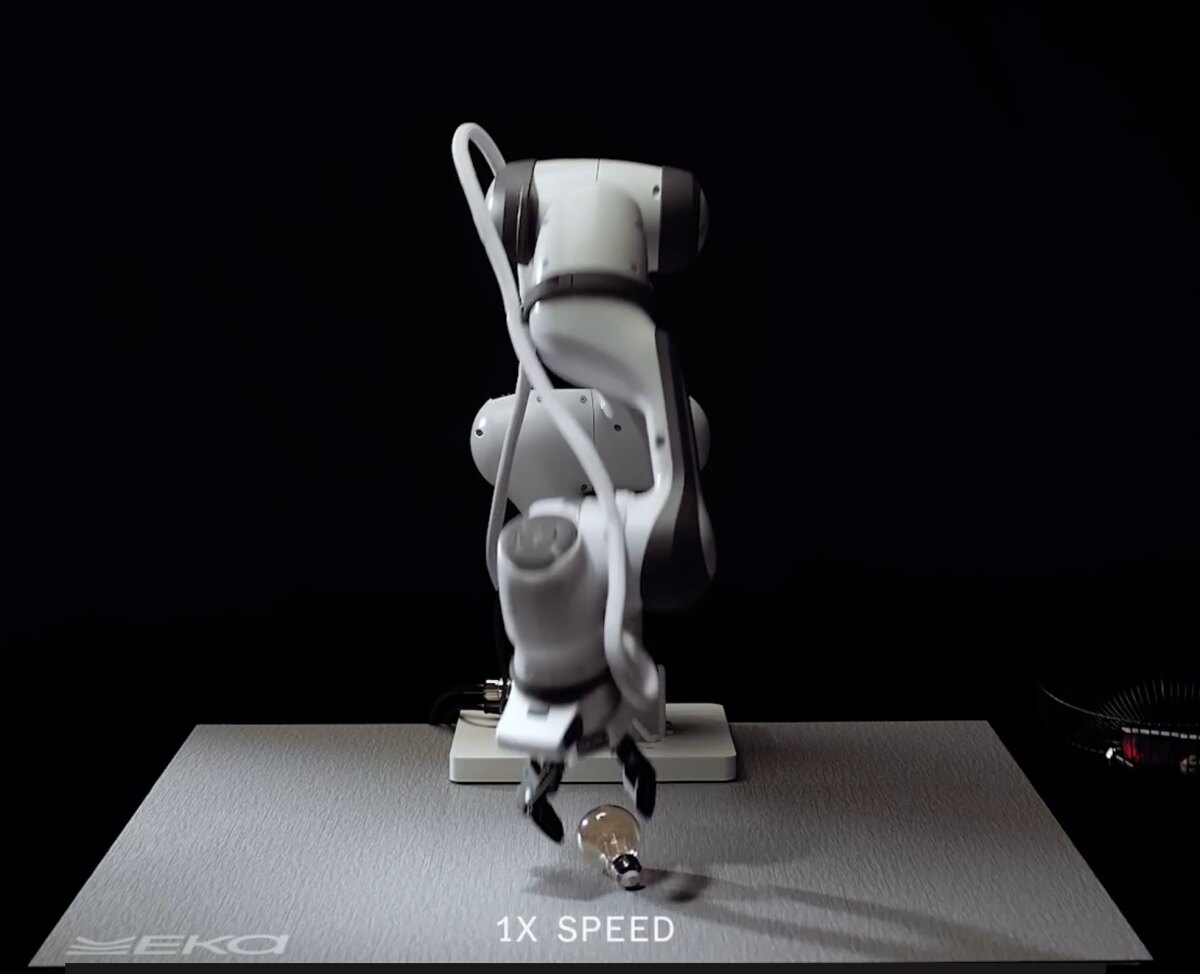
Eka Robotics has raised a $150 million Series A financing round at a $1.45 billion post-money valuation. The round was led by a16z and F-Prime, backing a robotics company founded by MIT professor Pulkit Agrawal and former Google DeepMind researcher Tuomas Haarnoja.
The company is developing a manipulation architecture that combines a force-sensitive robotic gripper with a vision-force-action model. Eka says its robot can pick up about 1,500 objects weighing up to 1 kg in an hour, compared with about 600 for a human, and that it succeeds more than 95% of the time.
Force data targets the final stage of grasping
Eka’s approach differs from vision-language-action models that connect language, images and robot actions. Its model focuses on the relationship between language, force inputs and actions. Agrawal argues that vision can estimate an object’s position and pose, but that the final act of grasping and searching depends on forces.
That emphasis also shaped the hardware. Eka designed a more flexible hand than conventional grippers and added more force sensors so that the device can respond to contact. The company says this is why the robot can handle delicate objects, including a raspberry, without crushing them.
For training, Eka uses a physics simulator to model the forces encountered during a grasp. It then uses the simulated setting as a reinforcement-learning environment that can run at scale. The founders say the process can create thousands of hours of robot experience in minutes, rather than depending primarily on human demonstrations, videos or operators repeatedly performing tasks.
Simulation seeks to narrow a robotics trade-off
The company’s bet is that simulation-based reinforcement learning can bridge the gap between generality and performance in robot manipulation. Broad models may attempt many tasks but remain weak at precise physical execution, while narrowly trained systems can perform one task well without necessarily supporting a compelling business case.
Eka positions its system as the physical layer for a broader decision-making model. A general model may determine that dishes should be put away after a dishwasher cycle, while a force-aware manipulation system would need to pick up and place the dish without damaging it. Haarnoja describes this as a bottom-up approach to physical intelligence, rather than starting with high-level planning and pushing it down to the hardware.
Industrial durability remains the next test
Eka is conducting undisclosed pilots with industrial customers in pick-and-place and wire manipulation. Those deployments will test whether results demonstrated in controlled settings transfer to real assembly lines, where equipment must operate reliably over long periods and work with integrators.
Its gripper hardware costs less than $1,000 and is rated for 5 million duty cycles, Agrawal said. Eka’s longer-term target is the 20 million duty-cycle benchmark used by standard industrial arms. The company is initially concentrating on pick, arrange, place and wire-handling workflows.
For businesses evaluating robotics, Eka’s funding and reported performance underline the growing importance of tactile and force data, but pilot results should be measured against task coverage, reliability over time, integration requirements and component duty cycles before a production rollout.